Get Full Government Meeting Transcripts, Videos, & Alerts Forever!
Get email alerts on the Public Safety Staffing topic
No spam. Unsubscribe anytime.
Commissioners approve new relief‑factor policy for jail staffing over dissent about comp time
Summary
The court voted 2–1 to adopt a new policy for calculating the relief factor used to staff the Collin County detention facility. County staff treated comp time as equivalent to overtime for the calculation; Sheriff Skinner argued comp time should be included in the net‑annual working hours and said accrued comp time totals about 49,000 hours.
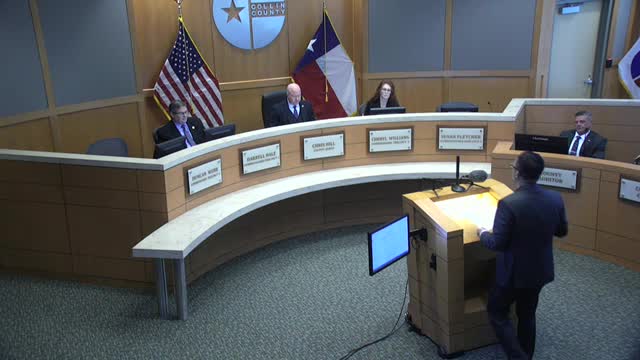
Collin County Commissioners on March 31, 2025, voted 2–1 to adopt a new policy, proposed by Administrative Services, that standardizes how net annual working hours are calculated for detention officers and establishes a relief factor for fiscal year 2026.
The issue: County Administrator Eun Kim told the court the working group — which included county administrative services, the sheriff’s office and human resources — proposed a relief‑factor methodology intended to calculate how many officers are needed to keep the jail staffed. The county presented a projected relief factor of about 4.97 for detention officers on 12‑hour shifts under the new calculation.
Majority view and vote: Commissioners moved and seconded approval of the policy, and the motion carried 2–1.
Dissent and why it mattered: Collin County Sheriff Skinner said he had concerns about the treatment of comp time. Skinner argued that national staffing guidance — which he cited from the National Institute of Corrections — includes comp time when calculating staffing needs. He said that if the policy treated a premium comp‑time assumption of 63 hours per employee differently, the relief factor would rise from 4.97 to 5.12, increasing the modeled staffing need from about 359 detention officers to about 368 — a difference of nine positions. Skinner also told the court the sheriff’s office currently carried roughly 49,000 hours of accrued comp time.
Staff rationale: Administrative Services explained they modeled comp time as overtime for the purposes of the policy under a conservative assumption that accrued paid‑time‑off would be used and that staffing posts identified by the sheriff, once filled, would lower overtime and comp‑time use. Staff also said higher training‑hour estimates altered prior relief‑factor calculations (for example, using the new methodology, the modeled relief factor would have been 4.82 for the 2024 calculation and had been 5.00 for 2023 and 5.09 for 2022).
What the policy does: The adopted policy sets a methodological standard for counting categories of time — training, PTO, comp time and premium pay — when computing net annual working hours and the resulting relief factor. Administrative Services said the policy also identifies temporary duty positions that the working group believes should be converted to permanent posts rather than being filled via overtime.
Next steps and implementation: County staff said departments will report quarterly under the agreement and that the court expects the sheriff’s office to identify posts to be filled. Commissioners asked staff to distribute reports to the court on a quarterly basis. The policy will inform FY2026 budget staffing requests.
Votes at a glance: - Consent agenda (remainder after pulls of items 1F2 and 1K9): approved 3–0. - Item 1F2 (consent pull): approved 3–0. - Item 1K9 (personnel promotion — Kimberly Riddlebaugh): approved 3–0. - Relief‑factor staffing policy (administrative services proposal): adopted 2–1.
Ending: The court adopted the policy despite the sheriff’s objections about comp‑time accounting; commissioners and staff said the methodology will be monitored and updated as experience and reporting data accumulate.