Get Full Government Meeting Transcripts, Videos, & Alerts Forever!
Get email alerts on the Public Safety Staffing topic
No spam. Unsubscribe anytime.
Collin County adopts new relief-factor policy for jail staffing after debate over comp time
Summary
The Collin County Commissioners Court approved a policy that standardizes how net annual working hours are calculated for detention officers, setting a relief factor of 4.97 for 12‑hour posts. The measure passed 2–1 after the sheriff urged the court to include comp‑time in calculations and warned of increased overtime costs.
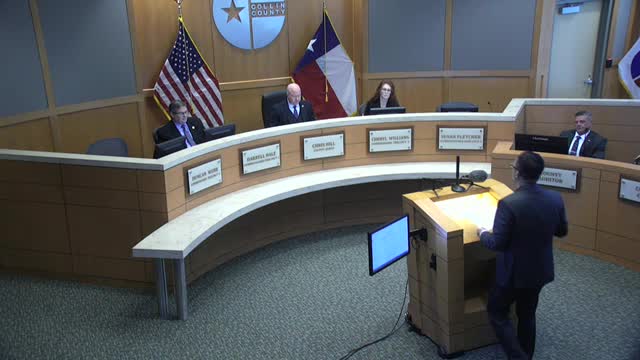
Collin County Commissioners Court approved a new policy to calculate the relief factor used to determine staffing needs at the county detention facility, a move intended to set hiring targets and reduce overtime. The court adopted the policy as presented by county administrative staff; the motion carried 2–1.
County Administrator Eun Kim told the court the policy was developed by a working group that included administrative services, human resources and the sheriff’s office. Using the policy’s methodology, administrative staff reported a relief factor for FY2026 of 4.97 for detention officers working 12‑hour shifts. Attachments cited alternative historical calculations: using the same methodology, the relief factor would have been about 4.82 for 2024, about 5.00 for 2023 and about 5.09 for 2022.
The policy’s aim is to standardize the way the county computes “net annual working hours” so supervisors can identify how many posts must be filled to staff the jail without reliance on premium overtime.
Why it matters
The relief factor determines how many employees the county must budget to staff posts without excessive overtime. Small changes in the relief factor can change staffing totals by single‑digit head counts but have outsized effects on overtime, comp time liability and operating costs.
What supporters and opponents said
Eun Kim, Collin County administrator, described the policy as the product of multiple meetings among county staff and the sheriff’s office and said it reflects categories and assumptions the working group agreed to. Kim said staff assumed that accrued PTO would be used and that comp time was treated for policy purposes the same as overtime—i.e., time worked above an employee’s schedule creates a post absence that the relief factor must cover.
Collin County Sheriff Skinner said he had concerns about excluding comp time from the calculation. “When a person accrues comp time and is off, that post is not filled,” he told the court, urging that comp time be included in the staffing analysis. Skinner said applying a premium‑hours assumption (63 premium hours per position) would raise the relief factor to about 5.12 and increase the number of detention officers from 359 to 368 under the model presented — a difference of nine positions. He also told the court the sheriff’s office currently holds roughly 49,000 hours of accrued comp time.
Commissioners debated how to treat comp balances and whether the county should model comp time as an ongoing liability or rely on added posts and hires to reduce premium pay. One commissioner noted that artificially adjusting the relief factor to reach a desired head count merely masks rather than resolves comp‑time liabilities.
Action and outcome
The court approved the policy as presented by administrative services. The motion passed by a 2–1 vote. The record does not name the mover and seconder; the court announced the tally as two in favor and one opposed. The formal outcome is recorded as approved.
Discussion versus decision
Discussion centered on methodology (which hours to count), the treatment of comp time versus paid overtime, and the inventory of temporary duty posts that should be permanently filled. The formal decision authorized adoption of the administrative services policy as presented. Commissioners asked staff to provide quarterly reports on long‑term agreements referenced in other agenda items and to continue tracking implementation effects.
What’s next
County staff and the sheriff’s office will implement the relief‑factor methodology during budget development and report results. Commissioners said they expect periodic updates about whether filling identified posts reduces overtime and comp balances.
Proper names and figures cited in the meeting include the county’s administrative services working group, the Collin County Sheriff’s Office, Chief Jaquis (Sheriff’s Office), and the relief‑factor values reported by staff (4.97 for FY2026; modeled alternatives: 4.82 for 2024, about 5.00 for 2023, 5.09 for 2022). The court instructed staff to continue reporting on staffing and comp‑time exposures so elected officials can review budget implications.