Get Full Government Meeting Transcripts, Videos, & Alerts Forever!
Get email alerts on the Land Use Development topic
No spam. Unsubscribe anytime.
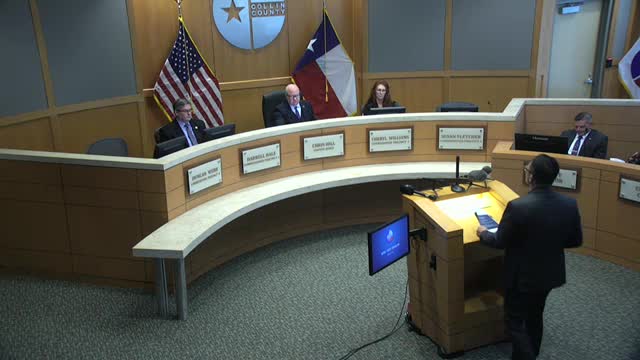
Collin County holds public hearing on proposed 'Epic City'; no application filed yet
Summary
County staff and the proposed developer described the project and county limits; dozens of residents spoke for and against Epic City, raising legal, water, safety and civil‑rights concerns. County officials said no development application had been submitted as of the hearing.
Collin County officials and residents spent several hours on March 31, 2025, at a public hearing about a proposed master‑planned development known as “Epic City,” a roughly 402‑acre project on unincorporated land near Josephine that straddles Collin and Hunt counties.
County Administrator Eun Kim told commissioners that Epic City is owned by Community Capital Partners and that, "as of today...no application for development" had been filed with county staff. Kim said the county’s role in unincorporated areas is limited to enforcing subdivision and infrastructure rules — streets, drainage, septic systems, utility certification and inspections — and that the county lacks zoning powers over residential density.
Why it matters: Residents pressed the court for specifics about water supply, public safety, governing authority and whether the project’s marketing and organization could lawfully restrict who may buy in. County staff and speakers also described ongoing state investigations into the project and affiliated entities.
County staff described the project as a planned community with roughly 1,000 homes, a K–12 school, a mosque, senior living and retail, and said the developer has been conducting due diligence work including flood, traffic and water studies. David Califfer of Westwood Professional Services, representing the project team, said, “The land has been acquired,” and that the team remains in a due‑diligence phase and has not set a date for filing applications with TCEQ or the county.
The hearing drew scores of public speakers. Some residents said Epic City’s marketing and membership structures appeared to limit ownership by religion and therefore risked violating federal and state fair‑housing rules. Jasmine Bayless read text from the developer’s own marketing, quoting, “because we are residents of this community… we will limit sales to only persons who believe that we will contribute to the overall makeup of our community,” and said that language appeared exclusionary. Other speakers raised water and fire‑protection concerns in Josephine and surrounding areas, noting local water restrictions and asking who would guarantee capacity and pressure for new taps.
Many speakers also raised broader objections linking the project’s stated goals to questions about Sharia law and legal authority. County staff referred repeatedly to published news reports that Representative Jeff Leach and Governor Greg Abbott, and Attorney General Ken Paxton, had raised questions about the project; Kim said the attorney general’s office had issued a civil investigative demand and that the governor had directed state resources to investigate affiliated entities. Kim also told the court that no municipal utility district (MUD) approvals existed yet and that, based on the densities shown on promotional materials, the development likely would require sewer rather than septic.
Not all public comment opposed the project. Jeremy Sitka, chair of the Collin County Democratic Party, urged the court to respect religious freedom and said the site as presented would be open to buyers and not a closed compound. Developer representatives told the court they intended the community to be inclusive and said they planned additional community meetings.
What the county can and cannot do: Kim reiterated that final plats and infrastructure certification are ministerial duties: if a proposed plat complies with state and county regulations and required infrastructure is built and inspected, the commissioners court must approve the plat. But Kim and other staff members emphasized that the developer must first secure necessary state approvals — for example, for water and sewer — and satisfy permitting and technical criteria before a plat would reach the court.
Next steps: No development application had been filed by the time of the hearing. Judge Hill told the room the court had no application before it and said the county would monitor filings and state investigations, and that any application would be reviewed under state and county law. The judge also urged the developer and county staff to work with neighbors to address infrastructure and safety questions.
Ending: With no plat or permitting package before the court, commissioners took no formal action at the hearing. Staff and developer representatives said they would return for future public engagement if and when applications are filed.