Get Full Government Meeting Transcripts, Videos, & Alerts Forever!
Get email alerts on the State Budget topic
No spam. Unsubscribe anytime.
House leaders release compromise budget targets, set stage for conference negotiations
Summary
House leaders released numbers-only budget targets they said reflect a compromise between House Democrats and House Republicans and will guide bill drafting and later conference negotiations with the Senate and governor.
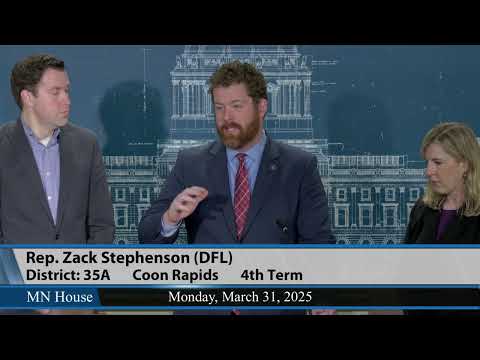
House leaders held a press availability to announce numbers-only budget targets meant to guide House budget bills and future negotiations with the Senate and the governor.
The targets, described by House leadership as a compromise between Democrats and Republicans, set specific spending directions — including $40,000,000 in new money in the first biennium for K–12 — and constrain forecast growth in Health and Human Services without specifying policy changes. "These budget targets represent a compromise between Democrats and Republicans," the House leader said.
Why it matters: The targets set the numerical framework that committee chairs will use to draft bills and that conferees will later compare with Senate and governor budgets. Leaders said the document is “numbers only,” with no binding policy agreements, and framed the targets as the first chapter in a multi-stage budget process that moves next to bill drafting, Ways and Means review, floor debate and, after the break, conference negotiations.
The House leader said the targets were negotiated with Republican House leadership and were released after a weekend when leadership expected some leaks and reporters' questions. "We worked hard in our negotiations with, leader Damoth and, Ways and Means co chair, Torkelson, to figure out a release … that wouldn't make our media staff work on the weekend," the House leader said.
Zac, a House leader who spoke at the availability, called the agreement a test of the chamber's new power-sharing arrangement. "This was the first, real test of the power sharing agreement, our ability to, get things done in this system of divided government," Zac said, adding that the deal shows leaders can "set aside the ideological battles" to complete a budget on time.
Representative Jamie Long, House 4 leader, said the targets preserve several policy wins from the previous biennium by excluding policy changes. "When you're looking at the budget, 1 of the important things is not just what's in it but what's not in it," Long said, noting the targets do not include changes to paid family medical leave, earned sick and safe time, reproductive rights protections or universal school meals.
Leaders and staff emphasized that the targets are a framework, not final appropriations. Chairs in affected subject-area committees will draft bills to match the targets and may make internal reallocations within departmental budgets. "The only things that are agreed to are the numbers in this deal," the House leader said. "There are some minor side agreements in certain budget areas but there are no policy agreements."
Key numbers and fiscal posture discussed at the availability (as stated by speakers): cuts in the governor's proposed K–12 funding were said to be much larger than the House targets; the governor's plan was described as cutting "upwards of $300,000,000 in the first biennium" and larger amounts in the tails, while the House target includes $40,000,000 in new first-biennium K–12 money and 0 cuts in the tails. Health and Human Services targets were described as reducing forecasted growth by roughly $300,000,000 in the first biennium and $1,000,000,000 in the second biennium (speakers framed those as reductions to forecast growth, not cuts to current appropriations). Leaders cited forecast figures that revenues are growing about 3.8% while expenditures were growing about 6.8%.
On specific programs and concerns: leaders said the numerical targets do not preclude committees from funding items such as unemployment insurance for school district hourly workers, but that those priorities were not earmarked in the targets. Co-chair Stevenson (referenced by leaders) noted that indexing the K–12 formula enacted in 2023 guaranteed forecast growth to schools and that the formula will continue to deliver baseline increases even if discretionary inflation adjustments are withheld.
Leaders also discussed bonding and debt service. The House targets were described as consistent with a $700,000,000 general-obligation bonding bill in the first biennium (the figure was described as what the adopted numbers would allow), while the Senate had earlier booked numbers to support a larger $1.3 billion bill in the first biennium.
Next steps and decision process: House chairs will draft budget bills to match the targets and send them to Ways and Means for review. After the break, House and Senate full budgets and the governor's proposal will be compared and conferees will negotiate a final package. Leadership said conferees will be split between parties on the House side so that bipartisan majorities will be required to adopt conference report provisions.
Speakers cautioned that these targets are a planning instrument and not a final budget. The availability closed after reporters asked about bonding size, specific program protections, and whether the numbers represent guarantees on policy items; leaders repeatedly emphasized the targets are "numbers only."