Get Full Government Meeting Transcripts, Videos, & Alerts Forever!
Get email alerts on the Forensic Science Capacity topic
No spam. Unsubscribe anytime.
Austin Forensic Science Department reports no sexual‑assault kit backlog, seeks staff and administrative support
Summary
Dr. Dana Cattabi, director of the City of Austin Forensic Science Department, told the Public Safety Committee the lab processed all sexual‑assault kits received in 2024 within an average of 51 days, holds multiple accreditations, and faces workforce and administrative‑support constraints.
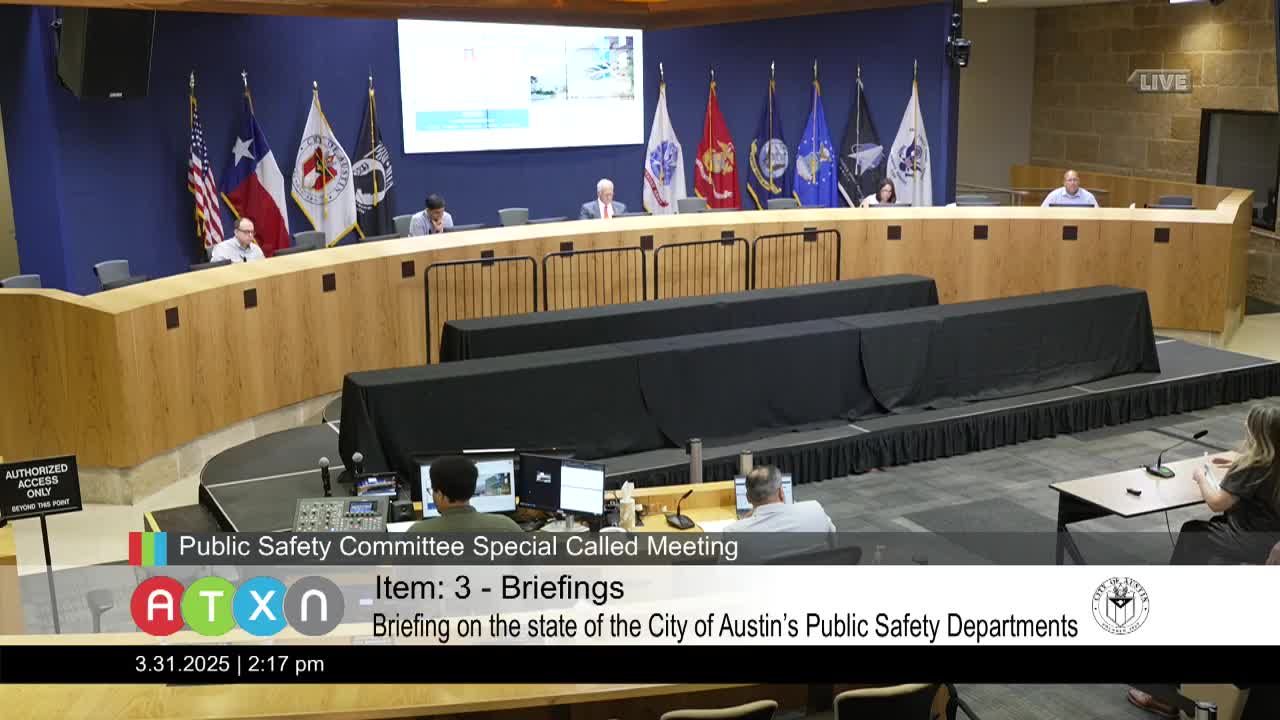
Dr. Dana Cattabi, director of the City of Austin Forensic Science Department, briefed the Public Safety Committee on March 31 about the department’s structure, services and capacity challenges.
Cattabi said the department became a standalone city department on Oct. 1, 2022, has 89 full‑time equivalents and operates five accredited forensic disciplines plus five support disciplines at a laboratory at 812 Springdale. “Our tagline is truth through science,” she told the committee.
Cattabi highlighted the department’s crime‑scene unit (24/7 response), firearms and tool‑marks, latent prints, seized‑drug analysis, toxicology and a case‑management group that oversees DNA analysis and outsourcing agreements. She said the evidence control section manages more than 1.4 million items and operates storage at East MLK and airport locations.
Operational highlights and performance: Cattabi said the lab processed all sexual‑assault kits received in 2024 with an average turnaround time of 51 days (the department’s goal is 60 days; the state requirement is 90 days). She said the lab produced about 7,500 forensic reports in the year, processed 25,000 evidentiary items, and disposed of 140,000 eligible evidence items.
Challenges and needs: Cattabi identified workforce development and administrative support as the department’s principal constraints. She said forensic hires generally arrive with relevant degrees but require one to three years of in‑house training before handling casework. She also said the department received operational FTEs when it stood up but not a commensurate level of administrative support, which complicates discovery requests, subpoenas and evidence logistics.
Accreditations and technology: Cattabi listed ISO/IEC 17025 accreditation, Texas Forensic Science Commission licensing requirements, and adoption of OSAC registry standards. She said the department purchased 3‑D virtual microscopy this year to improve firearms comparisons and to produce quantitative confidence metrics that can support transparency in expert conclusions.
Ending: Committee members thanked Cattabi and asked about degree pathways and regional assistance. Cattabi said the lab recently helped Fort Worth PD with CODIS reviews and reported the department had reduced vacancies to about two open positions at the time of the briefing, following an implemented career progression plan.