Get Full Government Meeting Transcripts, Videos, & Alerts Forever!
Get email alerts on the Police Staffing And Operations topic
No spam. Unsubscribe anytime.
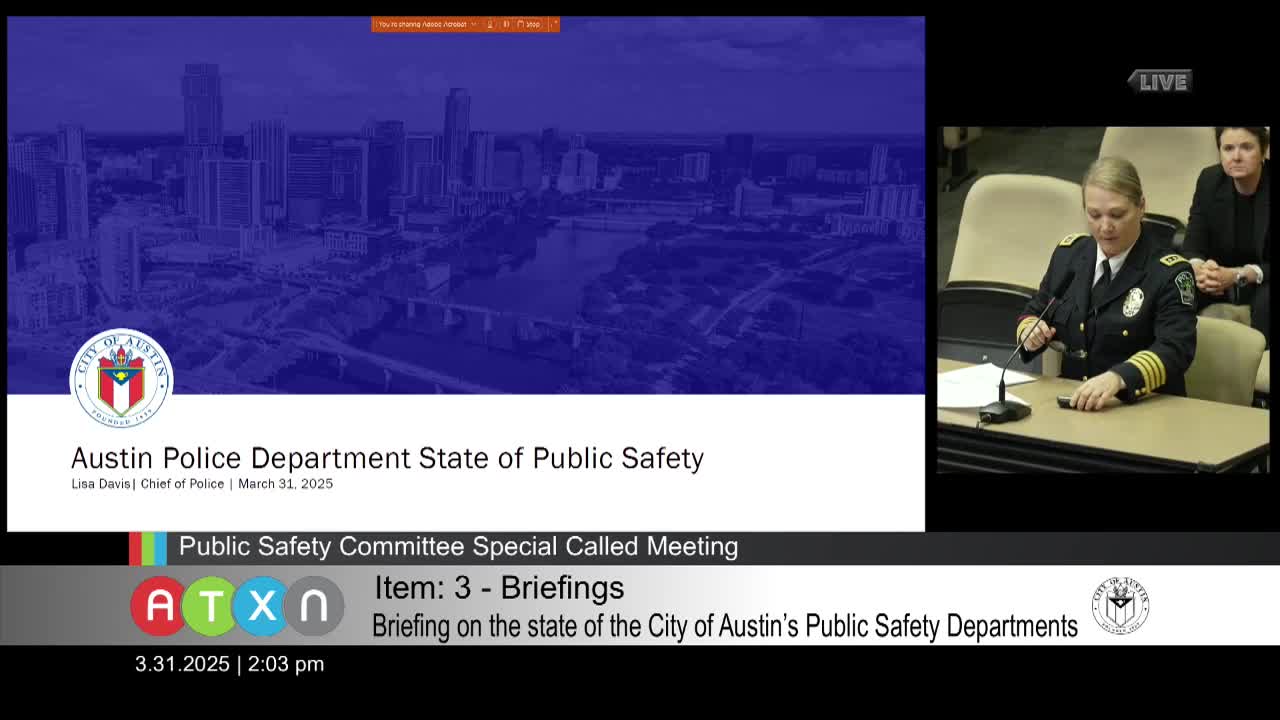
APD outlines staffing gains, Sixth Street pilot and crime trends at Public Safety Committee
Summary
Austin Police Department leaders told the City of Austin Public Safety Committee on March 31 that recruiting gains and contract changes are improving hiring, that violent crime fell year‑over‑year in 2024, and that a pilot to reopen Sixth Street to vehicles showed preliminary reductions in arrests and officer injuries.
Chief of Police Lisa Davis told the City of Austin Public Safety Committee on March 31 that the Austin Police Department (APD) is making progress on recruitment and retention, but remains short staffed.
Davis said APD currently has “well over 300 sworn police officer vacancies” and is running three cadet classes per year now that the department is “back under contract,” which allows continuous recruiting and testing. She said the department is holding three cadet classes yearly with a maximum of 104 seats per class and a minimum of 60, and that “if we have 3 classes a year with a minimum of 60 officers by the end of the year 2027, we will only be 40 officers short.”
The chief also described organizational changes she said should improve operations, including consolidation of investigative bureaus, creation of a chief of strategic initiatives position overseeing evidence‑based policing, and moving patrol under a single assistant chief for consistency.
Why it matters: staffing levels affect patrol coverage, response times and officers’ ability to do community problem‑solving. Davis said improved staffing would give officers more “uncommitted time” to engage with businesses and residents rather than handling only calls for service.
Davis presented APD data showing a roughly 8.3% reduction in violent‑crime victims between 2023 and 2024, and a homicide case clearance (closure) rate she reported at 94% for 2024. She cautioned that reporting and local trends vary by offense type and that increases in some offenses (including certain underreported crimes) can reflect improved victim reporting and outreach.
On the downtown entertainment district, Davis said APD piloted a traffic plan that reopened Sixth Street to vehicular traffic beginning in December to reduce crowding and confrontations. She described preliminary results comparing January–February 11 arrests to the same period in 2024 as showing decreases both across downtown and on Sixth Street, and said the city is moving from pilot toward “permanent solutions.”
Davis acknowledged longer average response times for high‑priority calls compared with prior years and attributed those changes to staffing levels and city growth. She said APD is using a backfill process that requires employees outside patrol to work shifts in patrol (five 10‑hour shifts within 90 days) and that her goal is to eliminate backfill by the end of the calendar year through academy graduations.
Other issues Davis identified as priorities included technology upgrades, data quality and public reporting, employee wellness and third‑party organizational reviews (she named a contractor engagement with Barry Dunn for workflow analysis). She highlighted community outreach initiatives, including ride‑alongs, multilingual liaison work and participation in a Univision town hall.
Ending: Committee members thanked Davis for the briefing and asked for clarifications about class sizes, academy length (an eight‑month academy), and the projected timeline to close the staffing gap. Davis repeated the target of the end of 2027 for reaching the staffing projection under the cadet class assumptions.