Get Full Government Meeting Transcripts, Videos, & Alerts Forever!
Get email alerts on the Criminal Justice Expungement topic
No spam. Unsubscribe anytime.
House Judiciary Committee debates governor's expungement bill; schedules vote for next day
Summary
The House Judiciary Committee discussed the governor's expungement bill (Senate Bill 432) on a March 2025 agenda and scheduled the bill for a committee vote the following day after the first session.
The House Judiciary Committee discussed the governor's expungement bill (Senate Bill 432) during its March 2025 meeting and agreed to take up the bill for a vote the following day after the first session.
Committee leaders said the bill would broaden eligibility for expungement in several categories, address a court decision referred to in the hearing as the "Abhishek" decision, and close remaining issues from 2023 marijuana-expungement legislation. Chair, House Judiciary Committee summarized the measure as "the governor's bill on expungement and it does several things," including adding certain crimes to the list of offenses that can be expunged and protecting certain "stat docket" matters from routine case searches.
Why it matters: The bill would change who may apply for expungement and how courts evaluate those applications. Committee members framed the changes as directly affecting people with old, minor offenses who have testified to barriers to employment and housing, and as an effort to reconcile state law with recent case law and prior legislation.
Key provisions discussed
- Added offenses: Committee discussion identified additions to the list of eligible offenses that include bad-check offenses and certain credit-card/theft-related charges and driving without a license. Committee members also referenced inclusion of PBJ (probation before judgment) and certain minor traffic offenses as examples of charges the bill would cover. The transcript did not supply a comprehensive statutory list or complete citations; specific statute numbers mentioned in discussion were not all fully specified in the record.
- Abhishek decision: Members said the bill incorporates language intended to address a court decision repeatedly referred to as the "Abhishek" decision. The committee described that change as one of the bill's central fixes but did not recite the court's holding in full during the hearing.
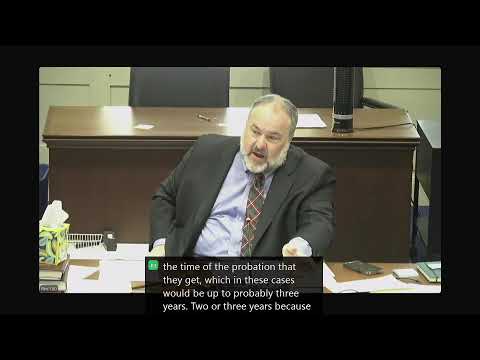
- Stat docket shielding: The chair explained that the bill would "shield references to things that are placed on the stat docket," describing the stat docket as a limited holding status that can last up to three years and that the proposed language would prevent finished stat-docket matters from appearing in routine case searches.
- Court-review language and automation concerns: Delegate Kaufman raised concerns about newly proposed language that would require courts to review a person's supervision outcome before granting expungement. Kaufman read the language into the record: "the court shall consider to the extent applicable the person's success at probation, parole, or mandatory supervision and whether the person is paid any monetary restitution." Kaufman said that mandatory review language risks creating a manual adjudication step that could impede movement toward an automatic-expungement system.
- Suggested edits: The committee's vice chair proposed softening the statutory phrasing to avoid using the word "success," suggesting terms such as "performance while under supervision" or a neutral "review" so the provision would not operate as an automatic disqualifier.
- Restitution and probation length: Members discussed that unpaid restitution can, in practice, extend a person's probation, which could delay eligibility. One member explained judges can and sometimes do extend probation until restitution is paid, creating long-running supervision in certain cases.
- Victim notification and participation: Committee members noted that existing victim-notification practices apply when someone files an expungement petition: prosecutors and victims may be notified and prosecutors can file objections. Members debated how automatic-expungement frameworks should preserve victims' ability to be notified and to object without imposing an unduly burdensome manual review on every case.
- Human-trafficking question: A committee member asked whether the bill would permit expungement for human trafficking convictions. Members clarified that human-trafficking convictions are not part of the bill's expungement eligibility and that separate local prosecutor practices vary; the committee said the statute in question does not currently include trafficking offenses.
Process, timing and next steps
Committee leaders said they would not vote on SB 432 that day and scheduled the bill for a vote tomorrow following the first session. The chair told members to submit proposed amendments to the committee by 10:00 a.m. on Tuesday.
Votes at a glance (other items considered in the same meeting)
- Voting List 15: The committee took unanimous consent to consider and vote on all bills on Voting List 15 as a block; the chair said the roll call on the first bill (identified in the transcript as "Senate Bridal 11") would count as the roll call for all listed bills. The transcript lists the bill identifiers in the block in the form presented on the record; specific statutory descriptions and cross-file details were not read into the record. Outcome: unanimous consent adopted (roll call recorded on the listed items).
- Senate Bill 46: Committee adopted conforming amendments to make SB 46 match the House-passed cross-file (identified in discussion as House Bill 164) and then voted the bill favorably as amended; outcome: amendments adopted and bill reported favorably.
- Senate Bill 202: Committee adopted conforming amendments to the House version and moved the bill favorably as amended; outcome: amendments adopted and bill reported favorably.
- Senate Bill 619 (referred to in the hearing as 619/619 or —619): Committee adopted conforming amendments to align with the House version (related to membership or qualifications for the Commission on Judicial Disabilities) and voted the bill as amended; outcome: amendments adopted and bill reported favorably.
(For the votes above the transcript records motions, seconds and recorded "yes" votes; where the transcript did not provide a complete statute text, cross-file number or further legislative details, those items are recorded here as "not specified".)
What the record does not show
The transcript does not contain the full statutory text of every change, complete lists of affected statute numbers, or final, printed amendment language. Where members referenced statute numbers or offense names in shorthand, the committee did not read a complete bill text on the record during this portion of the hearing.
For reporters and interested parties: the committee chair stated the committee will accept amendments for SB 432 until 10:00 a.m. on Tuesday; the committee will reconvene the next day for the scheduled vote.