Get Full Government Meeting Transcripts, Videos, & Alerts Forever!
Get email alerts on the Deepfakes And Online Harm topic
No spam. Unsubscribe anytime.
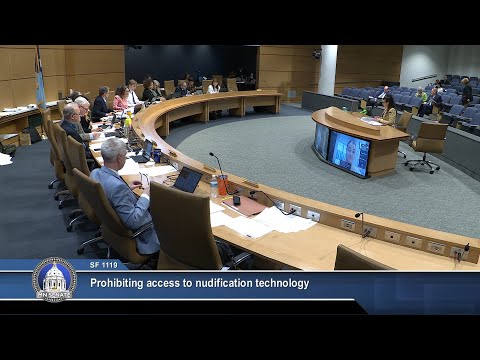
Committee approves bill banning online “notification” deep-fake tools, sets civil penalties and grants for victim services
Summary
Senate committee adopted the author's amendment and approved an updated bill that would prohibit features allowing users to create or download AI-generated intimate imagery (so-called "notification" technology) and establish civil penalties and grant funding for victim services.
Senator McQuade presented Senate File 11-19, a bill targeting online tools that create or distribute AI-generated intimate images (commonly called deepfakes). McQuade said the bill prohibits platforms from enabling functions that allow users to generate or download altered images or videos that realistically depict an identifiable person's intimate parts when those parts were not in the original image.
The committee adopted an A7 amendment as an author's amendment and heard testimony from Shannon Shevlin, who testified about harms associated with deepfake technology and urged passage. The bill language (as amended) includes civil penalties for violations with minimum civil penalties cited in testimony (the sponsor mentioned $500,000 as a floor in discussion of enforcement language), and directs some penalty revenue for victim services grants. Senator Overbaten confirmed the bill's grants would use a competitive process run through the Office of Justice Programs; the committee added an oral fiscal-technical amendment to clarify appropriation timing and administration.
Senator McQuade moved the bill to the Senate Commerce Committee; the committee voted to recommend Senate File 11-19 as amended to Commerce. Sponsors and testifiers said the bill aims to protect privacy and reduce harm, while the technical language and civil-penalty structure will be finalized in Commerce and fiscal review.
Votes at a glance: A7 amendment adopted as author's amendment; oral amendment to appropriation language adopted; Senate File 11-19 as amended recommended to pass and referred to Commerce.
Why it matters: Lawmakers framed the measure as an update to protect Minnesotans—particularly women and young people—from the nonconsensual creation and distribution of realistic intimate images using AI. The bill will move to Commerce, where enforcement, civil-penalty levels and implementation details will be further refined.