Get Full Government Meeting Transcripts, Videos, & Alerts Forever!
Get email alerts on the Ignition Interlock topic
No spam. Unsubscribe anytime.
Senate Transportation Committee advances bill to expand ignition-interlock rules after St. Louis Park crash
Summary
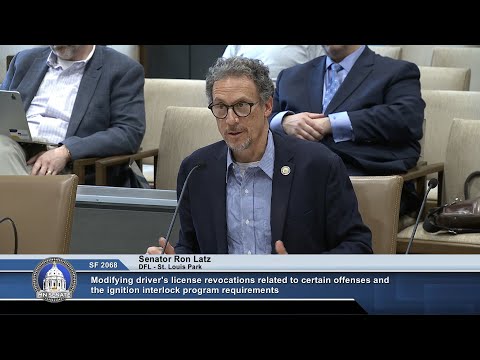
Senator Lats, sponsor of Senate File 2068, told the Minnesota Senate Transportation Committee on March 28, 2025, that the bill was drafted after “a tragedy that happened in Saint Louis Park” in which a repeat DWI offender drove into an outdoor patio at the Park Tavern, killing two people and injuring nine.
Senator Lats, sponsor of Senate File 2068, told the Minnesota Senate Transportation Committee on March 28, 2025, that the bill was drafted after “a tragedy that happened in Saint Louis Park” in which a repeat DWI offender drove into an outdoor patio at the Park Tavern, killing two people and injuring nine.
The bill would lengthen ignition-interlock durations on a graduated scale for repeat DWI offenders, extend the look-back period for prior offenses from 10 to 20 years, allow the statutory reinstatement fee to be paid over the course of the interlock requirement rather than all up front in some cases, and add ignition-interlock as an option in criminal vehicular homicide cases. The committee passed an A7 amendment addressing statutory clarifications and vehicle-forfeiture issues and then voted to recommend the bill, as amended, be referred to the Committee on Judiciary and Public Safety.
Senator Lats said the bill "started out as a specific response to a tragedy that happened in Saint Louis Park" where the driver had five prior DWI convictions, the most recent in 2015, and had regained driving privileges without an interlock requirement before the fatal incident. Under the bill’s proposals, interlock duration would be increased on a graduated scale — adding one to three years in some tiers and up to 10 additional years in the most serious repeat cases — and the statutory look-back for prior offenses would extend to 20 years so older priors can be counted when determining interlock requirements.
The measure would also change how reinstatement fees are collected. Senator Lats and witnesses described a current up-front cost of about $680 in reinstatement fees (a $250 statutory fee plus a $430 surcharge) plus roughly $30 for a new license application, which can make entry into the interlock program prohibitive. Senator Lats described the proposal as allowing the fee to be paid over the interlock period "to eliminate at least the upfront barrier to getting into the interlock program."
Charles Siegel, a private defense attorney testifying on behalf of the Minnesota Association for Criminal Defense Lawyers and the Minnesota Society for Criminal Justice, said he supported some provisions but opposed others. He told the committee he "wholeheartedly support[s] some of the provisions" including adding criminal vehicular homicide as a category eligible for interlock, but cautioned that lengthening interlock durations and extending the look-back window risked "penalizing the compliant." Siegel said many clients cannot afford the program even if payment is spread over time, and that extending terms could increase the financial burden on compliant participants.
Committee staff added procedural clarifications. Mr. Segal explained that under current law a revocation period "does not technically begin until you enter the program," so the required term must be served once someone enrolls. Fiscal staff (Miss Boyd) provided a breakdown of the reinstatement fee: "The $250 fee is split 20% to the driver vehicle services operating account, 67% to the general fund, 8% to an account under [the Bureau of Criminal Apprehension], and 5% to the vehicle forfeiture account," and she said portions of the $430 surcharge go to account(s) including a traumatic brain injury and spinal cord injury account and a remote electronic alcohol monitoring account, with a possible monthly transfer provision to the general fund.
The A7 amendment, offered by Senator Lats and moved by Senator Johnson Stewart, included language to allow return of forfeited vehicles when they are eligible for interlock installation and to address situations where a forfeited vehicle is inoperable or where the seized item is not a conventional passenger car (for example, to avoid excluding vehicles that are otherwise capable of hosting an interlock device). The amendment also added suspension and cancellation language alongside revocation so driver and vehicle services have clearer authority to implement interlock requirements, and clarified authority to extend interlock terms for reported violations.
Committee members voiced differing views on the magnitude of the proposed look-back extension. Senator Jasinski said that extending the look-back from 10 years to 20 "seems excessive" and expressed concern the change would capture long-ago, lower-level offenses. Senator Lats and others argued that extending the period would better account for patterns of repeated offending in some cases.
By voice vote the committee approved the A7 amendment and then, by voice vote, recommended that Senate File 2068 as amended be referred to the Committee on Judiciary and Public Safety. The committee record shows voice votes rather than a roll-call tally; the motion was announced as passing.
The committee paused for a final call for testimony and then adjourned. The bill will proceed to further committee consideration in the Legislature’s process.