Get Full Government Meeting Transcripts, Videos, & Alerts Forever!
Get email alerts on the Public Housing Redevelopment topic
No spam. Unsubscribe anytime.
Virgin Islands Housing Authority outlines accelerated redevelopment plan, cites funding as central constraint
Summary
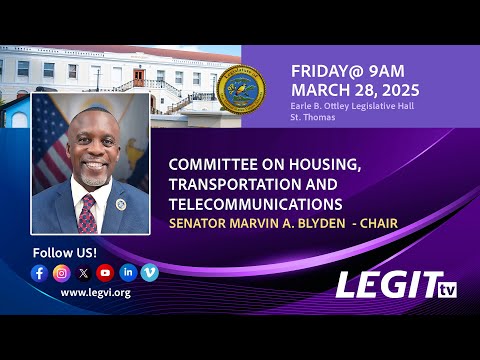
The Virgin Islands Housing Authority told the Committee on Housing, Transportation and Telecommunications on March 28 that it has refreshed a 10‑year infrastructure plan and now intends to accelerate demolition, redevelopment and new construction to address the territory’s affordable‑housing shortfall.
The Virgin Islands Housing Authority told the Committee on Housing, Transportation and Telecommunications on March 28 that it has refreshed a 10‑year infrastructure plan and now intends to accelerate demolition, redevelopment and new construction to address the territory’s affordable‑housing shortfall.
At the hearing Executive Director Dwayne Alexander said the authority currently manages "20 developments grouped into 9 asset management properties totaling 2,426 units" and has revised plans so the inventory will fall to "approximately 2,000 units" as demolition and redevelopment proceed. He told senators the authority’s annual target is to modernize or construct about 300 units per year.
Why it matters: The authority said hurricane damage, rising construction and insurance costs and a backlog of deferred maintenance have made the previous timeline infeasible. Alexander emphasized the practical constraint repeatedly: "the key word for us is funding, funding, funding." He described a mix of FEMA hazard mitigation and recovery dollars, HUD capital funds, tax‑credit financing and mixed‑finance/RAD transactions as the primary tools to pay for replacements and improvements.
What the authority will do: Alexander and Chief Operating Officer Lydia Pell outlined projects expected to move forward in 2025, including the recently completed Walter I. Hodge redevelopment, the D. Hamilton Jackson closing and work on Estate Dunu (St. Thomas) and phases of John F. Kennedy Terrace (St. Croix). Alexander said ongoing and planned work includes roof, door and window replacement and other exterior and interior repairs funded through FEMA’s 428 program and HUD capital funds.
Operational context and challenges: The testimony included operational metrics the authority described as improved: an occupancy rate reported at 92.5% (an increase from 90.6%), and a higher rate of closed maintenance work orders that the agency said improved some sites’ grades from failing to an A. Still, Alexander and Chief Financial Officer Cecile Tomfoy said staffing remains a constraint—authorities reported about 169 employees on staff with 31 vacant positions—and the authority is hiring on a ‘‘critical needs’’ basis because ongoing funding uncertainty has limited more aggressive recruitment.
Vouchers and federal regulatory change: The hearing also covered the Housing Choice Voucher program. Program director Akayla Anthony described operational pressure from rising market rents, landlord requests for rent increases and an ongoing transition to HUD’s Housing Opportunity Through Modernization Act (HOPMA). As she put it, implementation requires new software, revised forms and retraining staff; the authority reported training for HUD changes was held in December 2024.
Funding snapshot: In response to questions, Alexander described a roughly $71 million overall agency budget for the fiscal year and said public‑housing operating funds are about $20 million a year. He said that HUD capital grants and FEMA obligations remain critical; the authority reported about $33.5 million in recent capital grant awards, with roughly $16 million still drawable.
What senators pressed them on: Committee members pressed the authority on maintenance staffing and on timelines for specific communities—Tonky/Valley units the agency said it will reassess for possible reuse, while some demolition phases require environmental clearances (which the authority said it has recently received). Senators also pressed for quicker procurement and timely contractor payments to keep projects moving.
Outlook and next steps: The authority pledged to continue mixed‑finance and RAD approaches, to seek tax‑exempt bond financing for selected projects and to keep the committee updated on project closings and on the schedule for proposed redevelopment sites. Alexander closed by reiterating the central constraint: without predictable funding the pace and scale of redevelopment will be limited.
Sources and quotations in this article come from testimony given March 28 by Dwayne Alexander (Executive Director, Virgin Islands Housing Authority), Lydia Pell (Chief Operating Officer), Akayla Anthony (Housing Choice Voucher Program Director) and Cecile Tomfoy (Chief Financial Officer) at the Committee on Housing, Transportation and Telecommunications hearing.