Get Full Government Meeting Transcripts, Videos, & Alerts Forever!
Get email alerts on the Ai Education topic
No spam. Unsubscribe anytime.
Board hears Dreamscape Learn demo, discusses AI literacy guidelines and next steps for campus training
Summary
The board received a demonstration of Dreamscape Learn’s immersive, narrative VR for STEM education and reviewed draft AI literacy guidelines from the system’s AI Council, then discussed pilot deployments, costs and equity concerns.
At a special session on innovative educational technology and artificial intelligence, the Board of Governors heard a demonstration of Dreamscape Learn, a cinematic, immersive educational platform developed with Arizona State University, and a presentation of draft AI literacy guidelines prepared by the Chancellor’s Office AI Council.
Dreamscape Learn co‑founder and producer Walter Parks described immersive, narrative‑based modules (the demonstration used an intergalactic wildlife sanctuary scenario for biology) that place students in story‑driven problem‑solving experiences intended to build scientific reasoning, data analysis, collaboration and transferable skills. Parks said trials at Arizona State showed higher engagement, a sustained user satisfaction score (roughly 4.5 of 5 during a multi‑week deployment) and improved learning outcomes, with participating students earning higher grades in introductory biology than a control group. The technology can be packaged at multiple price tiers: a fully immersive, high‑fidelity lab installation (the most expensive, market‑quoted near a mid‑six‑figure classroom build), mobile pods that travel to campuses, lighter “cart” deployments, and 2‑D interactive versions intended for broader, lower‑cost distribution.
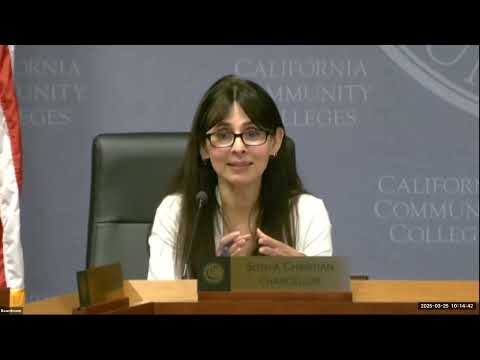
Board members asked about costs, scale, curriculum alignment and whether such work could be made affordable for community colleges in low‑resource areas. Deputy Chancellor Christian noted the chancellor’s office will pilot different approaches (including lower‑cost 2‑D pilots) and work with early adopter colleges (Glendale, Merced and Kern were mentioned) to evaluate outcomes. The chancellor’s office said some pilot deployments at ASU reached thousands of students and that districts have obtained state and local support to pay for immersive labs; staff said a mix of mobile and lower‑cost options can broaden access if funded.
The AI Council presented draft AI literacy guidelines intended as a concise, role‑based framework colleges can use to teach responsible and effective AI use. The document recommends six fundamental AI‑literacy competencies (understanding generative AI fundamentals, critical evaluation of outputs, ethical and privacy considerations, prompt and interaction skills, data and model limitations, and safety/mitigation practices). It also includes role‑based checklists for classroom faculty, counselors, library staff, classified professionals and administrators. The Academic Senate said the draft is a constructive starting point but asked for more faculty review and additional detail in several areas; the AI Council and Academic Senate plan continued iteration before wider publication.
Several board members and public commenters emphasized two persistent concerns: access and equity (ensuring low‑income students and underfunded colleges can use new tools) and data governance (who owns and trains models with student data). The chancellor’s office said it will publish the draft guidelines for field review, develop exemplar curricular modules, and pursue pilots with a mixture of high‑ and low‑cost deployments while continuing consultation with the Academic Senate and student groups.
Why it matters: AI and immersive learning tools are being tested as ways to increase engagement and learning gains in STEM and other fields. The draft AI literacy guidelines aim to create a common, systemwide baseline so students and staff learn to use AI responsibly. Board members emphasized the need to pair innovation with protections for students’ data and equitable access.
What’s next: The AI Council will post the draft AI literacy guidelines for field feedback, continue pilots of Dreamscape Learn at early adopter colleges, and the chancellor’s office will brief the board on pilot outcomes and recommended investments.