Get Full Government Meeting Transcripts, Videos, & Alerts Forever!
Get email alerts on the Budget Public Safety Millage topic
No spam. Unsubscribe anytime.
Eaton County outlines deep staff cuts and urges public safety millage to close budget gap
Summary
County officials presented budget scenarios showing multimillion-dollar deficits without changes, proposed moving public safety costs into a separate millage fund, and detailed potential elimination of roughly 76–98 positions across departments if revenue does not increase.
Eaton County officials on Wednesday presented budget scenarios showing large, recurring shortfalls that would require major personnel reductions unless voters approve a proposed public safety millage in May.
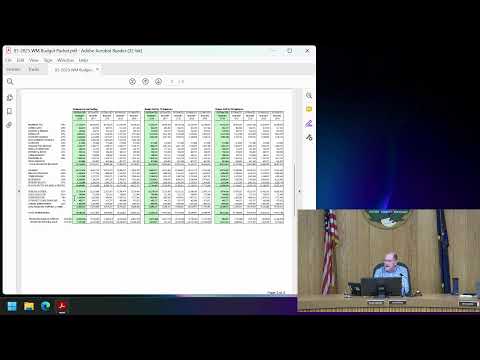
Controller Connie Sobe and her staff told the Board of Commissioners that under current staffing the county will face growing deficits driven largely by rising pension costs and legacy liabilities. Sobe said the county previously held a near $9,000,000 fund balance because many positions were unfilled, but that continuing current staffing would leave the county “in a deficit of 25,000,000” by 2030 unless action is taken. She and financial staff presented models that reduce 76 to 98 positions in different scenarios to stabilize the general fund in the short term.
The presentation matters because the county’s pension obligations and public safety staffing together drive most of the projected shortfalls. Sobe told commissioners that the county must factor in contributions to MERS and legacy pension costs; she said command-level pension contributions are particularly large and that the county’s share could rise markedly in coming years. The administration said those pension costs mean “a dollar of cuts does not equate to a dollar of savings,” estimating roughly $0.58 on the dollar would need to be set aside for long-term pension liability when positions are eliminated.
Officials laid out a menu of proposed reductions and tradeoffs. The scenarios discussed would: eliminate the county’s animal-control personnel; scale back the county road-patrol presence (including reductions tied to the Delta Township contract); remove some prosecuting-attorney and court-related positions; and cut or reduce funding to several external agencies and contracts. Specific items cited included a proposed elimination of a $156,000 memorandum of agreement with MSU Extension (two positions), a 30% cut scenario for Community Mental Health and the local health department, a $33,000 reduction to the conservation district, and a $17,000 reduction to the historical commission. Sobe said the 76-position scenario and the larger 98-position scenario both included combinations of vacancy eliminations and program reductions and that the actual mix would require further work with elected officials and department heads.
Officials gave a breakdown of positions discussed. The package the controller described would reduce roughly 72 positions in the sheriff’s department and 4 in the prosecutor’s office within the 76-position scenario, while the larger scenario increases that count. The sheriff’s reductions cited by administration notes included command staff, detectives, deputies, cadets and records clerks across multiple patrol and contract categories. Sobe stressed the Delta Township contract is currently funded by that township and would be preserved as a contract, but acknowledged moving road-patrol costs out of the general fund would change the county’s liabilities and the contract dynamics.
The county recommended a public safety millage — a voter-approved, dedicated property-tax levy — to move public-safety staffing and related costs into a separate fund rather than the general fund. Sobe said a public safety millage does not “come to the general fund” but rather creates a separate revenue stream to fund public safety directly; the county’s equalization director estimated roughly $10.3 million in the first year. Commissioners and staff emphasized that the millage would aim to restore patrol and staffing over time and would not be a general-purpose tax to cover unrelated county costs.
Prosecutor Doug Lloyd urged the board to recognize immediate public-safety consequences if staffing falls. Lloyd described cases and public-safety incidents that, in his view, make the county vulnerable to being treated as a “train station” — a place criminals exploit when law enforcement presence is thin — and he said that the combination of fewer road deputies and reduced prosecutorial capacity would increase public risk. Several department heads echoed those concerns: Eaton County Treasurer Darris Rainette said she supports the millage, Court Administrator Amy Edsall described already “bare bones” staffing in court offices and the stress of lost capacity, and 9‑1‑1 Director Kelly Cunningham said call volumes will not fall just because staffing does.
Administration also reviewed one-time and restricted funds that have masked operating shortfalls in recent years. Officials said American Rescue Plan Act (ARPA) funds and opioid-settlement dollars were directed or restricted and therefore not a sustainable solution for ongoing personnel costs. The controller said ARPA helped balance near‑term budgets but is not a replacement for recurring revenue. Officials also discussed several capital and infrastructure items paid from recent funds, including a Johnson Controls (JCI) energy/utility project that included solar components and an associated financing obligation they said is adding near-term debt-service costs even as energy consumption falls.
The board and staff described next steps and timing. Commissioners said they will continue working with department heads, elected officials and labor/union representatives to refine the list of affected positions and to examine which reductions are feasible or legally restricted by grants and mandates. The administration noted the millage appears on the May ballot; several commissioners urged public outreach to explain that the millage finances public safety in a separate fund and does not backfill general-fund spending. The board scheduled follow-up budget discussions and an organizational review after the May election.
Votes and formal motions at the meeting were limited. The board approved the meeting agenda at the start of the session by voice vote. No formal vote on the budget scenarios or staffing reductions was taken; officials described the meeting as a budget-review session to inform commissioners before formal budget decisions and before any negotiations or required public notices.
Commissioners and department leaders repeatedly emphasized personnel impacts and the human consequences of cuts. Sobe said repeatedly that employees are “hardworking” and that these choices involve people’s livelihoods; several elected officials asked colleagues to communicate clearly with staff and the public as the process continues. The administration acknowledged many details remain to be resolved, including pension actuarial modeling requested from MERS and precise grant‑funding impacts on revenue-sharing arrangements.
For now, the county’s fiscal planning centers on two paths: voters approve the dedicated public-safety millage and the county places certain public-safety positions into that separate fund, or the millage fails and the board must adopt deeper, recurring cuts that include personnel reductions and further program trims. Commissioners said they expect to revisit the budget in the weeks after the May election and to continue public outreach about the choices facing Eaton County residents.