Get Full Government Meeting Transcripts, Videos, & Alerts Forever!
Get email alerts on the University Of Guam Funding topic
No spam. Unsubscribe anytime.
Legislature committee approves $5.7 million for University of Guam with conditions on use and tuition
Summary
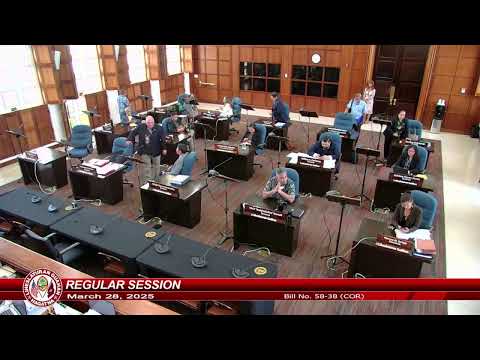
The Committee of the Whole advanced Bill 58-38, a $5,700,000 appropriation for the University of Guam (UOG), to the Legislature's third-reading file on a voice vote after a daylong hearing and multiple floor amendments.
The Committee of the Whole advanced Bill 58-38, a $5,700,000 appropriation for the University of Guam (UOG), to the Legislature's third-reading file on a voice vote after a daylong hearing and multiple floor amendments.
The appropriation is intended to cover near-term fixed costs that the university said are necessary to sustain operations this fiscal year, including payroll for the final pay periods, repairs and maintenance, capital improvements and other items the university identified as "accreditation-related priorities." The committee adopted several amendments that limit how the funds may be used.
Why it matters: The university told lawmakers it faces a budget shortfall driven largely by personnel costs and earlier salary adjustments. Committee members voiced concern about both preserving UOG's accreditation and protecting students from tuition increases at a time of economic uncertainty and federal grant freezes.
The university's president, Dr. Anita Boro Enriquez, told the committee the federal and grant landscape is uncertain but said the institution must demonstrate "financial sustainability" to accreditors and keep programs running. "We have to be able to demonstrate financial sustainability," she said in response to a senator's question about whether a tuition freeze would endanger accreditation.
Debate and conditions
Lawmakers questioned university officials about the source and timing of the shortfall. University witnesses said part of the $5.7 million would cover the last four payrolls of the fiscal year; other amounts were tied to specific units and programs the university said are central to meeting accreditation standards. During questioning, legislators also pressed for details about frozen federal grants (including NIH research grants), the size and repayment burden of student loans, and alternative revenue options such as the endowment, research corporation income, and potential reallocation of restricted grant funds.
Several amendments were adopted that change the bill's text and place conditions on the appropriation: - The committee adopted language narrowing permissible uses to repairs and maintenance, capital improvement projects and "accreditation-related priorities," while striking language that would have explicitly funded purchases of furniture for specified buildings. - An amendment was adopted that requires any unexpended funds remaining after Sept. 30, 2025, to revert to the general fund. - The committee adopted an amendment that bars the appropriation from being used for salary raises or the creation of new positions. - The committee adopted an amendment that prohibits UOG from imposing any tuition or mandatory student fee increases tied to this appropriation for a period of one year after the act's enactment; the panel also required the university to report to the Legislature on any proposed increases not related to this appropriation and to submit financial justification for them.
Senators who supported the conditions said they were designed to protect students and make the use of extraordinary funds transparent. "If we're going to give this $5,700,000 and a lion's share of it is going to the vagueness that is 'accreditation-related priorities,' I'm not confident that enough of it is going to improve services for the students," said Senator Michael San Nicolas Barnett (Senator Barnett) during floor debate, pressing for restrictions.
Other members said the appropriation was necessary to preserve programs and workforce pipelines the island depends on. "UOG can prepare our sons and daughters to fill this critical need in our community," Sen. Vince Borja, the bill's primary sponsor, said in closing remarks, noting nursing, education, public administration and engineering as workforce priorities.
Votes at a glance
- Amendment narrowing permitted uses (repairs & maintenance, capital improvements, accreditation-related priorities): adopted (voice/no objection). - Amendment making funds available only until Sept. 30, 2025, then revert to general fund: adopted (roll-call by show of hands recorded by the clerk; committee announced the amendment passed). - Amendment prohibiting use for salary raises or new positions (Borja amendment): adopted (no objection recorded). - Amendment limiting tuition/mandatory fee increases tied to this appropriation to one year: adopted (committee vote on a secondary amendment to change three years to one year passed, 8 in favor; final amendment as amended adopted). - Final committee action: Bill 58-38 reported out of the Committee of the Whole with recommendation to place in the third-reading file (no objection reported on the floor when the committee returned its report).
What the university said it needs
UOG said its FY2025 operations budget was approximately $34.2 million (with about $1.6 million allocated to the Guam Cultural Repository) and that a broader staffing pattern indicated personnel costs around $44 million if fully funded. University witnesses said the $5.7 million request represents amounts needed to close out payroll and sustain accreditation-related activities for the fiscal year.
University staff told senators that some federal research grants have been paused or frozen (with particular concern noted for certain NIH minority health and climate-related grants), and that some restricted grants support student internships and stipends that cannot easily be replaced. Dr. Enriquez said the university has a task force on cost efficiencies and a revenue-enhancement working group but requested legislative flexibility to balance tuition, fees and institutional funding in the short term.
Context and next steps
The Committee of the Whole's amendments largely reflect legislative concern about accountability and student affordability. With the committee's recommendation, Bill 58-38 moves to the Legislature's third-reading file, where it will be scheduled for floor action.
If enacted as amended, the law would provide the appropriation but restrict several uses of those funds and require reporting and reversion of unused funds as the Legislature and senators sought during the hearing. The committee explicitly required the university to submit financial justifications to the Legislature for any future tuition or fee increases that are unrelated to this appropriation.
For now, the measure preserves immediate funding for UOG while giving lawmakers oversight tools they said are necessary in a period of uncertain federal grants and local revenues.
Ending
The vote to advance the bill concluded the Committee of the Whole's deliberations; the measure now awaits scheduling on the full Legislature's calendar. Senators said they will continue oversight of university finances and federal grant developments as the FY2026 budget deliberations approach.