Get Full Government Meeting Transcripts, Videos, & Alerts Forever!
Get email alerts on the Appeals Adoption Finality topic
No spam. Unsubscribe anytime.
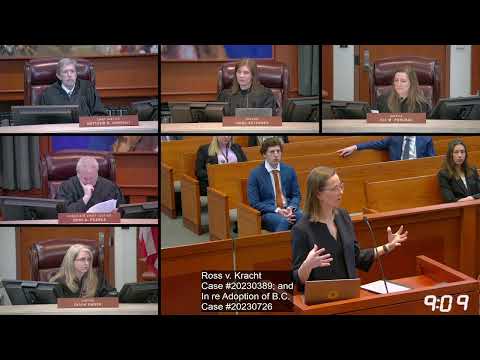
Utah Supreme Court hears argument on whether termination orders in district‑court adoptions are immediately appealable
Summary
At oral argument, lawyers for appellants said district‑court orders terminating parental rights should be treated as final and appealable like juvenile‑court termination orders; justices pressed whether the Adoption Act or case law provides an express statutory basis and whether the court should adopt a prospective rule.
At oral argument before the Utah Supreme Court, counsel for appellants argued that district‑court orders terminating parental rights in adoption proceedings are final and should be immediately appealable, while justices pressed whether the Adoption Act or prior case law provides an express statutory basis for that rule and whether any change should be applied prospectively.
The question matters, lawyers told the court, because treating a termination order as final allows an appeal to be taken immediately at the point the parent’s rights are terminated rather than waiting until an adoption decree is entered. Appellants said that practice reduces confusion for children, avoids later undoing of adoptions, and addresses practical barriers for indigent parents who may lose notice and access to filings after a termination order.
Alexander Marshall, counsel for one set of appellants, opened the argument by stating, “Termination orders are always final,” and urged the court to apply the same finality principles used in juvenile‑court termination orders to district‑court adoption proceedings. Marshall pointed to the Adoption Act’s structure and to this court’s decision in ACM (2009 Utah 30) as supportive precedent and argued that the petition‑based approach to defining an “action” provides a cleaner rule in district court than a more subjective, pragmatic test.
Marshall told the justices that district court adoptions typically involve a termination petition joined with an adoption petition and that practitioners already pause after a termination order to allow the 30‑day appeal window to run, often staying adoption hearings if an appeal is filed. He also argued the practical difficulties for terminated parents: "pretty much the second that that termination order is entered, that party is not only legally dismissed from the case, but practically dismissed from the case," which can prevent them from knowing or preserving appellate rights.
Taylor Webb, counsel for appellees Julie and Gerald Ross, said she had little to add to the record on the law but urged the court that if it concluded the orders are not appealable as a matter of jurisdiction the court should either construe an existing filing as an interlocutory appeal, allow certification under rule 54(b), or apply any new rule prospectively so the parties now far along in proceedings can proceed without returning to the district court.
Several justices challenged counsel on the foundations for an exception or rule. One justice asked whether the court had ever held that a statutory exception must be expressed for district‑court adoption proceedings; another pressed whether adopting the petition‑based definition of “action” would produce unintended consequences in other civil contexts. Counsel for appellants offered the bankruptcy analogy discussed in oral argument — that bankruptcy cases resolve discrete controversies within a larger case — but acknowledged the Utah Supreme Court could limit any rule to termination orders or children’s best‑interest contexts to avoid broad application.
The argument also canvassed precedent. Counsel referenced ACM (2009 Utah 30) and earlier cases the court has relied on to explain how finality has developed in juvenile court, and opponents of immediate appealability pointed to Court of Appeals decisions (as characterized in briefing) that read the statutory language differently. Counsel and several justices discussed Miller, Powell v. Cannon (2008, cited in briefing as Utah '19), Bradbury v. Valencia (2000 Utah 50), and other appellate authority as bearing on whether a statute must “expressly” provide an appeal route for nonfinal orders.
Counsel warned of constitutional and due‑process concerns if the court were to hold termination orders nonappealable going forward. Marshall described practical hurdles for parents typically represented by indigent counsel, saying automatic certification or treating the termination order as final would avoid lost appellate rights when parents lose access to filings and notices after termination.
No justice announced a decision from the bench. At the close of argument the court said it would take the matter under advisement.
The case will require the court to resolve whether to: (1) adopt a narrow rule treating orders terminating parental rights in district‑court adoption proceedings as final and immediately appealable; (2) rely on the Adoption Act’s language and existing case law to reach the same result; (3) hold the contrary and leave parties to seek 54(b) certification; or (4) adopt a prospective rule that preserves appellate rights in cases filed before any new rule.