Get Full Government Meeting Transcripts, Videos, & Alerts Forever!
Get email alerts on the Insurer Duty To Defend topic
No spam. Unsubscribe anytime.
Farmers urges Utah Supreme Court not to adopt Illinois rule on duty to defend
Summary
At oral argument, counsel for Farmers Insurance told the Utah Supreme Court that adopting the "Illinois rule" would be unnecessary on the case record and would force the court to decide issues that do not affect the parties’ rights, urging the court instead to treat the duty to defend as arising from contract.
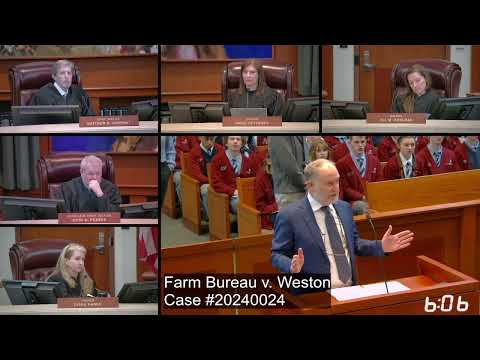
At oral argument before the Utah Supreme Court, Troy Buer, counsel for Farmers Insurance Exchange, urged the justices not to adopt the so-called Illinois rule for insurer liability for failing to defend. “If the court does not adopt the Illinois rule ... there's no reason to reach the duty to defend issue,” Buer told the court, arguing that the case’s factual record would leave the duty-to-defend question unnecessary to resolve.
Buer told the court that the unique posture of the record — including a prior partial summary judgment that removed tort liability and a trial record that limited damages — meant the court could avoid deciding the duty-to-defend question if it declined to adopt Illinois’s approach. “If indemnification goes away and there's no responsibility for the judgment and no emotional distress damages from causation ... you're left with a contingent fee with a judgment of 0,” he said, explaining why the court might not need to reach the duty-to-defend issue.
Why it matters: The question before the justices is whether Utah should follow jurisdictions that impose enhanced liability on insurers that refuse to defend (the Illinois approach) or continue aligning with what Buer characterized as the majority rule. Under the Illinois line of cases, an insurer that wrongfully declines to defend can be liable for the entire underlying judgment in some circumstances; under the majority rule described by Farmers’ counsel, an insurer’s exposure can be limited where the insurer had a reasonable basis to decline defense.
Arguments and authorities: Buer cited the court’s existing case law (citing McCarthy, Amica and Beck as analogues) and a Court of Appeals opinion that, he said, is inconsistent with Utah precedent. He emphasized a version of the Illinois rule that some courts limit to situations where an insurer “breached without reasonable basis,” an articulation he said would not apply here because the trial court found Farmers acted reasonably and tort claims had been eliminated earlier in the litigation.
Opposing counsel pressed the court on whether adopting the Illinois rule would alter whether the court must reach the duty-to-defend question. Justices queried both sides about the policy tradeoffs: one justice asked whether adopting Illinois would incentivize insurers to seek early declaratory relief instead of refusing defense and taking a “gamble” on coverage, a point Buer answered by warning that forcing insurers to defend where coverage is genuinely disputed could require insurers to spend insureds’ premiums defending people who are not insured.
Context and background: Counsel discussed how different formulations of the Illinois rule and Restatement drafts vary across jurisdictions, with some courts applying a heightened “unreasonable refusal” element before imposing the full-liability consequences associated with that rule. Buer argued that Utah’s precedent already functions consistently with the majority approach and that the court should clarify the law rather than embrace a broad Illinois-style rule.
Next steps: The court heard back-and-forth questioning on how adopting either rule would affect remedies and whether a decision could be cabined to the facts in this case. The justices took argument under advisement.