Get Full Government Meeting Transcripts, Videos, & Alerts Forever!
Get email alerts on the Green Ammonia topic
No spam. Unsubscribe anytime.
Committee hears bill to fund registry and rebates for locally produced green ammonia
Summary
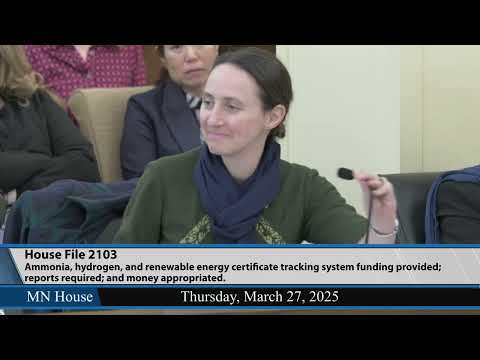
Representative Paul Anderson introduced House File 2,103, the “Minnesota Made Ammonia Act,” at the Minnesota House Committee on Energy Finance and Policy hearing March 25, 2025.
Representative Paul Anderson introduced House File 2,103, the “Minnesota Made Ammonia Act,” at the Minnesota House Committee on Energy Finance and Policy hearing March 25, 2025. Anderson asked the committee to adopt a DE1 amendment and to consider a one-time appropriation to develop software and a registry to verify ammonia produced using renewable electricity.
Anderson said the bill would allow Minnesota farmers “to choose green fertilizer as a way to reduce their carbon intensity scores,” and described the measure as a catalyst for growing local green ammonia production and related industries such as green steel. He said the amendment, beginning at line 12, would provide a rebate to Minnesota companies using the proposed registry, up to $500,000 per company as the amendment currently reads.
Rob Davis, chief growth officer at the Midwest Renewable Energy Tracking System (MRETS), testified in favor of the bill and described how a registry would function. “This registry for ammonia certificates produced by local distributed ammonia facilities will act in a similar fashion to MRETS’ existing registry for renewable energy certificates or RECs,” he said. Davis told the committee the organization would use appropriated funds to hire software developers, engineers and business analysts to create the registry and to issue and track “ammonia certificates.”
Davis pointed to academic and industry work that has explored localized ammonia production, saying decentralized production is promising in places with high transportation costs. He said a Minnesota-based nonprofit technology organization could scale a proven University of Minnesota–Morris pilot and match ammonia production to renewable generation across the region.
Rachel Stuckey, executive director of the Minnesota Conservative Energy Forum, also supported the bill. She told the committee the registry and the proposed rebate would improve market transparency and attract private capital to Minnesota, benefiting agriculture, mining and other industries by reducing dependence on imported fertilizer.
Committee members asked clarifying questions about who would receive the rebate and how it would be applied. Davis said the rebate would be credited as the registered entity incurs fees on the MRETS-style platform rather than issued as a single one-time check. Representative Kraft and others raised whether the language read like a single $500,000 award; Anderson and Davis said the intent of the amendment was to credit multiple Minnesota entities and that the total available rebates would be limited by the appropriation. Anderson also said the amendment could allow up to $9,000,000 in total rebates if appropriations permitted.
A member of the public, retired chemist Dale Lutz, testified in support and described prior Department of Energy work on electrolysis and green feedstocks. Lutz said he supports local production of ammonia to reduce greenhouse gas emissions from traditional ammonia production methods.
Procedural action: Representative Anderson moved the DE1 amendment; the amendment was approved by voice vote. House File 2,103 as amended was laid over by the committee for possible further consideration.
The bill would appropriate money to develop a software registry and provide rebates to Minnesota businesses that register and retire ammonia certificates through the registry. Questions remain in language and implementation details: committee members requested clearer statutory language on the rebate distribution and reporting requirements, and Davis said Commerce-style reporting would include all ammonia certificates issued in Minnesota, whether to Minnesota or out-of-state entities.
Supporters framed the bill as an economic and climate opportunity for farmers and for industrial users of ammonia; supporters pointed to potential markets for ammonia certificates including sustainable aviation fuel and industrial uses. The committee did not take a final vote on the underlying appropriation; the measure was laid over for further consideration.