Get Full Government Meeting Transcripts, Videos, & Alerts Forever!
Get email alerts on the Mpca Budget topic
No spam. Unsubscribe anytime.
MPCA outlines budget priorities, permits backlog, SAF and e‑waste stewardship to committee
Summary
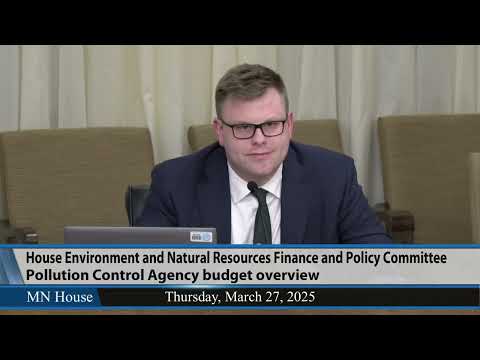
The Minnesota Pollution Control Agency on March 25 presented the governor's budget recommendations to the Environment and Natural Resources Finance and Policy Committee, centering on an operating adjustment for negotiated salary increases and inflation, a permitting efficiency package, regulatory support for sustainable aviation fuel projects and a proposed statewide electronics and battery product stewardship program.
The Minnesota Pollution Control Agency on March 25 presented the governor's budget recommendations to the Environment and Natural Resources Finance and Policy Committee, centering on an operating adjustment for negotiated salary increases and inflation, a permitting efficiency package, regulatory support for sustainable aviation fuel projects and a proposed statewide electronics and battery product stewardship program.
The agency described the package as rooted in “our mission to protect and improve the environment and human health,” Commissioner Katrina Kessler said in online remarks introducing the presentation. Tom Johnson, MPCA government relations director, led the committee briefing on the proposals.
The agency told lawmakers the operating adjustment is intended to fund routine work including prevention, permitting, remediation and scientific analysis. Johnson described the permitting package as a mix of budget and policy proposals that would add six temporary positions targeted at backlogged permits, an ombudsperson study and pilot for modernizing processes, a modest credentialing idea for consultants and a limited citation authority to address chronic non‑responses from applicants or consultants.
On sustainable aviation fuel (SAF), the MPCA said Minnesota has agricultural feedstocks, existing biofuel refinery infrastructure and transportation links that make the state attractive for SAF production. The agency requested four permitting FTEs plus an environmental review position and a permitting liaison to support potential facilities. Assistant Commissioner Frank Kolasch said the MPCA will follow the tax‑credit definition of SAF — a fuel pathway that achieves at least a 50% reduction in carbon intensity relative to conventional aviation fuel — and the state will assess the full production chain and feedstock impacts.
The agency included a revenue‑neutral electronics and battery stewardship proposal to reduce landfill fire and toxicity risks from embedded batteries, recover critical minerals and move implementation to fiscal 2027. For mercury‑containing skin‑lightening products, MPCA said enforcement and testing will expand despite those products already being illegal in Minnesota.
Lawmakers pressed the agency on monitoring and enforcement. Representative Zack Stephenson and Representative Mike Freiberg and others asked about five air toxics monitors funded in 2024; Assistant Commissioner Kolasch said leases are signed or nearly complete for sites in Northern Iron, North Minneapolis, Rochester, Newport and St. Paul’s Frogtown Park and that most monitors should be operational by summer 2025. The MPCA also described a mobile monitoring trailer for rapid deployment.
Committee members raised environmental‑justice concerns in light of recent federal enforcement actions at Smith Foundry and Northern Iron. Kessler said the MPCA has hired additional permitting and inspection staff for environmental justice communities, is working with EPA to coordinate inspections and is publishing data — including a continuous particulate monitor in East Phillips — to improve transparency and responsiveness.
Other MPCA proposals noted to the committee included a two‑FTE plan to reduce the backlog of high‑priority Superfund site assessments, cost‑recovery authority to recoup agency contractor costs for certain spills, an adjustment to revolving loan statute language and opening a statutory appropriation beginning FY2026 from the Closed Landfill Investment Fund for long‑term care of closed landfills.
"This allows us to do routine work that Minnesotans expect of us," Johnson said of the operating adjustment. Committee members said they expect more follow up and asked for additional detail on awarded, encumbered and expended grant funds that the MPCA provided in a late committee email.
The committee did not take final legislative action on the MPCA presentation itself but moved on to the day's agenda of bills after extended questioning of MPCA leadership. The full presentation and agency follow‑ups were referenced throughout the hearing, and lawmakers signaled continued attention to permitting efficiency, monitoring expansion and environmental justice concerns.
Outlook: The MPCA said several of the budget items require appropriation and statutory changes; the permitting package and SAF provisions were presented as part of the governor's recommendations and will require separate legislative action to implement.