Get Full Government Meeting Transcripts, Videos, & Alerts Forever!
Get email alerts on the Civic Engagement topic
No spam. Unsubscribe anytime.
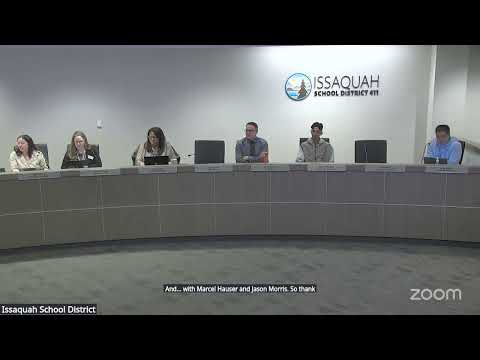
School board accepts monitoring report on civic engagement; students and staff call for stronger high‑school social‑emotional supports
Summary
Board accepted the Results 3 (civic engagement) monitoring report. Presenters highlighted positive student civic activities and progress on digital citizenship while students and community members urged improved high‑school social‑emotional learning and clearer reporting pathways for bullying and safety concerns.
The Issaquah School District Board voted to accept the district—s Results 3 monitoring report on civic engagement after staff and student representatives presented program highlights and survey results.
The report described student participation in civic activities, curricular adoptions in social studies, digital citizenship work and sustainability initiatives across the district. District staff said more than 80 percent of students earned a B or better in social studies courses used as part of the monitoring evidence and outlined ongoing social studies adoptions aimed at making materials more culturally relevant.
Presenters identified social‑emotional learning (SEL) at the high school level as an area that requires sustained attention; student feedback cited a need for high‑school SEL lessons that are authentic and student‑centered rather than canned or perfunctory. Doctor Bailey (district staff) said the high‑school SEL committee is developing approaches aligned with Washington K‑12 standards and responsive to student feedback.
Students who participated in the district—s Day on the Hill reported that meeting legislators reinforced their sense of civic efficacy and highlighted the role of student voice in advocacy. Student Krish said the experience "was overall really positive" and that meeting with legislators underscored how their stories register with lawmakers.
Public commenter Chinmay Nagar Nagarkar raised questions about district policy on artificial intelligence (AI) use for instruction and the proportion of the general fund used for administrative overhead, urging the district to experiment with tools that could reduce administrative load and redirect savings to instruction. Nagar Nagarkar said he wanted to understand whether an AI policy exists for using AI to support teachers and personalized learning.
Board members asked follow‑up questions about survey design, participation rates (noting difficulty getting seniors to respond in some years) and confidentiality of anonymous reporting tools. Several board members acknowledged the Healthy Youth Survey is administered anonymously and said the district would continue outreach to improve student participation and trust in reporting pathways. The board accepted the monitoring report by voice vote.