Get Full Government Meeting Transcripts, Videos, & Alerts Forever!
Get email alerts on the Solar Disclosure topic
No spam. Unsubscribe anytime.
CSLB weighs role in implementing PUC-approved solar disclosure; takes no immediate action
Summary
The board discussed a Public Utilities Commission-mandated solar energy system disclosure document required for investor-owned-utility customers and agreed to take no immediate enforcement action while staff continues discussions with stakeholders.
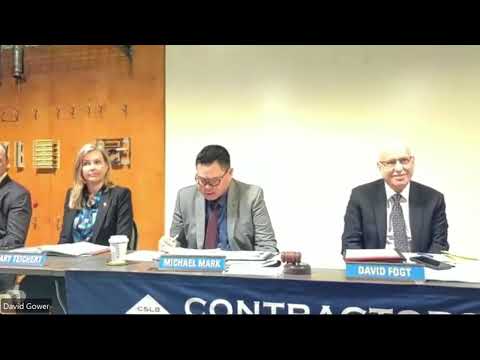
At its March 14 meeting, the Contractors State License Board (CSLB) reviewed a new solar-energy-system disclosure document approved by the California Public Utilities Commission (PUC) and discussed whether CSLB should enforce or verify that contractors provide the PUC form to customers.
Why it matters: the PUC-established disclosure standard is intended to give customers standardized cost, savings and financing information for residential solar installations; the CSLB must decide whether to incorporate the form into contractor oversight and complaint investigations.
The board packet identified the item as the solar energy system disclosure document “pursuant to Subdivision C, Business and Professions Code section 7169.” Staff reported the PUC had approved the standardized disclosure and that the PUC will require the document be provided to investor-owned utility customers; staff said the PUC’s requirement goes into effect November 1.
Staff outlined the document’s contents as including total estimated cost, estimated maintenance, estimated savings and financing information and said the PUC also set standardized inputs and assumptions for expected savings. Staff and counsel noted several minor wording changes from an earlier December draft and said trade groups had submitted additional comments for staff review.
Board members raised two central questions: whether CSLB should require contractors to present the PUC disclosure and whether CSLB should verify, during complaint investigations, that the disclosure was provided. One board member asked whether the disclosure could cause consumers to focus on price rather than contract terms; counsel noted industry concerns that financing terms might change after the disclosure is provided.
Legal counsel John Ken summarized the board’s practical options: take no action, support the PUC-mandated disclosure while staff continues working with stakeholders, or oppose requiring CSLB enforcement. After discussion staff recommended taking no action at this time and returning with more information; the board accepted that approach and directed staff to continue discussions with the solar industry and the trade group that had sent comments.
Staff and counsel said that, separate from the PUC disclosure, existing statute-language addresses payment and work-completion protections; staff noted where statutory language requires protections such as not accepting certain progress payments, and suggested changes could be pursued with the PUC if the board identified consumer-protection gaps.
No motion to adopt enforcement changes was made; the board’s near-term decision was to take no regulatory action and to seek further information before the next meeting.
Votes at a glance: no formal vote was taken on the disclosure; the board reached consensus to have staff continue engagement and return with proposed next steps at a future meeting.