Get Full Government Meeting Transcripts, Videos, & Alerts Forever!
Get email alerts on the Environmental Review Iws topic
No spam. Unsubscribe anytime.
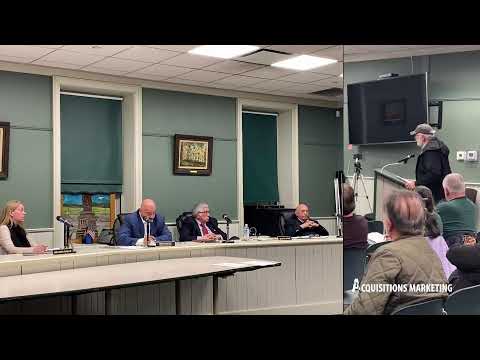
Goshen board finds potential environmental impacts for proposed IWS facility, requires EIS scoping
Summary
The Town of Goshen adopted an amended Full Environmental Assessment Form (EAF) Part 2 and issued a positive declaration for the proposed IWS facility, sending the project into the scoping stage for an environmental impact statement amid concerns over stormwater, groundwater contamination and human health.
The Town of Goshen Town Board on March 20 adopted a revised EAF Part 2 for the proposed IWS (industrial waste/similar) facility and issued a positive declaration, sending the project into the State Environmental Quality Review Act (SEQRA) scoping process.
The action follows a detailed presentation by John, the applicant’s project consultant, and comments from the town’s Environmental Review Board (ERB). John told the board, “So I prepared for you an FEAF part 2 that is based on the FEAF part 1.” The board voted to assume lead agency, adopt the FEAF Part 2 as modified and adopt a positive declaration directing the applicant to prepare a draft environmental impact statement (EIS).
Why it matters: the board’s determination moves the application from preliminary review to a formal environmental review that will require the applicant to produce an EIS. That will trigger public scoping and additional studies on topics the ERB raised, including stormwater management, potential contamination or leachate migration, impacts to groundwater, and risks to human health.
Board and ERB members flagged multiple possible impacts. As summarized by the consultant, the ERB recommended checking “yes” on land impacts (erosion and vegetation removal) and surface-water impacts (stormwater discharge and turbidity), and suggested additional attention to whether excavation would exceed 1,000 tons. On groundwater, the ERB recommended noting the potential to introduce contaminants. The consultant recommended addressing leachate removal and possible aquifer contamination under the EIS scoping.
ERB representative Neil said the board should consider gas migration risks from an adjacent landfill, noting uncertainty but recommending further investigation: “The ERB is really not sure what that is. It's gonna be an impact.” The board discussed treating some answers as “potential small impacts” and asking the applicant to scope further study or propose mitigation where appropriate (for example, test borings or monitoring wells to check for gas migration).
Transportation and public safety concerns were also raised. The ERB and planning board minutes flagged the Hartley Road–Route 17 intersection as a location that should be examined in traffic studies to determine whether changes to lane geometry, stop lines or turn accommodation are needed. The board asked that accident history and truck turning radii be included in the scoping.
Human-health impacts were elevated by the consultant from “small” to potentially “moderate to large” for some items based on DEC guidance; those items will be treated as significant in the scoping. The consultant said the DEC’s guidance requires stronger scrutiny when human health is potentially affected.
Next steps: with the positive declaration adopted, the town will circulate the determination, hold a public scoping session and publish the draft scope the board and ERB recommend. The town code sets a 180-day clock for action on the application from the date it was deemed complete (February 12), so the board emphasized timeliness. The consultant said the ERB aims to provide a draft scope by the ERB’s next meeting, and that the town expects to hold a public scoping session in April.
Quotes from the meeting are taken from the board’s March 20 transcript.