Get Full Government Meeting Transcripts, Videos, & Alerts Forever!
Get email alerts on the Land Development Setbacks topic
No spam. Unsubscribe anytime.
Planning commission forwards Title 19 amendment to create 105-foot arterial setback, citing trail preservation
Summary
The Saratoga Springs Planning Commission voted unanimously March 27 to forward a city-initiated amendment to Title 19 of the Land Development Code that establishes minimum setbacks along arterial roads and adds a definition for roadway centerline to protect existing trail corridors.
At its March 27, 2025 meeting the Saratoga Springs Planning Commission voted unanimously to forward a recommendation for approval of a city-initiated amendment to Title 19 of the city Land Development Code that establishes minimum setbacks along arterial roadways and adds a definition for roadway centerline.
Planner Stout, who introduced the amendment, said the proposal would require a 105-foot setback measured from the arterial roadway centerline or, if applicable, 15 feet from the back of a 30-foot trail corridor, whichever is greater. "So it's a hundred and 5 feet off the arterial roadway center line, or if applicable 15 feet from back of the 30 foot trail corridor whichever is greater," Planner Stout said. The package also moves the minimum front corner side setback from 10 feet to 15 feet and adds a definition for "centerline roadway" as the "horizontal center alignment of the currently accepted roadway construction drawings."
The change is city-initiated at the request of the City Council and is intended to preserve trail corridors and allow room for future roadway widening without buildings encroaching on new right-of-way. City staff described the practical effect as modest: staff said the amendment would typically move a building footprint about five feet farther from the road than current practice. "Our understanding ... is that this will ultimately result in about 5 additional feet of setback from where buildings would typically be built now," a staff member said, explaining the adjustment is intended to preserve the trail corridor if an arterial is widened.
Commissioners asked for clarification on how the new measurement works and on the geographic scope of the change. Planner Stout explained the 105-foot measure is taken from a building footprint to the roadway centerline shown on plats or accepted roadway construction drawings, and that the amendment primarily affects two existing arterials in the city today: Redwood and Mountain View. Planner Stout said the city already requires a 30-foot trail corridor along roads and that the new setback language formalizes additional buffer space for arterials in limited circumstances.
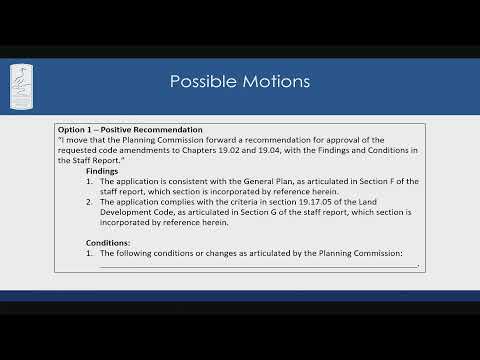
Commissioner Wheldon said he was concerned about the potential impact on existing property owners and asked what the norm would be. Staff replied that, because the city already preserves the 30-foot trail corridor, the amendment is largely a wording change that will push future building footprints only slightly farther back in the affected locations. Commissioner Miles supported the provision as a way to avoid later eminent-domain acquisitions for road expansion. Commissioner Hill moved the planning commission forward a recommendation for approval; the motion passed unanimously.
The amendment as presented will next go to the City Council for final action. The staff report and the commission's recommendation include two findings; the commission recorded no conditions attached to its recommendation.