Get Full Government Meeting Transcripts, Videos, & Alerts Forever!
Get email alerts on the Law Enforcement Training topic
No spam. Unsubscribe anytime.
Committee hears bill to allow accredited college-run law enforcement academies
Summary
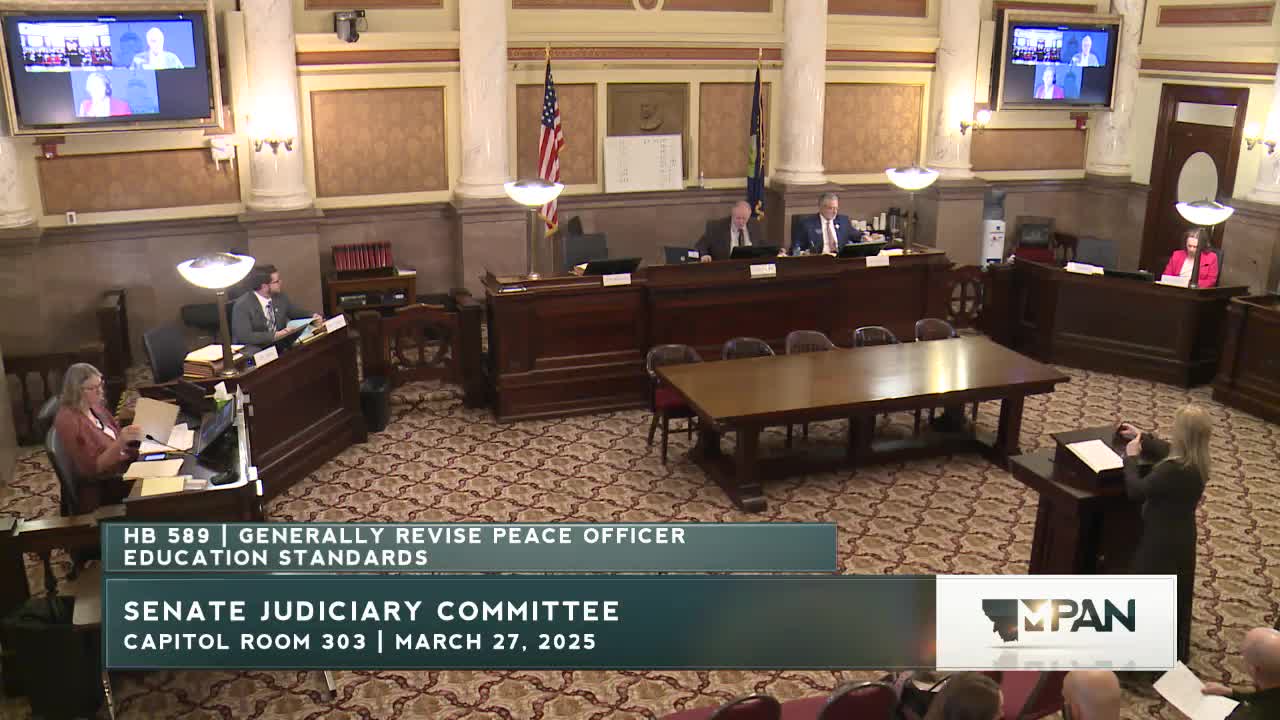
Representative Jane Gillette introduced House Bill 589 to allow accredited Montana colleges and universities to run law-enforcement pre‑service training programs that meet the Montana Law Enforcement Academy’s standards and that are approved by the POST council and hiring agencies.
Representative Jane Gillette introduced House Bill 589, which would allow accredited Montana colleges and universities to administer law enforcement academy courses that are commensurate with existing Montana Law Enforcement Academy (MLEA) standards and approved by the POST council and the employing state or local law enforcement agency.
Supporters from law enforcement and education said HB 589 would expand training capacity and help recruitment. Timothy Allred, director of the POST council, told the committee the council supports the bill and appreciated language allowing POST to adopt administrative rules to ensure national standards and consistency. Cascade County Sheriff Jesse Slaughter, who also chairs the POST council, described the college-based option as “innovative” and beneficial for recruiting pre-service candidates. Gallatin College Dean Stephanie Gray and other college representatives described a draft program already prepared at Gallatin College and said it would provide 27 credits over a summer semester in some drafts.
Proponents emphasized safeguards in the draft: curriculum must be approved by the POST council and a Montana-accredited college or university must administer the program. Nanette Gilbertson of the Montana Sheriffs and Peace Officers Association said her organization supported the bill after extensive stakeholder negotiations and specifically welcomed language preventing for-profit or out-of-state entities from administering Montana training.
During questioning, senators asked how college-based training would compare to the existing Montana Law Enforcement Academy’s 512-hour program and whether graduates would be eligible for immediate sworn status. Timothy Allred and other witnesses said the college curriculum would have to be commensurate with MLEA standards, subject-matter experts from hiring agencies would review course content, and a graduate would still need to work for a local law enforcement agency and meet hiring requirements; the college program would not automatically create sworn officers without agency employment and completion of the required service period.
Representative Gillette closed by saying the bill was not a criticism of MLEA, which she called “remarkable,” but a response to population growth and recruitment needs in large areas such as Billings. The hearing record included law-enforcement associations, county sheriffs and college personnel supporting the bill; no opponents signed on during the hearing.
The committee left the bill with the record open for work on rule language and other technical matters.