Get Full Government Meeting Transcripts, Videos, & Alerts Forever!
Get email alerts on the Work Plan 2026 topic
No spam. Unsubscribe anytime.
Minnetonka sustainability commissioners seek edits to draft 2026 work plan after review of 2025 outreach gains
Summary
The City of Minnetonka Sustainability Commission discussed a draft 2026 work plan on Sept. 16 and gave staff direction to revise targets and add items including more reuse swaps, business outreach and tours; staff will return with a revised plan for formal recommendation in November.
The City of Minnetonka Sustainability Commission on Sept. 16 reviewed a draft 2026 work plan and asked staff to revise targets, flesh out proposed subcommittees for events and to return with a final recommendation in November.
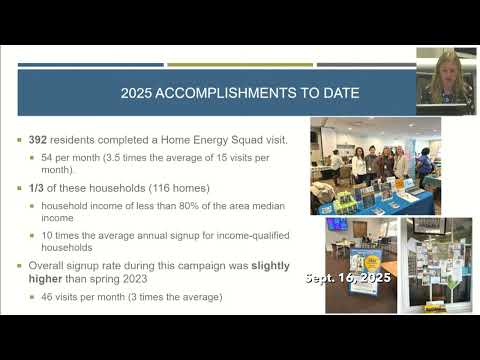
The commission’s staff presentation highlighted 2025 outreach and program results, notably a Home Energy Squad campaign that generated 392 sign-ups between October 2024 and June 2025. City staff said the campaign was funded in part by a Minnesota Pollution Control Agency grant that covered about two-thirds of the cost; the city covered roughly one-third. Staff told commissioners about outreach at farmers markets, a clothing reuse swap that diverted 875 pounds of clothing through a community swap, the Sustainable Minnetonka awards program, and an Everything Electric exhibit attended by an estimated 6,000 festival visitors where volunteers reported speaking to about 400 people directly.
Commissioners offered a mix of edits and additions to the draft plan. Several supported creating small planning subcommittees to coordinate the Everything Electric exhibit and reuse swaps, and multiple commissioners recommended drawing on past Sustainable Minnetonka award winners as volunteer ambassadors and interview subjects. Commissioners also supported a goal of holding at least two on-site educational tours in 2026 and asked staff to make targets clearer and to map overlapping actions so the commission can track progress.
Allie Sutherland, a city staff presenter, summarized the draft plan’s four categories of duties — advising the city council, serving as an ambassador to the public, cultivating community relationships and reporting progress — and said the plan’s actions were tied to the Climate Action and Adaptation Plan and the city’s strategic priorities. Sutherland said staff would "collect the feedback, draft some changes, and bring this back in November for a final discussion and recommendation for city council approval."
On specifics, commissioners asked staff to ensure regular CAP implementation updates (Sutherland proposed January and June), to include emissions-trend information in those updates, and to formalize SMART (specific, measurable, achievable, relevant, time-bound) targets for each action. Commissioners recommended promoting the next Everything Electric exhibit at the city open house and staffing exhibit stations with commissioners or volunteers who can give short activities or quiz-style interactions for visitors. Commissioners also suggested expanding the Sustainable Minnetonka awards web page to include profiles or interviews with past winners so those winners can act as local ambassadors.
Staff outlined proposed 2026 actions that include: twice-yearly CAP implementation updates; continued support for the Sustainable Minnetonka awards (targeting at least four residents and four businesses to receive special recognition); at least two on-site tours; residential education tables (farmer’s market and city open-house events) with a target of reaching at least 300 residents; at least one renewable-energy education event for residents (target: 20 attendees); business outreach (a proposed "business blitz" leveraging partners such as the Center for Energy and Environment and Xcel Energy); and creation of small subcommittees to coordinate the Everything Electric exhibit and reuse swap.
Commissioners used an interactive Mentimeter polling tool during the meeting to rank priorities. Staff recorded several suggestions submitted by commissioners and attendees, including proposals to: host two reuse swaps in 2026, create a neighborhood sustainability champion or resident-academy program modeled on neighboring cities, and explore modest financial incentives for residential energy-efficiency work now that some federal programs are changing.
Staff said it will follow up on several requests: checking the availability of partner organizations (for example the one-stop efficiency teams), expanding the awards web page to host winner profiles, and pulling historical research and any prior work on organized collection of trash for future discussion. The draft plan will be revised based on the commission’s feedback and returned to the commission in November for a final recommendation to city council.
Votes at a glance: The meeting recorded two formal, routine motions: approval of the evening’s agenda (motion passed by voice vote; no recorded roll call vote) and a motion to adjourn (moved by Michael; seconded by Alan; unanimous "aye").