Get Full Government Meeting Transcripts, Videos, & Alerts Forever!
Get email alerts on the Utilities Water topic
No spam. Unsubscribe anytime.
Council hears update on St. Paul Regional Water Services code rewrite; public hearings laid over to March 12
Summary
Council members received a staff presentation on a package of updates to the St. Paul Regional Water Services code — roughly 200 edits including language cleanup, technology updates and a restructured fee schedule — and closed public hearings on multiple related ordinances, laying final adoption over to March 12.
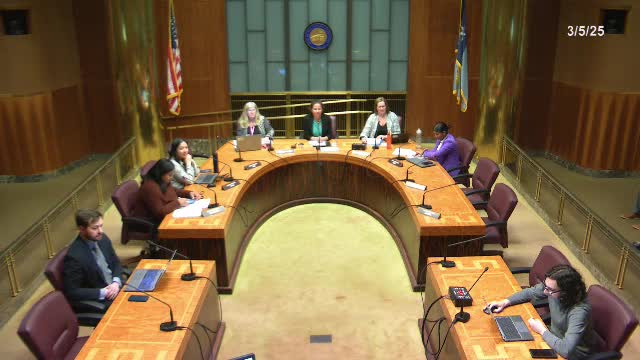
Saint Paul City Council members on March 5 heard a staff presentation on an extensive rewrite of the St. Paul Regional Water Services code and closed a series of public hearings, laying final adoption of multiple ordinances over to March 12.
Staff told the council the package contains roughly 200 code changes across many chapters of the water code. The changes fall into three broad groups: language cleanup (removing industry‑specific or outdated terms), updates to reflect current technology and operations, and moving discrete charges out of the code into a separate, annually updated fee schedule. A staff speaker said the fee schedule shift will allow the city to update charges through the budget process rather than amending the code every time a technical fee must change.
The council opened and immediately closed public hearings for a set of ordinances including Ordinance 25‑6 (chapter 85, water rates), 25‑7 (chapter 87, water service connections), 25‑8 (chapter 88, water meters), 25‑9 (chapter 89, fire supplies), 25‑10 (chapter 90, fire hydrants), 25‑11 (chapter 91, miscellaneous water provisions), 25‑12 (chapter 92, plumbing), 25‑13 (chapter 93, water service connections), 25‑14 (chapter 94, interior work), 25‑15 (chapter 96, connection of air conditioning equipment to city water) and 25‑16 (chapter 97, well drillers). In each case, councilmembers said there were no members of the public present to testify on those items.
Councilmember Yang, who serves as one of the council’s representatives to the Board of Water Commissioners, praised staff for consolidating the work and called the proposed edits “important” for modernizing operations and accelerating lead‑service replacement work. A staff presenter said the revisions had already been reviewed and supported by the Board of Water Commissioners.
Because staff were still finalizing related materials, the council laid each ordinance over to March 12 for final adoption; the public hearings were closed with unanimous procedural votes.
Council members said they welcomed the code cleanup and the move to a transparent annual fee schedule but reserved detailed questions for the March 12 session when staff will be available to answer technical questions and the council will consider final adoption.