Get Full Government Meeting Transcripts, Videos, & Alerts Forever!
Get email alerts on the Climate Action Plan topic
No spam. Unsubscribe anytime.
Council reviews draft climate action plan with 55% emissions reduction goal by 2035
Summary
City staff and consultant Pale Blue Dot presented a draft climate action plan that sets interim targets (55% community-wide emissions reduction by 2035), 100% renewable electricity for municipal buildings by 2035, and long-term net-zero by 2050; council feedback will be incorporated before final adoption in mid-April.
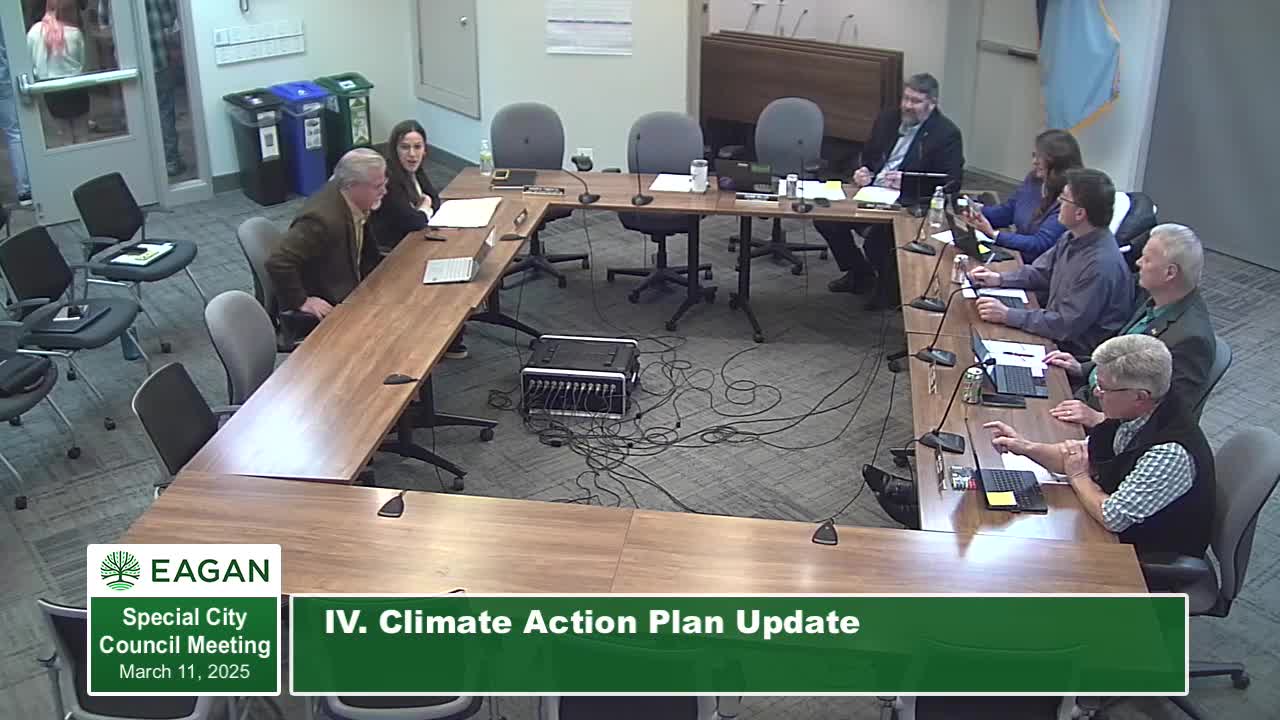
Eagan staff and consultants presented a draft 10-year climate action plan to the City Council on March 11 that blends mitigation and adaptation strategies and sets measurable interim goals.
Director Andrew Pimentel introduced the presentation and said the planning process ran about 14 months with robust community engagement. Jillian (staff) and consultant Ted Redmond of Pale Blue Dot summarized the plan's structure: eight sectors (transportation and land use; buildings and energy; waste management; water/wastewater; food and agriculture; green space and ecosystems; health and safety; and economy) with 24 strategies and 244 supporting actions intended for phased implementation over 10 years.
Ted Redmond said the plan's three headline goals are a 55% community-wide greenhouse gas emissions reduction by 2035 (relative to the baseline year used in the plan), 100% renewable electricity for municipal buildings by 2035, and community net-zero emissions by 2050. The presentation included modeling that projects reducing community emissions to roughly 567,000 metric tons by 2035 if the plan is fully implemented and if certain "business-as-usual" statewide changes proceed as expected.
Consultants said engagement included about 1,000 participants across surveys and meetings. Staff plans to incorporate council and public feedback, present a final draft to the Sustainability and Energy Advisory Committee (SEAC) on April 8, and seek council adoption at the April 15 regular meeting. Staff also noted implementation planning is already underway, with a proposed public-facing dashboard and a phased two-year implementation cadence.
Council members asked implementation questions: how the plan dovetails with other city plans, how often the plan will be revisited (staff proposed two-year implementation phases with greenhouse-gas inventory updates and potential 5-year reviews if needed), and whether actions requiring partners (county, MVTA/MBTA transit, utilities) were common (staff estimated fewer than 20% of actions will require heavy external partnership). Council also asked about data sources used to estimate costs and savings; consultants said the plan draws on national and state studies and databases (AAA, Kelley Blue Book for vehicle economics; IEA/DOE and building efficiency studies for energy estimates) and includes cited sources in Appendix B.
No formal council vote was requested on March 11. Staff will incorporate comments and return a final plan to SEAC and then to the council for adoption in April.