Get Full Government Meeting Transcripts, Videos, & Alerts Forever!
Get email alerts on the Land Use Development topic
No spam. Unsubscribe anytime.
St. Paul council delays ruling on University of St. Thomas driveway condition after lengthy hearing
Summary
After a multi-hour public hearing that divided neighbors, students and the university, the Saint Paul City Council laid over a decision on whether to require removal of a driveway linking Goodrich Avenue to the University of St. Thomas south campus. The item was rescheduled for final action on March 12.
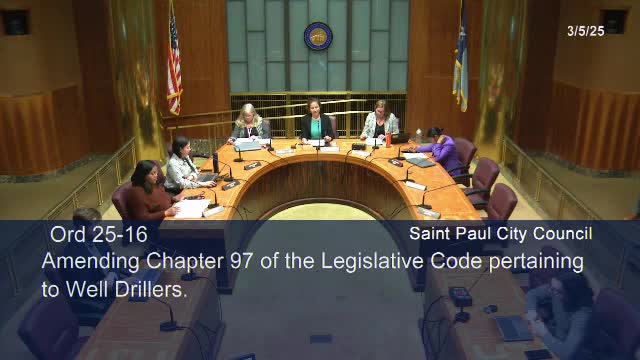
The Saint Paul City Council on March 5 laid over a decision on an appeal by the University of St. Thomas of a planning commission order that would require removal of a driveway connecting Goodrich Avenue to the university's south campus, saying it would take up the matter at its March 12 meeting.
The appeal concerns condition 16 of a 2004 conditional use permit (CUP) tied to development of St. Thomas’s south campus. The planning commission in December voted to uphold the condition, which requires removal of the Goodrich driveway when the university remodels or replaces certain buildings. The university asked the council to reverse that decision and instead adopt a modified condition recommended by the zoning committee and city staff that would allow limited, restricted use of the driveway for deliveries, maintenance and emergency vehicles — and for up to two years of interim use during arena construction.
The case drew extensive public testimony on both sides. Tamara Deem, a shareholder at Winthrop & Weinstine representing the university, told the council the planning commission “errored in two ways: the written findings are not supported by the record and the decision failed to consider the overwhelming evidence related to health and safety.” Deem asked the council to adopt the zoning committee’s recommendation preserving limited access with conditions.
Opponents, including longtime neighborhood activists and two former city councilmembers who filed written comments, urged the council to uphold the planning commission and enforce the 2004 settlement. Mark Manderscheid, who said he drafted the paragraph in 2004, told the council the condition was negotiated and agreed to by the parties then and should be enforced now.
Neighborhood groups and residents expressed public-safety and quality-of-life concerns tied to arena-related traffic and potential drop-off use of the driveway. Resident Jerome Abrams said the arena “can generate ... about 2,853 trips” and argued area streets already operate at or near capacity, a claim he attributed to traffic studies and firefighter comments. Tom Darling, president of the Summit Avenue Residential Preservation Association (SARPA), urged the council to deny the university’s appeal and to preserve the CUP as the product of a negotiated settlement.
University witnesses and students pushed back, saying the driveway provides essential emergency access and needed accessibility for residents of Grace Hall and other south-campus buildings. Jim Brummer, vice president for facilities management at the University of St. Thomas, said he studied alternate routes with the city’s fire protection engineer and that the engineer “agreed that the Goodrich Drive is the preferred route for emergency access.” Student witnesses described on-campus medical incidents and drills in which responders used the driveway to reach Grace Hall.
Planning staff and the zoning committee had recommended modifying condition 16 to restrict general public use while allowing deliveries, pickups, maintenance and emergency access; zoning committee members added an interim provision allowing existing access during arena construction for up to two years. The planning commission instead found the driveway must be removed to comply with Comprehensive Plan policy LU‑54 on institutional campus compatibility, creating the split now before council members.
Councilmember Jost moved to lay the item over one week; the motion passed 4–0. The council will take up the appeal again at its March 12 meeting.
The record assembled for the appeal includes the original 2004 conditional use permit, the planning commission’s December resolution, the zoning committee recommendation, technical reports on traffic and fire access, and written submissions from neighborhood groups and former councilmembers; council members said they will review that material before final action.