Get Full Government Meeting Transcripts, Videos, & Alerts Forever!
Get email alerts on the Hospital Pricing And Assessments topic
No spam. Unsubscribe anytime.
Senate committee advances bill to cap some hospital facility fees, redesign Medicaid assessment
Summary
The Indiana Senate Health Committee voted to advance House Bill 1004, a package that would cap certain hospital facility fees relative to Medicare, alter nonprofit reporting requirements and redesign the state hospital assessment ("the half") to a state-directed payment program; the committee moved the bill to appropriations 10-1.
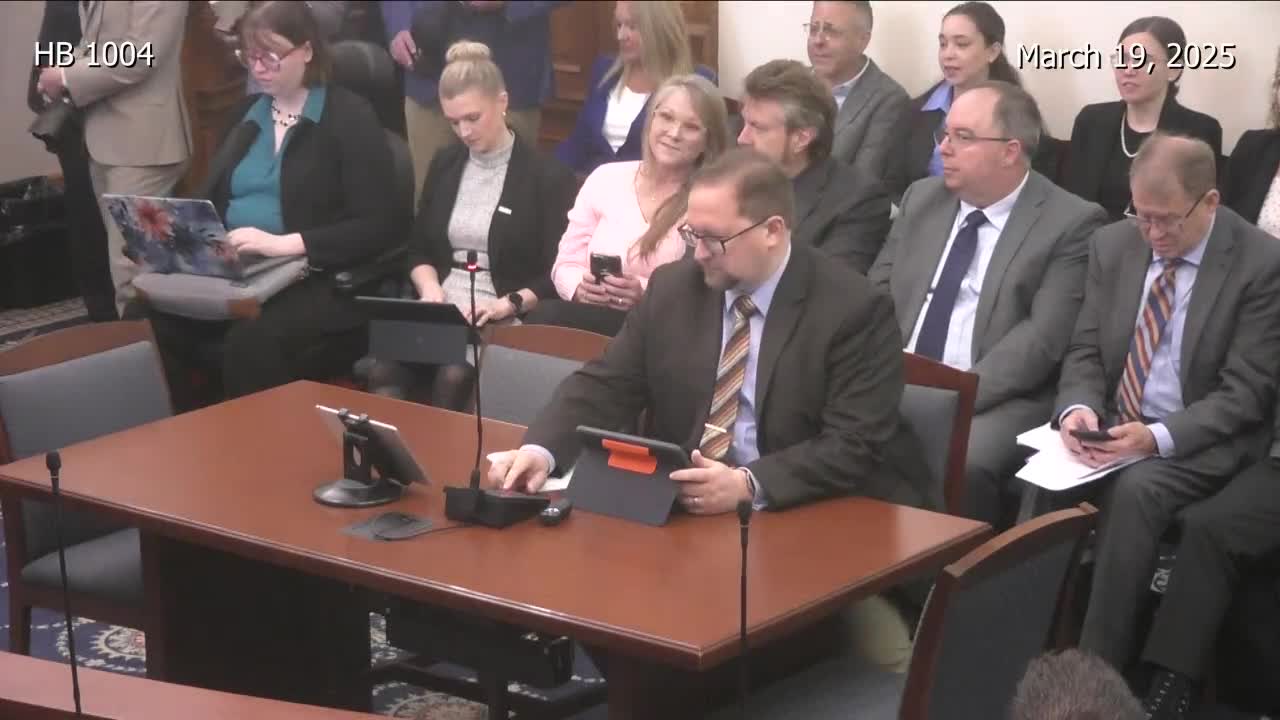
House Bill 1004, legislation from Rep. (last name) Carball aimed at lowering health care costs in Indiana, advanced from the Senate Health Committee on a 10-1 vote after several hours of testimony from hospitals, business groups, patient advocates and rural providers.
Representative Carball opened testimony saying Indiana’s hospital prices are high and described a set of measures in HB1004 intended to reduce commercial prices and increase federal Medicaid matching dollars. “According to the latest RAND study we have the ninth highest cost hospitals in the country,” the bill author said, outlining three main elements: (1) a phased cap and excise tax on facility fees above a percentage of Medicare, (2) changes to nonprofit reporting on community benefit, and (3) redesign of the hospital assessment (the “half”) and a new managed-care assessment to increase federal Medicaid matching funds.
Why it matters: supporters said the bill would constrain what they described as outsized hospital prices that increase premiums and out-of-pocket costs for employers and families. Opponents said the measure could reduce hospital revenues needed to maintain services, especially in rural areas where many hospitals already operate at a loss.
Key provisions described in testimony
- Facility-fee cap and excise tax: The bill would phase in a cap on facility fees tied to a multiplier of Medicare. Testimony specified a 265% of Medicare threshold for the facility fee with an excise tax on amounts above that level: 33% of the excess in 2026, 66% in 2027 and a 100% tax (a hard cap) in 2028 and after. Testifiers said funds collected by the excise would be distributed 75% to Medicaid and 25% earmarked for hospital workforce needs. The bill text presented to the committee also would allow the state to revoke state nonprofit status if a hospital’s total charges inclusive of all fees exceed 300% of Medicare for any service; hospitals could regain state nonprofit status after complying with the law for 90 days.
- Reporting and community benefit: HB1004 would change how hospitals report community benefit, requiring reporting beyond the Schedule H summary line on IRS filings and to make worksheet detail available to state officials.
- Redesign of the hospital assessment (“the half”): The bill would move the half to a state-directed payment model to increase Medicaid reimbursement. Agency witnesses said this change is intended to draw down more federal matching dollars without additional general fund cost to the state.
Positions and concerns raised in committee
Supporters: Employers and consumer advocates urged action. David Kelleher, CEO of the Employers Forum of Indiana, and Matt Bell of Hoosiers for Affordable Healthcare said high hospital prices harm employers and workers and argued a ceiling would bring prices closer to peer states. Families USA testified that consolidation has led to higher prices and that caps tied to Medicare are an evidence-based tool to reduce commercial prices.
Hospitals and rural providers: Hospital leaders and rural health associations urged caution. Michael Shroyer, president of Baptist Health Floyd, and Randy Cristoforl, CEO of Goshen Health, described sizable losses at some hospitals, heavy Medicaid and Medicare payer mixes, and the role of the half in their finances. Shroyer said his hospital lost $22 million in the most recent fiscal year even with rising volumes and cautioned that excise taxes and nonprofit-status penalties could force closures or service cuts, including obstetrics. Goshen Health estimated a possible $10.6 million revenue loss under the proposed 265% payment cap and said the nonprofit-status provision could create operational chaos if a provider transiently exceeded a single listed charge.
Rural hospitals and mental-health providers also raised concerns that the cap or excise tax could unintentionally shift revenue shortfalls onto low-volume, high-cost services or threaten vital local services; the Indiana Rural Health Association said the half redesign was essential but that other bill provisions create risks for small hospitals.
Operational and data points offered to the committee
- Testimony referenced RAND hospital price studies and Medicare cost reports showing variation across hospital types and high private payer margins in some Indiana hospitals; panelists disagreed on interpretation and completeness of those measures. Witnesses emphasized that published charge masters differ from actual reimbursements negotiated with insurers.
- The bill sponsor and administration staff said the half redesign and a proposed managed-care assessment are intended to increase Medicaid payments to hospitals through federal match; witnesses compared Indiana to Kentucky’s state-directed payment model and cited differences in administrative fee rates.
Committee action and next steps
After extended debate, the Senate Health Committee voted to advance HB1004 to the Appropriations Committee with a recommit to appropriations; the committee reported the bill “passed 10 to 1 with a recommit to appropriations.” Several senators explained they supported moving the bill now to continue negotiations and amendments in appropriations and on the floor. Some members explicitly reserved the right to change their support pending further amendments.
Votes at a glance
- Committee action: Motion to move HB1004 to Appropriations with recommit — outcome: passed 10–1. The transcript records multiple senators saying “aye” and Senator Brown announcing a “hard passionate no.” The committee chair recorded the motion as carried.
What remains unresolved
Committee members and witnesses repeatedly said the bill is a work in progress: the sponsor said he expected changes and more stakeholder meetings before final law. Key open questions flagged in testimony include how excise tax revenue would be used in practice, how the nonprofit-status provision would interact with federal tax law, and whether employers and insurers would pass savings to consumers.
The bill will be considered next by the Senate Appropriations Committee and later on the Senate floor. Testimony and data submitted to the committee will be available in the committee record.