Get Full Government Meeting Transcripts, Videos, & Alerts Forever!
Get email alerts on the Code Revision topic
No spam. Unsubscribe anytime.
Committee clears code-revision bill to resolve technical conflicts and reorganize Indiana Code
Summary
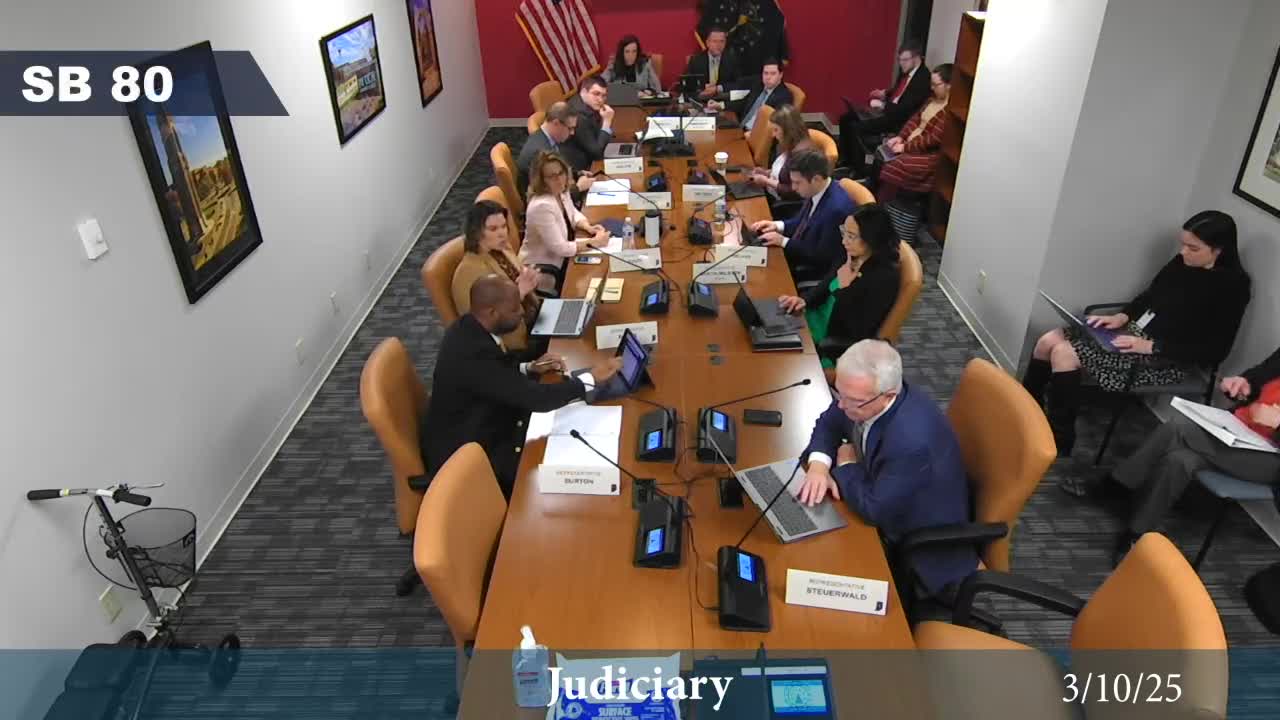
The Judiciary Committee passed Senate Bill 80, the annual code-publication bill used by the Code Revision Commission and Office of Code Revision to resolve technical conflicts and reorganize crowded chapters of the Indiana Code. An amendment correcting a typographical word was adopted by consent.
Representative Engleman presented Senate Bill 80, describing it as the Code Revision Commission’s vehicle to resolve technical conflicts that arise during legislative sessions and to provide printing instructions to the Office of Code Revision. She said the bill "allows code revision commission, to reorganize specific crowded chapters in the Indiana code." The measure is typically considered late in session to settle technical drafting conflicts.
The committee adopted Amendment 1 by consent, which changed a single word in the bill from "priced" to "price." Representative Engleman publicly thanked Stephanie Lawyer, an attorney who assists the committee and the code revision process.
Committee members expressed support for the bill as a routine, technical measure. On a motion to pass as amended, the committee recorded the roll call that produced an 11-0 (with one member excused) result in favor during the first week's business; the chair announced the session’s adjournment afterward.
Why it matters: SB 80 is an annual, technical housekeeping bill that permits early resolution of drafting conflicts, provides printing instructions, and allows reorganization of code sections to improve clarity for future publication. The bill does not change policy substance but facilitates accurate codification of enacted measures.