Get Full Government Meeting Transcripts, Videos, & Alerts Forever!
Get email alerts on the Campaign Finance topic
No spam. Unsubscribe anytime.
Senate elections panel advances multipart campaign finance bill, strips advisory-opinion authority
Summary
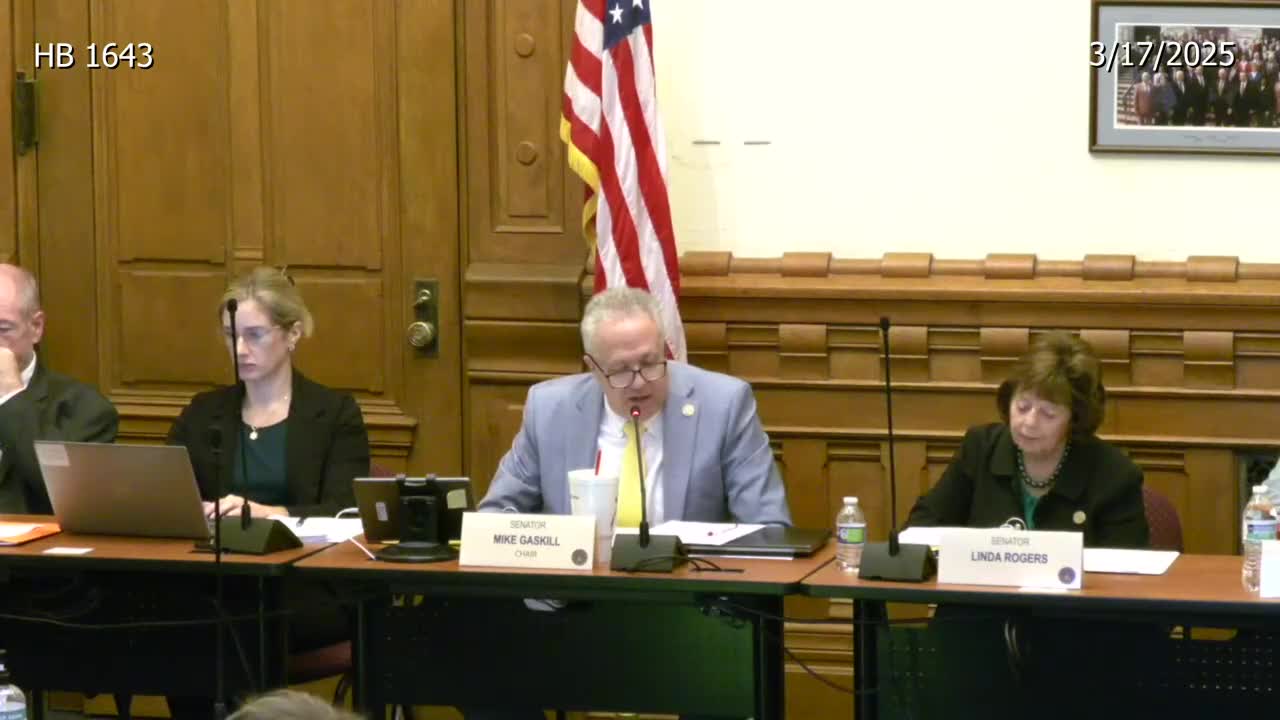
House Bill 16-43, a multipart campaign finance bill, moved forward in the Senate Elections Committee on March 17, 2025, after testimony and questions about advisory opinions, administrative capacity and local impacts.
House Bill 16-43, a multipart campaign finance bill, moved forward in the Senate Elections Committee on March 17, 2025, after testimony and questions about advisory opinions, administrative capacity and local impacts. The committee approved the bill and will recommit it to the appropriations committee; the committee vote was 6-2.
The bill, introduced to the committee by Representative Kyle Pierce, would create a state-funded online campaign finance portal for local filings, expand the ways election-related deadlines may be communicated (including email), raise certain limits for auxiliary political organizations with inflation adjustments, clarify the legal definition of contributions, codify rules for paid political advertising and void advisory opinions previously issued by the Indiana Election Commission before a specified date in the bill. Pierce said the measure "has the creation of a new local government online campaign finance portal" and also "repeals and nullifies advisory opinions for the Indiana election commission," while noting amendments on procurement and management of the portal. Representative Kyle Pierce, author of the bill, also described an amendment ensuring the system be state funded, bid with a public hearing and not paid for by local governments.
Supporters told the committee the bill increases transparency and moves local filings into a searchable online system. Keegan Prentice, representing the Secretary of State's office, said the bill would make local campaign finance reports more accessible across counties and supported clarifying auxiliary committee thresholds and the definition of "contribution." Prentice noted the Secretary of State's office is pursuing a separate capital request for a new campaign finance system in conjunction with the statewide voter registration system.
Election division officials raised concerns about implementation. Angie Nussmeier, Democratic co-director of the Indiana Election Division, said she was "neutral" on the bill but warned that implementing a statewide campaign finance website for 92 counties would be "a very big lift" and questioned rolling the system into the statewide voter registration system because "state law is very clear that the commission manages campaign finance filings." Nussmeier said stripping the bipartisan Indiana Election Commission of authority to issue advisory opinions was a substantive change and opposed Section 3 of the bill that removes that commission's ability to issue advisory opinions, characterizing advisory opinions as a nonbinding guidance tool used by candidates and committees to avoid enforcement hearings.
Brad King, Republican co-director of the election division, testified in favor of the bill and emphasized that the General Assembly is the primary policy maker for election law. He said some advisory opinions contained a caveat directing matters to the General Assembly and that the commission had grown reluctant to issue opinions that could be seen as encroaching on legislative prerogatives.
Committee members asked about practical effects. Senator Ford questioned the removal of advisory opinions and whether candidates would be left without pre-enforcement guidance; Pierce said candidates could still ask the election division for advice and proceed, but that enforcement questions would be resolved by the division or commission if challenged. Pierce and witnesses also discussed a high-profile advisory opinion about whether campaign funds can be used for childcare or eldercare; Pierce said he believed the commission "chose far too narrowly" and that codifying policy in statute was appropriate.
On funding and procurement, Prentice said the election division manages the current campaign finance system and that the secretary's office hopes to roll work into broader systems where appropriate, but that the election division would have final say on the campaign finance system and any procurement tied to it. Nussmeier repeated objections about authority and about training counties for rollout, saying the bill as drafted could miss some committees (she flagged regular party committees) and that training 92 counties before the municipal election cycle would be challenging.
Action: the committee held a roll call and approved the measure, then held the vote open for an absent senator; after the senator returned and voted, the final committee result was 6 in favor and 2 opposed. The transcript records Senator Schmidt, Senator Johnson, Senator Rogers, Senator Walker, Senator Good and Chair Gaskell voting yes; Senator Ford and Senator Spencer were recorded as voting no or nay. The committee chair noted the bill will need to be recommitted to appropriations.
The committee hearing included repeated requests that implementation details—procurement language, public hearings for the vendor selection, training plans for counties and the bill's interaction with the statewide voter registration system—be clarified on second reading. Democratic election-division testimony focused on preserving the commission's role in issuing advisory opinions as a source of nonbinding guidance to candidates; bill proponents countered that policy choices should rest with the legislature.
Next steps: the bill will be recommitted to the Senate appropriations committee for consideration of fiscal impact and funding for the proposed portal and related implementation costs.