Get Full Government Meeting Transcripts, Videos, & Alerts Forever!
Get email alerts on the Mobile Food License topic
No spam. Unsubscribe anytime.
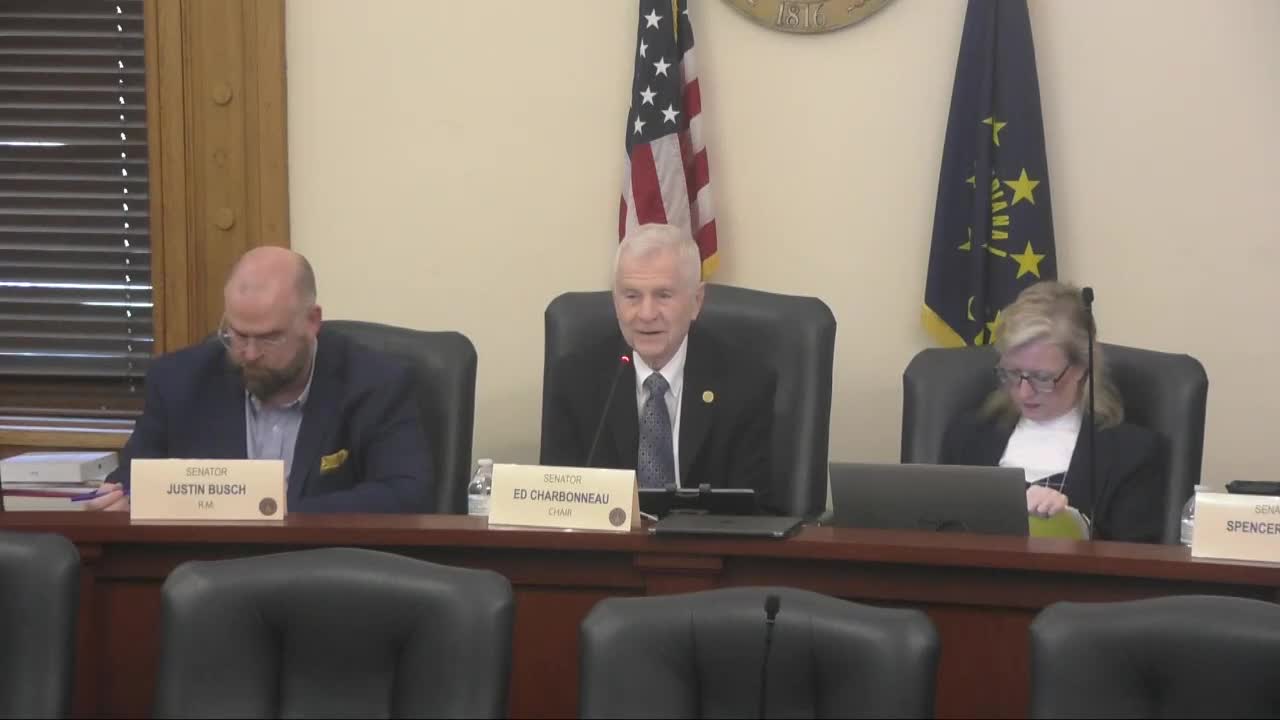
Senate committee weighs statewide mobile food license as local health officials warn of enforcement and funding gaps
Summary
House Bill 1577 would create a statewide mobile retail food license and an online portal run through the Indiana Department of Health, sponsor Representative King told the Senate Public Health Committee, seeking to streamline permitting for food trucks that now must comply with 92 county permitting systems.
House Bill 1577 would create a statewide mobile retail food license and an online portal run through the Indiana Department of Health, sponsor Representative King told the Senate Public Health Committee, seeking to streamline permitting for food trucks that now must comply with 92 county permitting systems.
The bill "requires the IDOH to establish a statewide mobile retail food license, to create a portal and to establish licensure, inspection and operation standards of mobile food trucks," Representative King said, adding the start date was moved to Jan. 1, 2027 to give IDOH time to build the portal and assemble a work group that includes representatives from each congressional district.
Supporters said the portal would reduce administrative burden and increase public safety by making inspection histories and violations visible across counties. "Violations that a food truck received, they do not travel across county lines," said Abby Rabin of the Indiana Restaurant & Lodging Association. "This will create that database, that portal where local health departments can go online and see the history of these food trucks, and really create that safer environment for the public." Graham Renbarger, legislative director for Americans for Prosperity, said a single license would lower startup costs for vendors operating across county lines and spur small-business growth.
Local public health officials urged caution. Brian Williams of the Putnam County Health Department said the bill, as written, creates uncertainty about where permit fees and fine revenue would go and could reduce local enforcement authority. "If permit fees are diverted to the state, local departments will lose critical funding used to fund those inspections, provide education efforts to those local businesses, as well as enforcement efforts," Williams said. He also said the bill does not make clear whether local health departments retain authority to issue fines or whether the state will do inspections.
During a question-and-answer exchange, Senator Brown pressed Williams on operational impacts. Williams said Putnam inspects about 300 mobile units but that staffing constraints and the possibility of being required to perform inspections whenever a truck enters the county raised serious capacity concerns. "If I'm gonna be required to do two inspections on each of those mobile units every year, we physically can't do it," Williams said. He added he would accept another county's inspection results if it were a uniform, trustworthy standard, but that the bill lacks clarity on who performs and is accountable for inspections and how often.
Representative King said the bill does not change state food-safety requirements such as time-and-temperature controls and that the portal is intended to mirror robust local systems like Marion County's. She asked the committee to support a statewide license to reduce duplicative local fees and improve transparency.
After testimony, the committee moved to recommit the bill to the Appropriations Committee. The roll call recorded 12 ayes, 0 nays; the chair announced the motion as "12 to 0 with a recommit to appropriations."