Get Full Government Meeting Transcripts, Videos, & Alerts Forever!
Get email alerts on the Transparency Contract Accountability topic
No spam. Unsubscribe anytime.
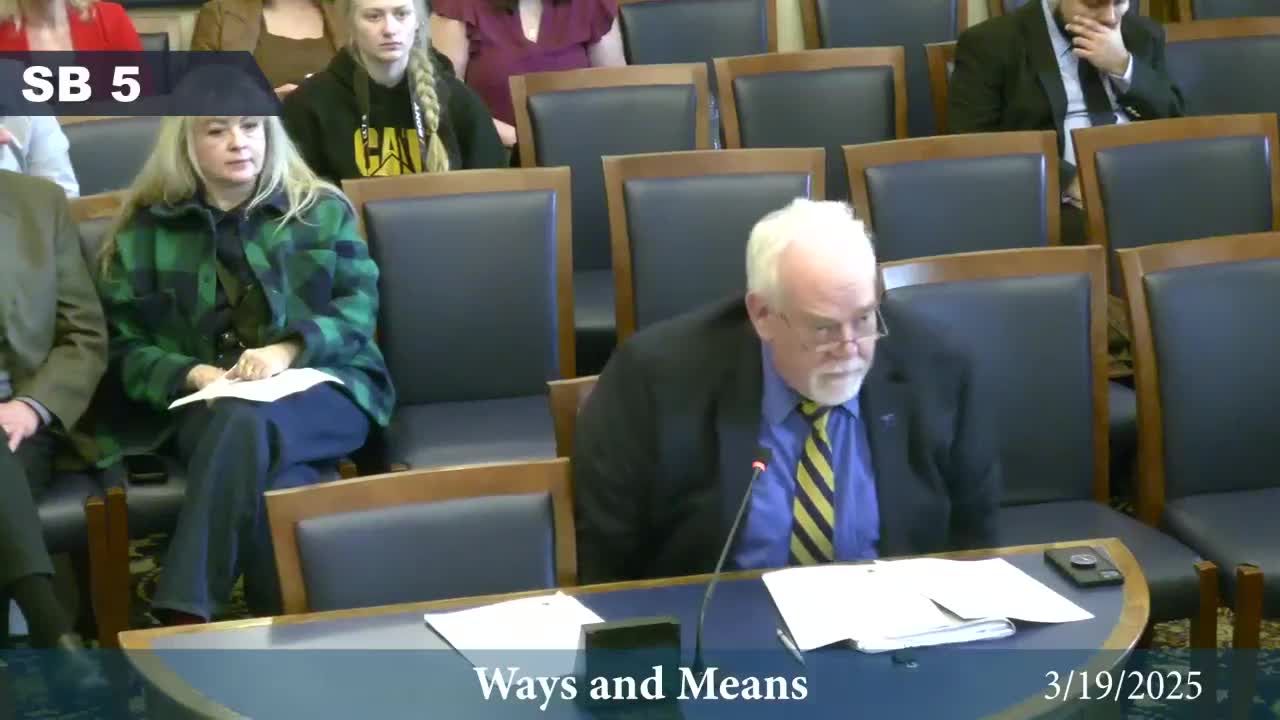
Committee hears House sponsor’s planned changes to Senate Bill 5 on contract accountability and federal funds reporting
Summary
Representative Layman summarized a narrowed amendment to Senate Bill 5, emphasizing quarterly reporting of new federal funds to the budget agency and narrower contract‑accountability changes.
Representative Layman, the House sponsor, told the House Ways and Means Committee he intends to present an amendment that pares down Senate Bill 5, focusing on a narrower set of transparency and contract-accountability changes rather than the broader approach the Senate advanced.
Layman said the amendment will require state agencies that seek new federal funds to report those requests to the budget agency on a quarterly basis, rather than be subject to a statutory “review” process. “The genesis behind this and the reason behind it is we just don't always know who's going out and capturing federal dollars,” Layman said, describing the proposal as a check to improve legislative visibility into newly captured federal programs.
The amendment, as Layman described it, would also: (1) keep a provision allowing the budget director to reclassify positions left open more than 90 days; (2) remove a statutorily mandated contractor-disqualification regime that the sponsor said can be handled administratively; (3) exclude contracts subject to non‑disclosure agreements from immediate public posting until the agreements are executed; (4) add carve-outs for linear INDOT projects (flagged at a $500,000 threshold) from contract-posting and mandatory-term requirements; (5) change automatic reversion of unspent appropriations from 60 to 90 days so state reversions track federal timing; and (6) scale back requirements for entities that receive state appropriations by removing political subdivisions, nonprofit organizations and state educational institutions from some reporting obligations.
Committee members asked whether elected statewide officials remain covered. Representative Delaney asked whether “state elected officials are not among the people whose requirements are being deleted” and Layman replied they would remain covered. Several members asked when the amendment text would be available; the chair said the practice is to post amendments by 5 p.m. the day before consideration, and Layman said he expects to present the amendment at a future meeting and answered members’ policy questions in advance.
Members raised additional concerns during Q&A. Representatives pressed whether the bill would void existing no‑bid contracts; Layman said the amendment does not attempt to void existing contracts and that, at most, it would require competitive bidding when contracts expire or when new obligations are incurred that meet the amendment’s thresholds. Representative Pryor asked whether the federal‑funds reporting rule would affect existing federal programs and waivers such as Medicaid; Layman said the intent is to target “new federal funds” or programs in which the state is not currently participating, not longstanding programs like Medicaid. Layman also said language on Medicaid reporting would strike creation of a separate steering committee and instead ask existing entities to perform monthly review and public posting duties already listed in the bill.
Layman emphasized the amendment is intended to remove statutory mandates where administrative practice is sufficient and to create narrower transparency measures to surface inconsistencies in contracting and federal‑fund capture. He told the committee he is open to additional tweaks when the amendment is formally offered. The committee took no final action and held the bill for possible further action next week.