Get Full Government Meeting Transcripts, Videos, & Alerts Forever!
Get email alerts on the Beach Recovery topic
No spam. Unsubscribe anytime.
Charlotte County outlines phased reopening for Englewood Beach, seeks FEMA reimbursement for larger repairs
Summary
County staff presented a two-phase plan to reopen portions of Englewood Beach after storm surge damage, with an immediate, limited reopening funded by county dollars and a longer, FEMA-bid phase to recover major infrastructure at an estimated county cost of $323,000 plus recurring port-a-let and signage costs.
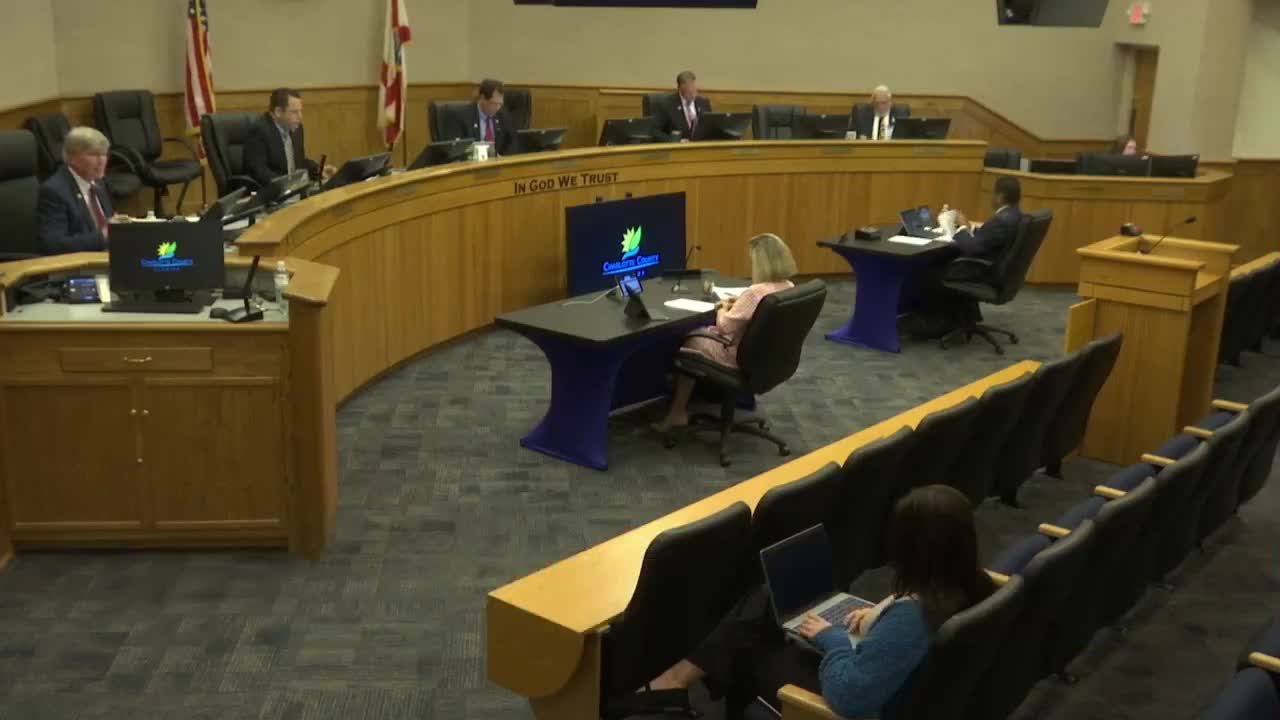
Tommy Scott, Charlotte County community services director, told the Board of County Commissioners on March 11 that county crews have cleared large volumes of sand and stabilized parts of Englewood Beach but substantial damage remains to boardwalk sections, sidewalk slabs, lighting and parking infrastructure.
Scott said staff proposes a two-phase approach. Option 1 would quickly open the southern portion of the beach parking (about 20–25 spaces) and provide access via a relocated fence, temporary parking bumpers, environmental fencing and wind screening, porta-potties and signage. Scott estimated about $10,000 in near-term county costs and an ongoing $4,000-per-month expense for replacing signage and servicing portable restrooms. He estimated the vendor-dependent work could be completed in roughly four weeks.
Option 2 would be a longer, FEMA-focused approach that bids out larger repairs with FEMA-compliant contract language so the county can seek federal reimbursement. That phase would remove damaged boardwalk sections, install full-length environmental fencing and screening, replace parking bumpers and sidewalks, resurface asphalt driving areas and stage additional portable restrooms. Scott said the county’s share of Option 2 work would be about $323,000, with an implementation timeline of roughly 5–6 months (about 180 days) to complete bidding, mobilization and work, and that FEMA reimbursements would be sought on the backend.
Scott noted some costs—such as environmental fencing—are expected to be covered by the county’s property-in-the-open insurance coverage, while other costs would be paid up front by county funds and, where possible, rebid to include FEMA recoverable language. He cautioned that vendor availability, particularly for fencing installers, poses a scheduling risk.
To address limited parking, Scott said county transit (Heidi Maddox and team) will pilot a park-and-ride circulator from Tringale Park to Chadwick Park and the beach. The proposed transit pilot would run Monday–Saturday from about 10 a.m. to 4 p.m., with buses every half hour and a planned drop-off/pickup at Chadwick; Scott said Chadwick has about 50 spaces across the street and the southern beach area about 20–25 spaces. The transit pilot is intended to reduce parking pressure while phased reopening proceeds.
Board members voiced broad support for pursuing both phases concurrently: implementing Option 1 quickly to allow some beach access while preparing the FEMA-bid Option 2 for larger repairs. Multiple commissioners praised public works and recovery staff for cleanup and recovery efforts and asked administration to return with details needed to move forward. Commissioners also asked staff to explore establishing a temporary hurricane recovery coordinator role to centralize recovery project management and accelerate FEMA closeout work; County Administrator Hector Flores said staff would develop a job description and bring it back for board consideration.
Scott and risk management confirmed the playground and remaining damaged boardwalk will remain closed until fully repaired and staged work areas will be secured. Scott said site lighting will be a long-term project and will not be restored immediately.
The board expressed consensus to proceed with the phased plan and for staff to advance the FEMA-bid procurement for the larger repairs; commissioners said they wanted formal follow-up items returned for appropriation or action as needed.
Ending: Commissioners thanked staff for the work to date and asked for continued updates. Scott cautioned that vendor scheduling and FEMA procurement timelines are the biggest sources of implementation risk and reiterated that Option 1 is intended to restore some safe public access within weeks while Option 2 addresses the larger rebuild with the aim of recouping costs through FEMA.