Get Full Government Meeting Transcripts, Videos, & Alerts Forever!
Get email alerts on the Clean Energy Tariff topic
No spam. Unsubscribe anytime.
Public Utilities Commission approves NV Energy clean transition tariff with timing clarifications
Summary
The Public Utilities Commission of Nevada unanimously accepted an all-issues stipulation and approved a clean transition tariff (CTT) filed by Nevada Power Company and Sierra Pacific Power Company, operating as NV Energy, adding language to clarify filing/timing and pausing new CTT applications pending an IRP filing.
At a meeting of the Public Utilities Commission of Nevada held in Carson City and Las Vegas, commissioners voted unanimously to accept an all-issues stipulation and issue an order approving a clean transition tariff (CTT) proposed by Nevada Power Company and Sierra Pacific Power Company, both doing business as NV Energy.
The commission’s action covers advice letter filings to implement tariff schedule CTT, a mechanism intended to allow eligible customers to receive bundled electric service for new clean energy resources. Commissioners said they added on-the-record edits to the draft order to clarify when the commission’s findings take effect and to avoid accepting additional CTT applications before a framework is filed in an Integrated Resource Plan (IRP) or IRP amendment.
Commissioners said the CTT touches rate-allocation and cost-allocation questions that affect both existing ratepayers and potential large customers. Commissioner Cordova cautioned that technical and economic disagreements remain and said the stipulation defers some contested details to future dockets. "Very smart people do disagree about spreading costs and the devil's in the details," Commissioner Cordova said, adding that resolving the tariff framework before adjudicating individual energy supply agreements (ESAs) would provide clarity to large customers.
A member of the public in Las Vegas, Tony Simmons, commented on parties to the docket and on public access to historic commission materials. "I noticed that there was not a petition to enter a petition for leave to intervene submitted by the Shareholders Association. So it appears they are not part of the party that is proceeding," Simmons said during the initial public comment period. Simmons later urged the commission to restore an accessible docket index for older files on the agency website to ease public research.
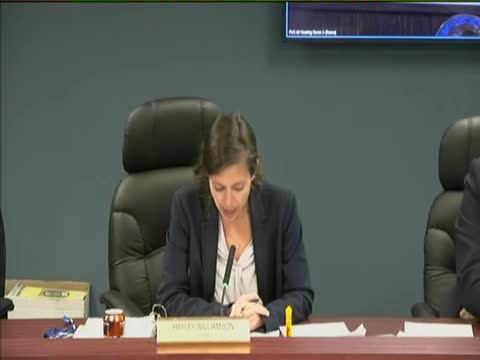
On the record, Chair Haley Williamson said she proposed and incorporated several edits to paragraph 6 of the commission’s findings and corresponding compliance language. The edits include changing the word "approved" to "filed" in one recitation, and adding language that the commission’s directive would be "effective upon issuance of this order." The commission also added text to make clear that, "upon issuance of this order," the commission would not accept additional applications under the CTT until the framework and model are filed in an IRP amendment or full IRP.
Commissioners noted three pending ESAs that rely on the tariff: one pending before Commissioner Cordova, one pending before Commissioner Brown, and one pending before Hearing Officer Kraino. Commissioners said they expect parties in those dockets to litigate any customer-specific issues as needed. The commission did not resolve those ESAs in this meeting; instead the stipulation and the modified order establish the tariff approval and the timing rules described above.
Chair Haley Williamson moved to accept the stipulation and issue the order as modified on the record; Commissioner Brown seconded. The commission’s recorded vote was: Haley Williamson — yes; Commissioner Brown — yes; Commissioner Cordova — yes. The motion carried unanimously.
The order and the on-the-record edits incorporated at the meeting will be entered into the official docket for the matter. Commissioners did not set additional on-the-record deadlines at the meeting; parties with pending ESAs were directed to proceed under the existing dockets and to litigate any outstanding issues in those proceedings as appropriate.