Get Full Government Meeting Transcripts, Videos, & Alerts Forever!
Get email alerts on the Tenant Protections Housing Element topic
No spam. Unsubscribe anytime.
Community coalitions press Planning Commission for stronger tenant protections as rezoning moves forward
Summary
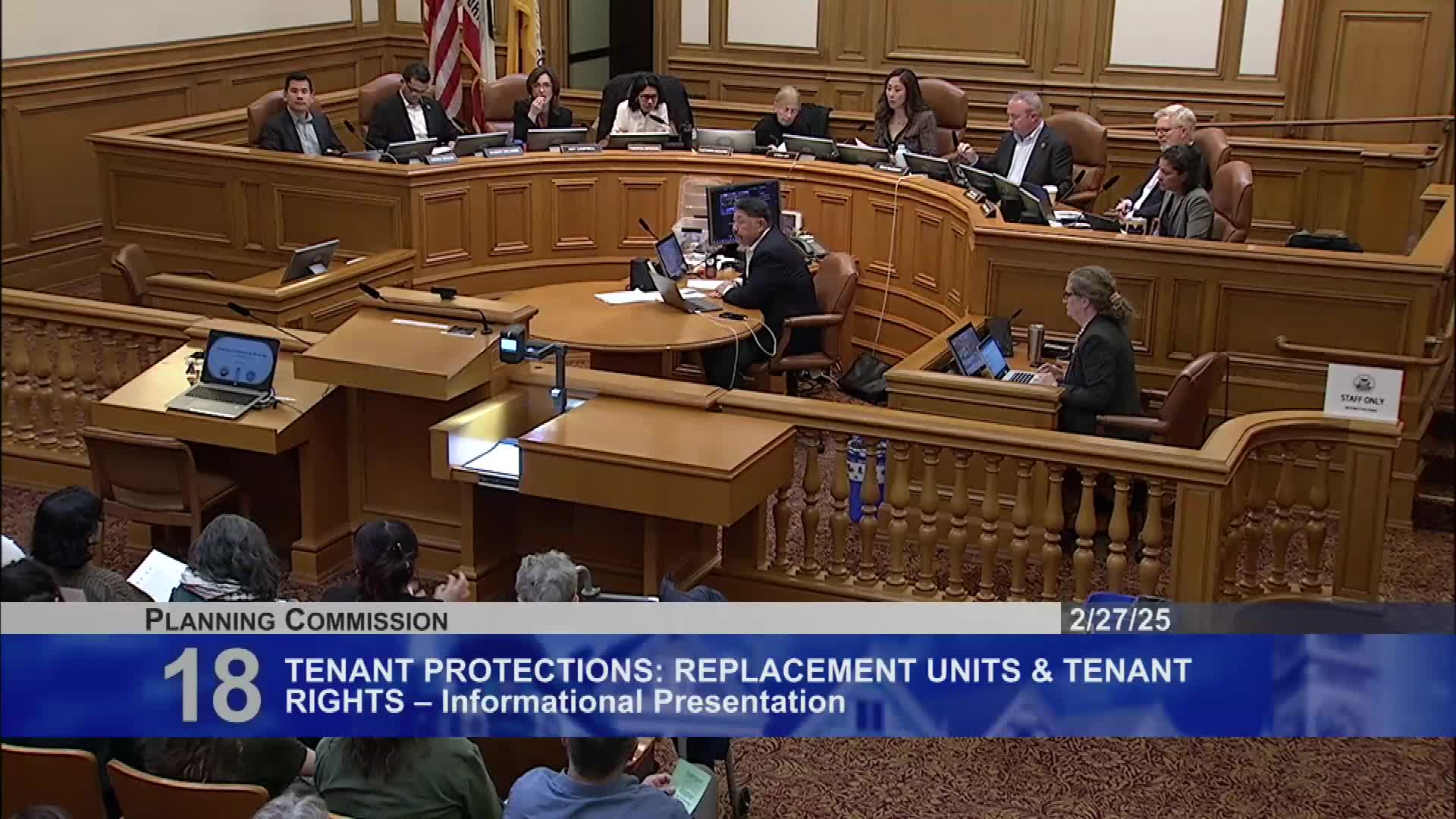
Community coalitions and Planning Department staff on Feb. 27 presented competing accounts of how the city should protect tenants as San Francisco advances a housing‑element rezoning: staff proposed a city ordinance that would codify and strengthen state protections, while tenant advocates pressed for mandatory relocation specialists, 1:1 replacement of protected units and stronger enforcement and funding.
The San Francisco Planning Commission held an informational hearing on Feb. 27 on proposed citywide tenant protections that staff are drafting to accompany the housing‑element rezoning. Community coalitions including Rep SF, the San Francisco Anti‑Displacement Coalition and the Council of Community Housing Organizations urged the commission to adopt a comprehensive package of local protections that strengthen and clarify state law (notably the Housing Crisis Act, commonly cited as SB 330) and close implementation gaps.
Community presenters said tenant displacement is already acute. Coalition data drawn from tenant‑counseling organizations showed several thousand eviction‑related calls and a much larger number of displacement threats than appear in rent‑board filings, highlighting differences in how data are recorded. Presenters argued that market incentives, state streamlining tools and capital improvements can combine to produce “renovictions” and displacement even where outright demolitions are rare.
Planning Department staff — Lisa Chen and Milena Leon Ferrera — described a proposed city ordinance that would codify key provisions of SB 330, add local enhancements, and create clearer implementation and enforcement mechanisms. Key proposed elements included:
- A codified no‑net‑loss requirement based on a five‑year lookback and site visits for demolition and permit submittals; - A binding requirement to replace “protected units” 1:1; protected units would include deed‑restricted affordable units, rent‑controlled units, units last occupied by low‑income tenants, Ellis Act units and qualifying unauthorized dwelling units where occupancy can be demonstrated; - Mandatory use of a relocation specialist for demolition and major capital‑improvement projects, with relocation plans signed by all parties and relocation benefits tied to permit issuance and temporary certificates of occupancy; - Notification and enforcement improvements, including posted notice at project sites, direct tenant notification when demolition permits are issued and tying rights and relocation payments to the building‑permit timeline; and - Increased relocation assistance (the coalition proposed extending temporary relocation assistance and compensation) and an explicit right of first refusal for low‑income tenants to return to comparable, affordable units.
Staff stressed the proposed ordinance is a work in progress and said many operational details remain to be refined in coordination with the Rent Board, Mayor’s Office of Housing and Community Development (MOHCD), and tenant‑counseling organizations. Planning staff also said their official data show relatively few demolitions: planning records show 269 units demolished from 2012–2025, about 20 units per year, and planned demolitions account for roughly 4% of no‑fault evictions over the last decade; most no‑fault evictions were attributed to owner move‑ins, capital improvements and the Ellis Act. Advocacy organizations countered that those official tallies undercount eviction‑threat events recorded by counseling networks and that many displacements occur through renovation and other pathways that do not meet the city or state definitions of demolition.
Community groups asked the commission to support a set of specific implementation items, including mandatory pre‑application site inspections, certified “as‑built” drawings in project submittals, immediate tenant tracking and earlier tenant notification, mandatory relocation specialists and stronger replacement rules that require replacement of rent‑controlled units as rent‑controlled units (rather than as other categories of affordability).
Commissioners thanked staff and community groups and asked detailed implementation questions including how unauthorized dwelling units (UDUs) would be treated, the interaction with state streamlining programs and the need for funding and staffing to support relocation specialists and enforcement.
Next steps: Planning staff said they will continue collaboration with Rep SF, the anti‑displacement coalition, MOHCD, the Rent Board and legal counsel; a refined ordinance is expected to be released for public webinar and considered for introduction alongside the rezoning this spring. Community groups urged the city to move quickly and said tenant protections should be in place before or concurrent with rezoning approvals.