Get Full Government Meeting Transcripts, Videos, & Alerts Forever!
Get email alerts on the Central Soma Commercial Requirements topic
No spam. Unsubscribe anytime.
Land Use Committee continues Central SoMa, Transit Center commercial-requirements ordinances pending amendments to preserve key-site benefits
Summary
The San Francisco Board of Supervisors Land Use and Transportation Committee continued two ordinances that would remove commercial development requirements in Central SoMa and the Transit Center District, agreeing to return March 10 with drafted amendments that would preserve previously negotiated community benefits on major "key sites."
The Land Use and Transportation Committee of the San Francisco Board of Supervisors on March 3 continued two related ordinances affecting Central SoMa and the Transit Center District to its next meeting on March 10, 2025, after sponsors and planning staff said they are finalizing amendments that would preserve previously negotiated community benefits on the city's largest development parcels.
The ordinances would remove requirements that large sites in the Central SoMa Special Use District and the Transit Center District provide a mandated portion of new floor area for nonresidential uses. Committee co-sponsor Supervisor Matt Dorsey said the change would "remove a requirement that large sites in Central SoMa and the entirety of the transit district provide 2 thirds of their square footage for nonresidential uses." He described the package as intended to "unlock more housing" on those parcels.
The committee's decision to continue followed presentations from Planning Department staff and the Office of Economic Analysis and more than a dozen public commenters representing neighborhood groups, developers, labor and affordable-housing organizations. Joshua Switzky, deputy director for citywide long-range planning in the Planning Department, reviewed the Central SoMa Plan's origins and explained that the rezoning adopted in 2018 anticipated substantial office development alongside housing. Audrey Marloney of the Planning Department said the Planning Commission recommended modifications to retain site-specific benefits and to exempt certain projects from commercial requirements only if they meet defined physical parameters and continue to provide specified community benefits tied to impact fees. As Marloney told the committee, the commission voted to approve the general plan amendments and recommended that the ordinance be modified accordingly.
Asim Khan of the Controller's Office of Economic Analysis presented the office's findings on market conditions and projected impacts. Khan said office attendance and demand remain well below pre-pandemic levels, that downtown office vacancies rose sharply to 34.3 percent in the fourth quarter of 2024, and that office values have declined by roughly 40 percent from earlier peaks. Using a forecasting model, the office estimated the ordinance could result in roughly 325 additional housing units over a 20-year horizon compared with the baseline scenario; Khan described the projected annual citywide economic impact as about $38 million in GDP and roughly 200 additional jobs on average over the forecast period.
Public commenters urged protection of the key-site commitments to affordable housing and neighborhood amenities while supporting the pivot toward housing. David Wu of Soma Filipinas said the community "appreciate[s] your recognition of the importance of these key site commitments" and urged that land dedication and other benefits be preserved. Zach Weisenberger of Young Community Developers said forthcoming amendments that "guarantee the retention of public benefits, including land dedication for a 100% affordable housing," would protect the development rights his organization holds for a key site. Representatives from developers, labor and neighborhood organizations expressed broad support for removing the commercial-floor-area mandates provided the previously negotiated community benefits remain in place.
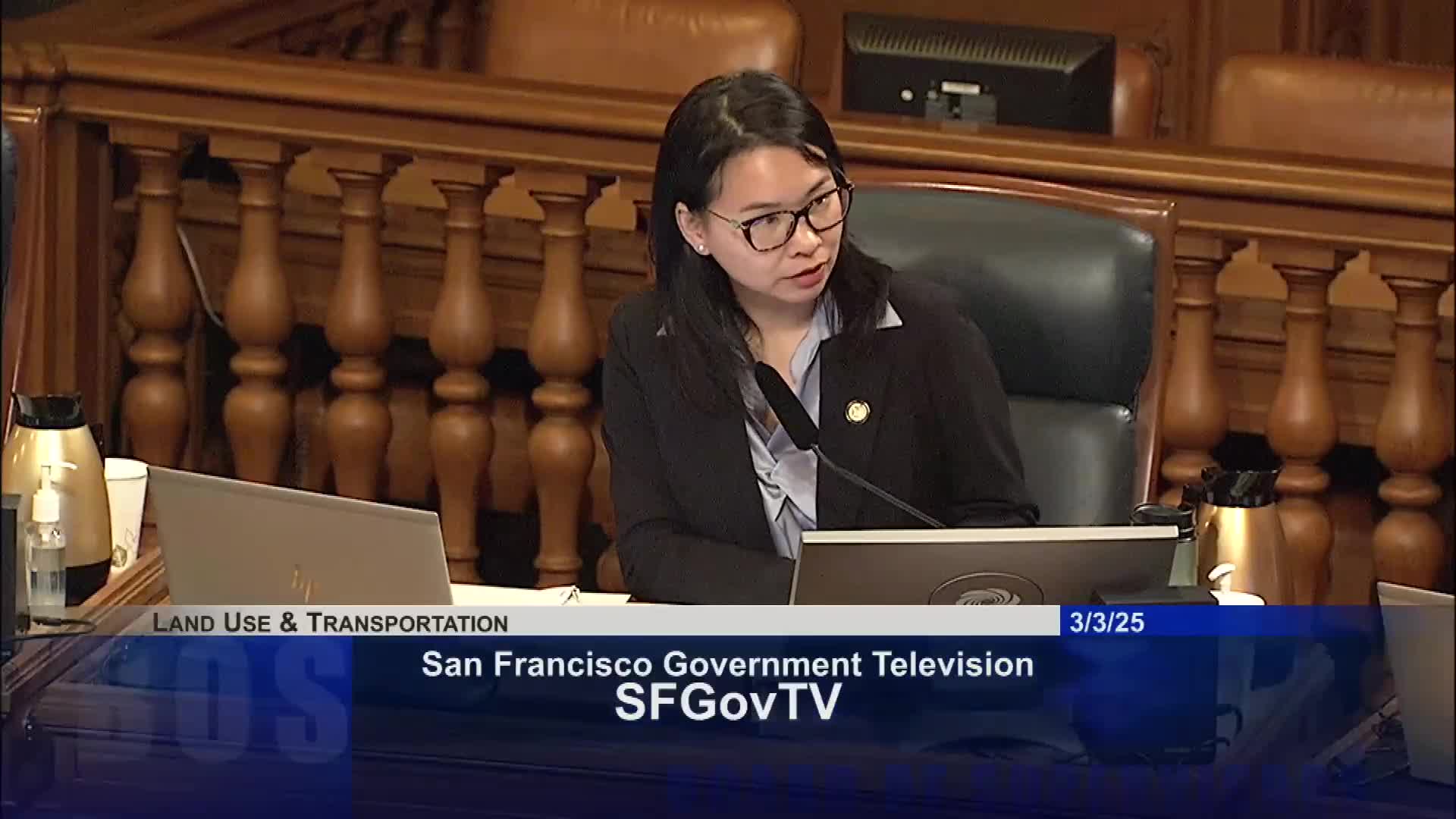
After public comment, Supervisor Dorsey moved to continue both items to the Land Use and Transportation Committee meeting on March 10, 2025, to allow sponsors, Planning staff and the City Attorney's Office to finalize the amendments. The motion passed on a roll call vote: Dorsey, Mahmood and Chair Cheyenne Chen voted yes. The committee clerk said there were three ayes and the motion to continue passed.
Votes at a glance
- Motion to continue Ordinance amending the Planning Code and zoning map to reduce commercial development requirements in the Central SoMa Special Use District and delete the Transit Center C-3-O-SD Commercial Special Use District, and Ordinance amending the General Plan to reduce commercial development requirements in the Central SoMa area plan and the Transit Center District sub-area plan: continued to March 10, 2025 (motion by Supervisor Matt Dorsey); roll call: Dorsey ' aye; Mahmood ' aye; Chen ' aye; outcome: continued.
What remains to be decided
Committee members and staff said they expect to return on March 10 with amendments that (1) limit exemptions from the nonresidential requirements to projects 600 feet in height or lower and (2) retain previously agreed site-specific benefits such as land dedication for affordable housing, additional open space, complete-streets and other public-realm improvements on the city's designated key sites. Planning staff and the City Attorney's Office are preparing the text of those amendments for the next hearing, and the committee indicated it intends to forward the item to the full Board of Supervisors once the amendments are incorporated.
Background and context
The Central SoMa Plan was developed from about 2011 through 2018 and was adopted by the Board of Supervisors in 2018. The rezoning under that plan added capacity for multiple thousand housing units and tens of thousands of jobs and established special provisions for a small number of very large "key sites" that were expected to deliver public benefits in exchange for exceptions. Sponsors and planning staff described those site-specific commitments ' including land dedication for 100 percent affordable housing on certain key sites ' as part of the public benefits package tied to the earlier rezoning. The Planning Commission acted on related general plan amendments and the ordinance at a November 7 hearing and recommended modifications now being incorporated into sponsor amendments.
The committee meeting closed after adopting the continuance. The ordinances will return to the Land Use and Transportation Committee on March 10, 2025, unless the sponsors remove or alter that schedule.