Get Full Government Meeting Transcripts, Videos, & Alerts Forever!
Get email alerts on the Public Trash Infrastructure topic
No spam. Unsubscribe anytime.
Committee holds wide‑ranging hearing on city trash‑can policy; continues item to track follow‑up
Summary
Supervisors heard detailed presentations from San Francisco Public Works and Recology about procurement, placements, service levels, sensors and a proposed $15 million one‑time use to replace cans; the committee continued the hearing to the call of the chair to allow follow‑up on pilots, funding and operational questions.
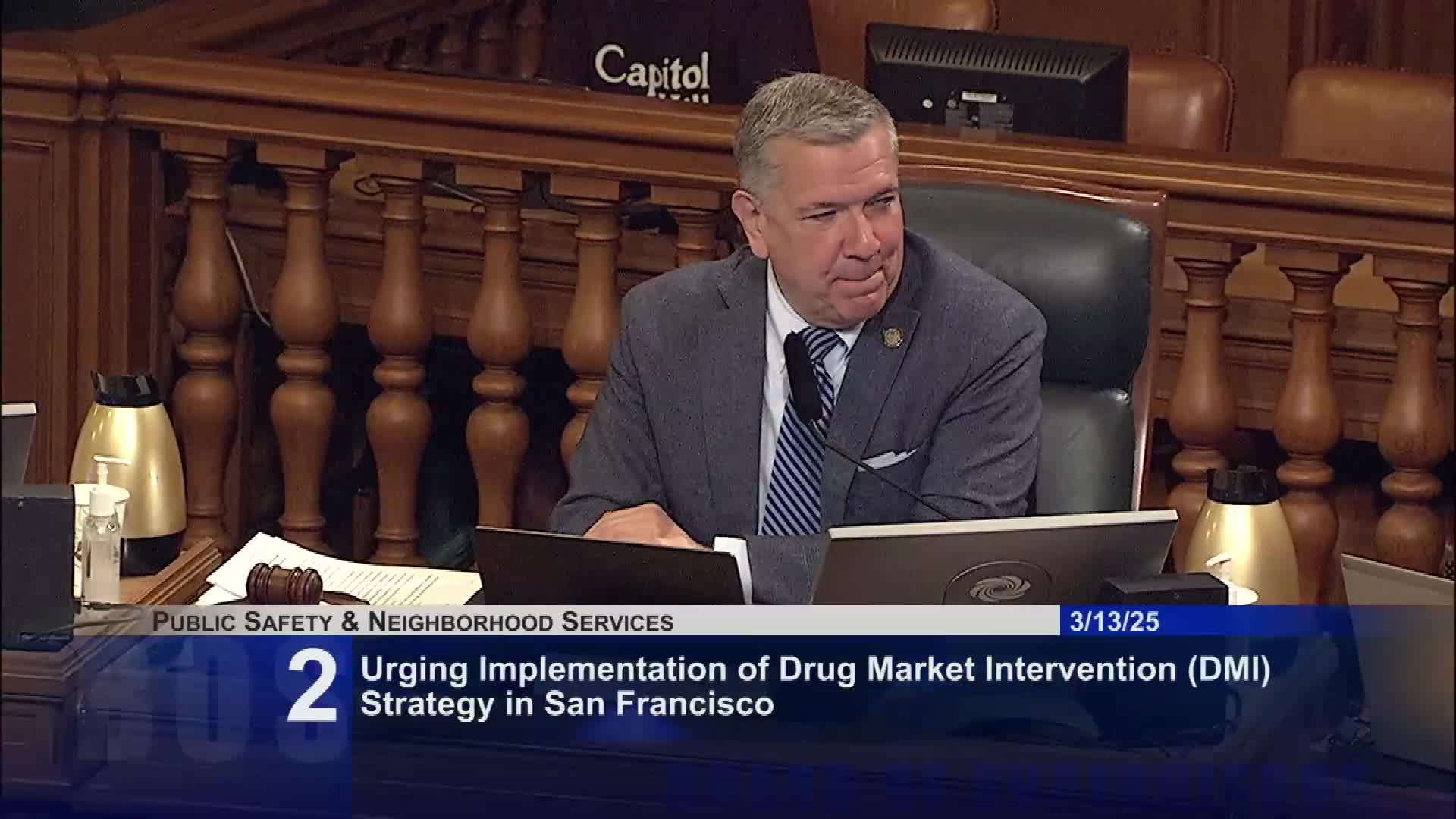
The Public Safety and Neighborhood Services Committee on March 13 held an extended hearing on the City’s policies and procedures for procuring, installing and maintaining public trash cans. The hearing featured presentations from San Francisco Public Works (DPW) and Recology Golden Gate, followed by two hours of questions from supervisors and about three dozen public comments from neighborhood leaders, volunteers and business owners. The committee continued the item to the call of the chair for further follow‑up and asked agencies for commitments on pilots, data and funding details.
DPW presentation
Ian Schneider, government affairs manager for San Francisco Public Works, summarized DPW’s responsibilities for city‑owned litter receptacles — procurement, placement, installation, removal, and internal policy. He said public receptacles are intended for loose debris from the public right‑of‑way (for example coffee cups, wrappers and similar items), not household or commercial waste.
Schneider said the department’s placement criteria prioritize transit shelters and high‑volume pedestrian corridors and that members of the public can request cans via 311. He said the city currently has about 800 sensors installed in city cans (sensors generate automatic 311 requests when tripped) and described a past pilot (2017 “Yes We Can” on Mission Street) that tested dense placement but did not show a long‑term litter reduction. He described two primary can styles currently in use (concrete/square and metal/round) and summarized a multi‑year replacement effort: DPW conducted a 2022 pilot of several off‑the‑shelf and custom can designs, selected a slim silhouette design for durability and maintainability, and is preparing an RFP with the Office of Contract Administration to fabricate the final design. Schneider told the committee there is an existing $15,000,000 balance in the refuse rate reserve account that could fund a one‑time replacement without using the general fund; the plan would replace cans roughly one‑for‑one over time.
Schneider also described DPW’s enforcement and education work (anti‑litter code enforcement, illegal dumping investigations, and coordination with Recology), weekly operations meetings with Recology to review hot spots, and plans to hire a trash‑can manager to improve data and mapping. He acknowledged that cans can be abused — vandalism, arson, illegal dumping — and that in some cases removal led to cleaner streets.
Recology presentation
Kevin Flanagan, general manager of Recology Golden Gate, described Recology’s public receptacle collection program: nearly 3,000 public receptacles are serviced citywide. He said all public receptacles receive at least one scheduled pass daily; 12 dedicated routes provide a second pass and respond to 311 sensor/overflow requests (two‑hour SLA for overflow, eight‑hour SLA for automated sensor alerts). A limited third pass is provided in high‑traffic areas (Flanagan cited Mission and Chinatown). Recology reported a year‑over‑year reduction in 311 overflow and sensor requests following recent service increases and said drivers use a connected worker app to receive and resolve requests.
Recology also described “CleanStreetCarts” (automatic‑locking carts) used in impacted corridors; Flanagan said the carts cost roughly double standard carts and should be targeted to high‑need areas rather than citywide deployment.
Public comment and themes
More than two dozen public commenters — neighborhood group leaders, cleanup volunteers, business owners and residents — told supervisors the city needs more trash cans in many neighborhoods (several speakers cited District 3, Russian Hill, North Beach, Chinatown and the Mission). Speakers emphasized street cleaning as a civic pride issue and urged more pilots, targeted solutions (cardboard collection in Chinatown, ash receptacles for cigarette butts near nightlife), better enforcement of commercial accounts that dump into residential bins, more robust sensor and QR reporting, and exploration of drone monitoring pilots. Several speakers urged stronger measurement of outcomes (audits of street cleanliness) rather than focusing only on inputs.
Key numeric and budget details discussed in the hearing
• DPW noted about 1,500 trash cans were removed over the last 15 years. • DPW said the city currently has sensors in roughly 800 city cans. • DPW said a $15,000,000 balance in the refuse rate reserve account could fund a one‑time trash‑can replacement and RFP/fabrication to roll out a new design; DPW described a plan to replace cans on a roughly one‑for‑one basis over time (target ~3,000 cans in the rollout) without increasing general‑fund expenditures. • Recology said the citywide public receptacle inventory is nearly 3,000 receptacles and explained its SLA (2 hours for overflow requests, 8 hours for automated sensor alerts) and that 12 dedicated routes provide daily secondary collection on public receptacles.
Committee direction and next steps
Supervisor Danny Sauter, who called the hearing, said he sought commitments for pilot projects, better reporting of outcomes and a district‑sensitive approach to deployments. After extended questioning and public comment, the committee voted 3‑0 to continue the hearing to the call of the chair to allow DPW and Recology to provide follow‑up on pilots, sensor rollout plans, RFP timing, use of the $15 million refuse rate reserve, enforcement strategies, and outcome metrics. The committee asked agencies to return with specific proposals and data to inform neighborhood‑level decisions and potential Board oversight.