Get Full Government Meeting Transcripts, Videos, & Alerts Forever!
Get email alerts on the Grid Hardware Policy topic
No spam. Unsubscribe anytime.
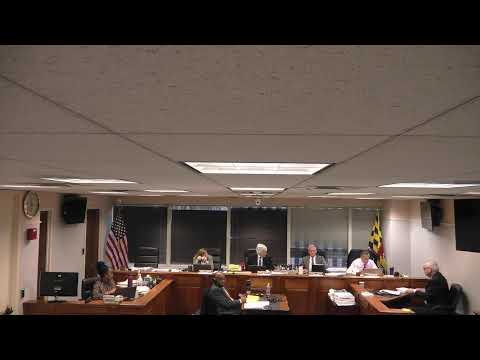
OPC and Pepco clash over when utilities should replace substation equipment — tests or age?
Summary
Panel witnesses for the Office of People's Counsel argued that many non‑investor utilities do not replace equipment that passes diagnostic testing, while Pepco and IEEE guidance say diagnostic results are one tool among several; commissioners pressed both sides for evidence.
A major technical dispute emerged at the Public Service Commission hearing over when electric utilities should replace substation components such as transformers and circuit breakers: should replacement be triggered by failed objective functional or diagnostic tests, or can age, condition and other non‑test factors justify proactive replacements?
Why it matters: The outcome matters for both reliability and customer cost. Replacing equipment early can reduce catastrophic outages but raises immediate rate base and capital charges; deferring replacement until tests indicate failure can lower near‑term rates but increase outage risk. Commissioners pressed witnesses on whether test results alone are definitive and asked for supporting data.
What OPC witnesses argued: The panel for the Office of People's Counsel (witnesses Paul J. Alvarez and Dennis Stephens) told the commission they consider “premature replacement” to be replacing equipment when functional and diagnostic tests indicate equipment is safe to return to service. The panel said utility practice among many cooperatives and municipal systems is to repair or replace only after failed objective tests, and OPC recommended regulatory language that would tie corrective‑maintenance definitions to “objective industry standard diagnostic or functional tests.” During cross‑examination the OPC witnesses acknowledged they could not point to a large catalog of investor‑owned utilities that follow the same exact practice and that some of the assertion rests on interviews and professional experience.
Pepco and standard bodies: Pepco and other witnesses drew the commission’s attention to IEEE guidance. The IEEE DGA (dissolved gas analysis) guidance explicitly warns that DGA results “can sometimes be indeterminate or misleading” and that “conclusions or actions should never be based exclusively on a single DGA result.” The IEEE guidance recommends that expert interpretation and unit‑specific conditions be part of evaluations — language OPC’s witnesses cited when discussing the role of tests.
Boardroom interplay and evidence gaps: On cross‑examination Pepco asked OPC for documentary evidence showing that investor‑owned utilities uniformly defer replacement until tests fail. OPC’s panel provided surveys of municipal/cooperative practices and named industry contacts but did not produce a broad published dataset of investor‑owned utilities that follow a strict “tests only” rule. Pepco also cited sworn testimony from an Excel company witness (Public Service Company of Colorado) showing that the company tracks age and condition and uses DGA as a diagnostic tool among other inputs to select units for replacement — testimony OPC’s panel did not dispute but said was consistent with risk‑informed judgement.
What commissioners asked for: Commissioners asked both sides to clarify the policy implications (cost versus reliability trade‑offs), to identify any published studies that compare predictive power of objective diagnostics versus age or condition factors, and to provide more empirical evidence when making broad claims about the practices of hundreds or thousands of utilities.
Next steps: The commission said it expects parties to provide clearer citations and documentary evidence if they intend to anchor rules or disallowances on a particular approach. OPC proposed regulatory changes to tie definitions to industry‑standard tests, while IEEE and Pepco emphasized test interpretation and expert judgment rather than a strict binary pass/fail rule.
Sources: Panel testimony of Paul J. Alvarez and Dennis Stevens (OPC), Pepco witness testimony and rebuttals, IEEE guidance cited in discovery and at the hearing.