Get Full Government Meeting Transcripts, Videos, & Alerts Forever!
Get email alerts on the Land Use Parking topic
No spam. Unsubscribe anytime.
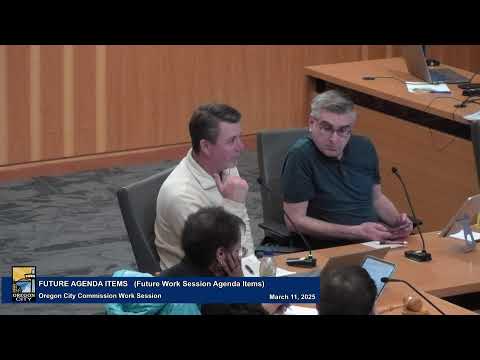
Oregon City debates state-mandated parking changes under Climate Friendly Equitable Communities rules
Summary
Oregon City staff and consultant Brian Davis presented a conceptual compliance approach Tuesday for the states Climate Friendly Equitable Communities rules, and commissioners debated how to tailor required parking changes to local topography and transit realities.
Oregon City staff and consultant Brian Davis presented a conceptual compliance approach Tuesday for the states Climate Friendly Equitable Communities (CFEC) rules, and commissioners debated how to tailor required changes to local topography and transit realities.
Under the state rules and the citys proposed Option 3, the city would eliminate off-street parking minimums within a transit buffer (Line 33 service area) and within a quarter-mile climate-friendly downtown area. The rules also require some maximum parking levels, bicycle and micromobility parking, and electrical "conduit" that allows up to 40% of residential parking spaces to accommodate Level 2 EV chargers.
Brian Davis, the city's consultant, cautioned that eliminating minimums "is not the same thing as saying no parking is going to be built." He said the state expects the market to provide needed parking in many cases, while the rules aim to free underused paved lots for other uses such as street seating or bike parking.
"By eliminating minimum require parking requirements . . . That is not the same thing as saying no parking is going to be built," Brian Davis said.
Key elements presented to the commission included: - Removing minimum parking requirements in the transit buffer and climate-friendly area and adopting parking maximums (multifamily maximums would need minor adjustment). - Requiring conduit so that at least 40% of residential parking spaces could support Level 2 (240V) charging; Davis said the requirement is to provide conduit for future chargers rather than to install chargers immediately. - New tree-canopy or solar requirements for new parking areas (the plan recommends prioritizing tree canopy to meet a 40% coverage target at maturity, with solar allowed where tree canopy is impractical). - Rules for allowing redevelopment of "underused" parking (suggested definition: lots below 50% capacity most of the time) to be converted to other uses.
The presentation and public outreach findings prompted robust comment from commissioners and the public. Commissioners repeatedly raised Oregon Citys topography and limited transit service as complicating factors: several said a transit-buffer radius of roughly a half-mile covers a large portion of the city, including many steep neighborhoods where car travel remains essential. Commissioner Mitchell and others said these geographic and transit limitations mean the city must adapt the state framework rather than adopt a one-size-fits-all approach.
Commissioner Marl voiced concerns that the rules could increase housing costs for some developers and complicate construction of affordable housing. Rocky (a resident in attendance) and other speakers urged tailoring the buffer and requirements to reflect local conditions.
Some practical code details were discussed: the citys draft language would require conduit sized for Level 2 EV chargers, set bicycle parking rules (some items could be handled during the citys Transportation System Plan update), and require tree-well sizing and species lists so trees reach the 40% canopy target at maturity without damaging pavement.
Commissioners also discussed enforcement and downstream effects: removing minimums could increase demand for on-street parking and create a need for additional public parking management and potential meters or permit systems downtown. Several commissioners asked staff to pursue grant opportunities to install demonstration EV chargers on city property.
After extended discussion, commissioners gave staff direction to continue with the planned schedule: a planning commission public hearing in mid-April and return to the commission for first and second readings in May, while several commissioners said they would continue pushing state contacts to clarify or tailor rules for Oregon City.
Why it matters: The state CFEC rules change local land-use requirements and will change how the city regulates parking for new development in transit-proximate areas. The rules affect future multiunit housing projects, commercial redevelopment, downtown circulation and parking management.
What happens next: Staff will proceed with the outreach and hearing schedule and prepare code amendments for the planning commission and subsequent council consideration; several commissioners will pursue further discussions with state staff to seek clarifications or flexibility for Oregon City.