Get Full Government Meeting Transcripts, Videos, & Alerts Forever!
Get email alerts on the Committee Roundup topic
No spam. Unsubscribe anytime.
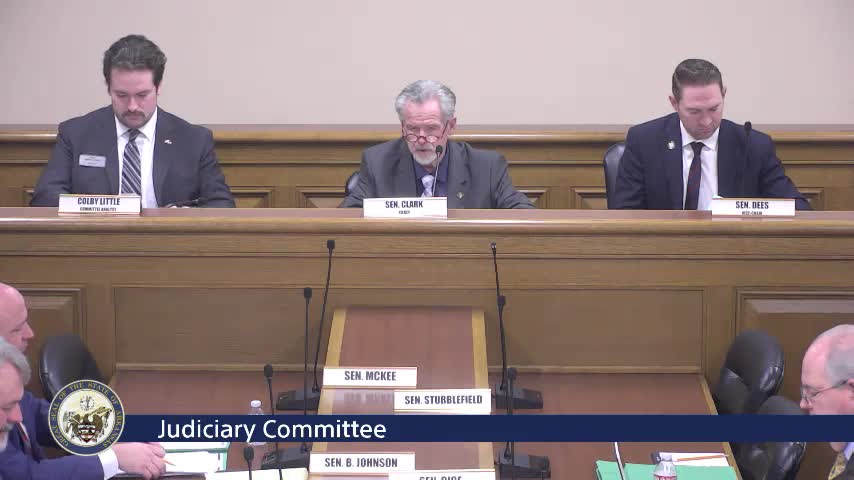
Judiciary Committee advances multiple bills on courts, juror pay, contractors and fentanyl measures
Summary
The Senate Judiciary Committee advanced a series of administrative, civil and criminal bills affecting courts, juror reimbursement, contractor remedies and fentanyl‑related offenses in a single session, carrying most measures on do‑pass motions.
The Senate Judiciary Committee, meeting as the session's agenda allowed, advanced a number of bills by voice vote. Members took up a mix of administrative, civil‑law and criminal‑law items; most measures carried with no recorded roll call in committee. Key actions and short descriptions follow.
Votes at a glance (committee actions and brief descriptions):
- House Bill 16‑44 (Representative Carol Dolby): Clarifies that retired judges may immediately be appointed as special judges in conflict cases upon leaving office; committee voted to pass. Sponsors said the change clarifies section 13 of Amendment 80 and shortens a previous one‑year requirement that retired judges sit out before serving as special judges.
- Senate Bill 321 (Joshua Bryant / Brenda DeShields and Circuit Clerks’ Association): Amends the prioritization of distributions from the Administration of Justice (AOJ) fund to make county juror reimbursement a priority payment; proponents said counties currently cover shortfalls and the bill would direct AOJ funds to reimburse juror pay first; committee passed the bill.
- Senate Bill 404 (Senator Justin Boyd / Department of Finance & Administration): Clarifies that a decedent’s personal representative must provide actual notice to the Department of Finance and Administration if a state tax lien (certificate of indebtedness) exists; sponsor said this clarifies existing expectations and supplies a mailing address; committee passed the bill.
- Senate Bill 364 (Senator Bart Hester): Modifies contractor licensing enforcement by allowing a contractor who would likely have obtained a license to recover contract payments under certain procedures, while retaining significant penalties for unlicensed work; committee passed the bill and sponsors said questions about equitable remedies will be addressed before floor debate.
- House Bill 15‑52 (Senator Ben Gilmore / Prosecuting Attorneys Association): Amends code offenses related to fentanyl; sponsor presented and committee passed the bill by voice vote.
- House Bill 16‑28 (Deputy Prosecuting Attorney Laurie Campuris / Prosecuting Attorneys Association): Adds second‑degree sexual assault to the list of crimes eligible for extended post‑conviction no‑contact orders; committee passed the bill.
- House Bill 16‑03 (Representative Gasaway / Senator Gilmore as sponsor): Clarifies payment priority to make restitution the first payment priority ahead of court costs; committee passed the bill.
- House Bill 15‑93 (Senator Flippo presenting, recertification for Amendment 33 reporting): Consolidates several Department of Corrections reports into a single report and reaffirms reporting structure; committee passed the bill.
- House Bill 15‑63 (Senator Gilmore presenting for House sponsor): Adds knowingly exposing another to fentanyl (first degree) to the list of restricted release felonies under the Protect Arkansas Act; committee passed the bill.
- House Bill 15‑79 (Senator Gilmore presenting for Senator Wallace): Limits reassessment requests for certain offender risk assessments to times near release, seeking to reduce backlog; committee passed the bill.
Procedure and next steps: Most bills were carried on committee do‑pass motions and advanced to the floor for additional consideration, with sponsors or committee counsel expected to address drafting questions raised in committee (for example, venue/jurisdiction language and equity remedies in contractor language). In several cases sponsors said stakeholders such as the Administrative Office of the Courts, Circuit Clerks’ Association, Department of Finance and Administration, and prosecuting attorneys had been consulted.
Why it matters: The package of measures touches administrative court operations (juror pay priority, notice to DFA), remedies and civil procedure (contractor recovery, treble damages for livestock), and criminal‑law updates (fentanyl‑related offenses and victim protections). Several measures alter funding priorities and civil recovery remedies that can affect counties, cities and individuals.
Committee attendance and workflow: The committee heard many bills in a single session and scheduled additional committee time for the following Wednesday for items needing witnesses; committee leadership indicated the next regular meeting was planned for 10 a.m. Wednesday (after session), with the possibility of an additional meeting if important bills arrive.