Get Full Government Meeting Transcripts, Videos, & Alerts Forever!
Get email alerts on the State Legislation topic
No spam. Unsubscribe anytime.
Rep. Vanessa Hartman briefs Oregon City commissioners on transportation, childcare and housing bills
Summary
Representative Vanessa Hartman (District 40) gave Oregon Citys commission a legislative update covering a proposed transportation package, childcare access and zoning changes, local water assistance and several housing bills; commissioners asked for clarifications on utility rate definitions and church-led housing proposals.
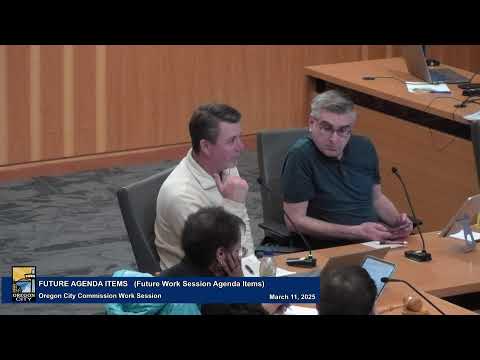
Representative Vanessa Hartman (District 40) updated the Oregon City Commission on state legislative activity on Tuesday, March 11, focusing on transportation funding, childcare access, housing measures and water-rate assistance.
Hartman told the commission that lawmakers have filed 2,551 bills this session and noted that 27 were authored by her. She said the transportation package under consideration is primarily intended to stabilize funding for maintenance, operations and safety and to prioritize unfinished projects promised under House Bill 2017. Hartman said declining gas-tax revenue and rising construction costs are driving the search for multiple funding options, and she reiterated her opposition to tolling and her offices push for a comprehensive audit of the Oregon Department of Transportation (ODOT).
"My office as usual is always going to be fighting against tolling and the implementation of tolling and calling for a comprehensive audit of ODOT," Hartman said.
Hartman said she and colleagues are advocating for the additional lane on I-205 to relieve the bottleneck at the Abernathy Bridge and said members of the Clackamas caucus — working with senators including Senator Meek — are coordinating on related bills.
Hartman also said she has been named chair of the House Early Childhood and Human Services Committee and is prioritizing employment-related daycare (ERDC) access. She said about 4,000 families have been approved for ERDC stipends but remain unable to connect with providers because of supply constraints. Hartman described work to identify zoning barriers and to develop a guidance packet for local governments to make siting childcare easier, with an eye toward future funding to help cities update zoning.
"We have about 4,000 families that have been approved for this employment related daycare stipend, and have not been able to be connected to a childcare provider," Hartman said.
On housing and development, Hartman identified several measures she and colleagues are tracking: a reinstated SDC (system development charge) deferral that would allow payment up to 180 days after certificate of occupancy; a bill to close a loophole affecting so-called squatter evictions; and measures to allow churches with sizable properties to undertake predevelopment work and potentially build housing on their land. She said some bills that had died in the prior long session have been reintroduced.
Hartman also summarized work on water and elder services: she described a state-level version of the federal Low Income Household Water Assistance Program (LIHWAP) (House Bill 3527 was referenced in her remarks) designed to replace an ended federal program, and she said House Bill 3497 would establish a task force to plan statewide for a growing elder population and related service capacity.
The legislator said she and others are tracking declines in VOCA (victims of crime) federal funding and are working to ensure local victim-services providers remain funded.
Commissioners questioned Hartman on several details. Commissioner Mitchell pressed for a precise definition of what constitutes a "major" utility rate increase under bills being discussed; Hartman said that definition is part of ongoing negotiations (year-over-year thresholds and multi-year caps were among possible approaches mentioned). Commissioners also raised concerns about allowing churches to build housing outside urban growth boundaries, noting potential service limitations and septic systems.
Hartman invited continued contact from the commission and said she would follow up on questions about the SDC-deferral bill and the churches billincluding whether proposed grant language had shifted to cover predevelopment costs.
Why it matters: The items Hartman outlined affect city projects and local services: transportation funding decisions influence completion timelines for local road and interchange projects; changes to SDC timing affect developers and local revenue timing; EI policies affecting childcare and housing development could alter the city's capacity to site childcare and housing; and state funding choices for low-income water assistance and victim services have direct impacts on Oregon City residents.
What happens next: Hartman indicated hearings and work sessions were planned for several of the measures described. She and commission members agreed to follow up offline on specific bill language and to share constituent feedback with bill sponsors.