Get Full Government Meeting Transcripts, Videos, & Alerts Forever!
Get email alerts on the Court Funding And Fees topic
No spam. Unsubscribe anytime.
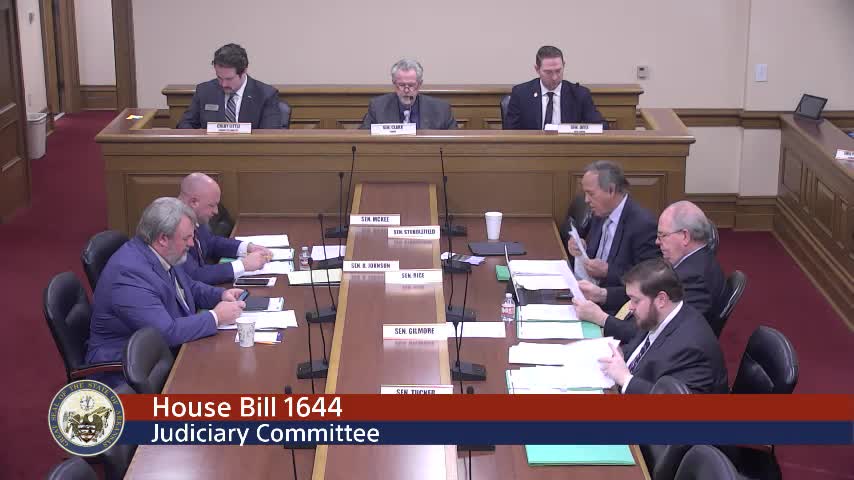
Senate Judiciary Committee advances district court funding, splits court fee revenue and trims installment fee
Summary
The Senate Judiciary Committee voted to pass House Bill 16‑61, a multi-part bill that moves district judge salaries onto state funding, adopts a 50/50 split of court costs between state and courts, and reduces a monthly installment fee for defendants from $10 to $7.50 with a maximum cap.
The Senate Judiciary Committee on [date not specified] voted to pass House Bill 16‑61, a package of statutory changes meant to reflect the full implementation of Amendment 80 and to revise how court fees and judge salaries are funded.
The bill, presented to the committee by Representative Carol Dolby (District 100, Texarkana) and accompanied by Kristen Clark of the Administrative Office of the Courts (AOC), makes three principal changes: (1) it directs that district court judges’ salaries be paid from the state constitutional officers fund rather than by counties and cities; (2) it requires district courts to remit 50% of court costs and fees to the state and retain 50% locally; and (3) it reduces the monthly installment fee assessed when a defendant pays fines in installments from $10 to $7.50, caps total installment fees at $90 per defendant, and attaches a sunset to the installment-fee provision as drafted.
Representative Dolby said the bill implements recommendations from a two‑year joint task force that convened stakeholders including the AOC, the Municipal League and county associations. “All those stakeholders came to the table and worked on this bill and everybody is in agreement,” she told the committee. Dolby said the shift in salary funding would take “the burden off of your counties and cities, which I think is really significant because they are state employees.”
On the revenue split, Dolby said the bill moves district courts to an equal retained-share model. “We are now saying all district courts will now send 50% of their court costs and fees to the state and retain 50%,” Dolores said, adding that some jurisdictions will be net winners and others net losers in the short term but that the sponsor expects balances to even out over time because localities will no longer pay judges’ salaries.
Members of the committee debated the installment fee at length. Dolby told the committee the fee reduction could not be made a full elimination without a $14 million offset. “Taking that $10 fee down to $7.50 and the most that any one defendant could be required to pay is $90,” she said, adding the committee included a sunset to study the change as courts move toward a Supreme Court case‑management system. She characterized the change as an attempt to reduce the burden on defendants who pay fines in installments while preserving revenue for courtroom automation and related uses funded from the AOC fund.
Questions from senators focused on the fiscal tradeoffs. Senator Tucker asked whether an appropriation would be preferable to reprioritizing existing fund distributions; Dolby and other supporters said the AOC fund already exists and the bill reprioritizes payments rather than creating an immediate appropriation. Committee members noted audit findings the task force reviewed showing substantial variation in prior retained shares and said the proposal reflects those audit recommendations.
Representative Dolby closed the presentation and asked the committee for a do‑pass recommendation; a motion to pass the bill carried on the committee voice vote. The bill sponsor told the committee most stakeholders supported the measure and that the provisions reflect multi‑year work to adapt state law to the effects of Amendment 80.
Why it matters: The bill shifts the recurring salary cost for district judges from counties and municipalities to the state, changes how fines and fees are distributed between state and local jurisdictions, and lowers the installment fee charged to people who cannot pay fines in lump sum. Those changes affect local budgets, court operations and low‑income defendants who use installment plans.
Outlook: The committee approved the bill and it now moves forward for floor consideration. The sponsor and supporters said they expect the revenue and workload impacts to be absorbed over a one‑to‑two year period as the new funding relationships settle.