Get Full Government Meeting Transcripts, Videos, & Alerts Forever!
Get email alerts on the Land Use Development topic
No spam. Unsubscribe anytime.
Supervisors continue appeal hearing for 3400 Cesar Chavez project after marathon public testimony
Summary
The Board of Supervisors continued on July 17 a marathon appeal hearing about the Planning Department's mitigated negative declaration for a proposed mixed-use project at 3400 Cesar Chavez Street in the Mission District after more than two hours of department presentations and public testimony from residents and community groups.
The San Francisco Board of Supervisors continued a prolonged public hearing on July 17 about the adequacy of a mitigated negative declaration for a proposed mixed-use project at 3400 Cesar Chavez Street, in the Mission District. The hearing, convened as an appeal of the Planning Department's environmental finding, drew hundreds of residents and more than two hours of board-level presentations, department briefings, and public testimony.
The project before the board: 7 Hills Properties proposed a mixed-use building that would place ground-floor retail (the sponsor described a single anchor retail space of roughly 12,000 square feet at times in the record) with residential units above. The sponsor's counsel described the scheme as roughly 60 residential units with a substantial fraction of two- and three-bedroom family units and said the developer voluntarily offered 15% of units as below-market-rate inclusionary housing, above the code baseline.
Why it matters: The appeal raises whether the Planning Department properly considered the project's potential to contribute to cumulative changes in land use and housing affordability in the Eastern Neighborhoods area plan. Appellants said the Department's document did not adequately analyze how new market-rate housing in the eastern Mission reduces the supply of sites available for deeply affordable housing, nor how that loss interacts with long-range rezoning work underway in the Eastern Neighborhoods program.
Arguments and evidence on the record - Appellant (Mission Anti-Displacement Coalition, represented by attorney Sue Hester): Argued the site had been coded as PDR in draft long-range maps, that the Planning Department's negative declaration did not incorporate the board's own prior direction (resolution 2660 Harrison) calling for cumulative analysis, and that the NEGDEC therefore failed to analyze the full environmental implications of new market-rate development on the neighborhood's ability to meet the city's housing goals. - Planning Department (Victoria Wise and project staff): Maintained that the project site was a retail use under the planning code rather than an industrial PDR use, that the NEGDEC analyzed project-specific and cumulative traffic, parking and collision data, and that the documents properly applied the criteria the Department developed after the Board's 2660 Harrison decision. Planning staff said socioeconomic concerns and citywide housing policy goals are being addressed in the separate Eastern Neighborhoods EIR and socioeconomic reports rather than in every individual project-level CEQA document. - Project sponsor (counsel Steve Vettel for 7 Hills Properties): Said the project provides a mix of housing (including 15% below-market units voluntarily), union construction jobs and community benefits; argued the appellant had not submitted substantial evidence showing a significant physical environmental impact and requested that the board deny the appeal.
Key issues raised at the hearing - PDR vs. retail classification: Planning staff and long-range planners explained the program-level Eastern Neighborhoods mapping had been developed from SIC-code-based initial maps and was later refined in site-level analysis; the department's project-level determination treated the prior retail occupant (Kelly Moore paint store) as retail rather than industrial PDR because it served the general public. Appellants countered that program-level documents nonetheless flag the location as PDR and that the department should have reconciled those different analyses. - Housing-element/cumulative analysis: Appellants cited a study and the board's earlier 2660 Harrison resolution to argue projects in the pipeline must be reviewed for cumulative impacts on the city's ability to meet affordable-housing goals. Planning staff replied that CEQA focuses on physical environmental impacts and that socioeconomic and policy-level tradeoffs are being handled through the Eastern Neighborhoods programmatic EIR and related socioeconomic impact reports. - Traffic and pedestrian safety: Planning staff reported that a project-specific transportation study found no substantial traffic or collision impacts and noted planned sidewalk widenings and bulb-outs at the intersection of Mission and Cesar Chavez to improve pedestrian safety. - Alternatives and feasibility: Appellants and community groups stated a community-led alternative (Bernal Heights Neighborhood Center and other non-profit proposals) had been discussed with the property owner and that the negative declaration should examine whether the site could be reserved or acquired for deeper affordability. The project sponsor responded that offers had been considered and declined by the property owner and that the sponsor had made concessions and community benefits in good faith.
Public testimony and community positions The hearing drew extensive public comment from dozens of neighborhood residents, nonprofit housing advocates and community organizations. Speakers for the appeal emphasized cumulative displacement, the neighborhood's need for family-sized permanently affordable rental housing, the scarcity of sites for deeply affordable units, and potential negative effects of formula retail on local merchants. Speakers in favor of the project noted the sponsor's outreach, job creation, the voluntary 15% inclusionary rate and the expectation that new residents would increase street activity and local business traffic.
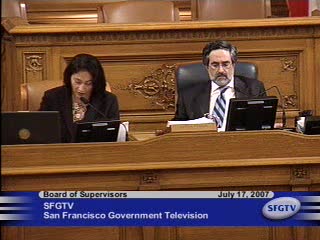
Board action: continuance After hours of testimony and cross-examination, Board President Aaron Peskin moved to continue the item for two weeks to allow additional review. The motion was seconded and the board agreed to a two-week continuance. The board asked for additional analysis and higher-level planning staff participation before reconvening.
Speakers and participants (on the record) Sue Hester (attorney for Mission Anti-Displacement Coalition and appellant); Victoria Wise (Planning Department staff); Steve Vettel (attorney for 7 Hills/real-party-in-interest); Matt Franklin (Mayor's Office of Housing); Ken Rich (Planning Department, long-range planning); Joseph Smook (Bernal Heights Neighborhood Center); and many community members from Mission-area nonprofits and neighborhood groups.
Authorities referenced in the hearing - Planning Department NEGDAC (final mitigated negative declaration for 3400 Cesar Chavez) and related Planning Commission resolution (referenced on the record); - Board of Supervisors Resolution 2660 Harrison (earlier board direction on Eastern Neighborhoods review).
Clarifying details extracted from the record - Sponsor's project description on the record: roughly 60 residential units with approximately 12,000 square feet of ground-floor retail (described by sponsor counsel as a Walgreens-style anchor) and a voluntary 15% inclusionary below-market offering. - Controller's transportation note: project-level traffic study concluded no substantial collision or intersection-level impacts; planning staff described proposed sidewalk widening and bulb-outs at Mission and Cesar Chavez as mitigation measures.
Proper names referenced 7 Hills Properties; Mission Anti-Displacement Coalition; Bernal Heights Neighborhood Center; Mission Economic Development Agency; Planning Department (City and County of San Francisco); Eastern Neighborhoods Draft EIR; Progress Foundation.
Community relevance Geographies: Mission District, Eastern Neighborhoods planning area. Impact groups: low- and very-low-income households, family-sized renters, small retail merchants, day laborers.
Meeting context Engagement level: very high (long hearing, large public turnout, heated community debate). Implementation risk: medium-high (project approvals could set planning precedents for Eastern Neighborhoods projects). History: The appeal frames earlier Board instructions on cumulative analysis (2660 Harrison) and overlays them with a currently active Eastern Neighborhoods program and draft EIR.
Searchable tags 3400 Cesar Chavez, Mission District, mitigated negative declaration, NEGDAC, Eastern Neighborhoods, affordable housing, PDR, Walgreens, community benefits
Provenance (transcript excerpts) - topicintro: {"block_id":"cch_intro_7051","evidence_excerpt":"This is a hearing on the adequacy, thoroughness, and completeness of the environmental document for 3400 Cesar Chavez Street.","reason_code":"topicintro"} - topfinish: {"block_id":"cch_continue_27876","evidence_excerpt":"There is a motion to continue this item for two weeks to allow additional review and higher level planning staff participation.","reason_code":"topicfinish"}