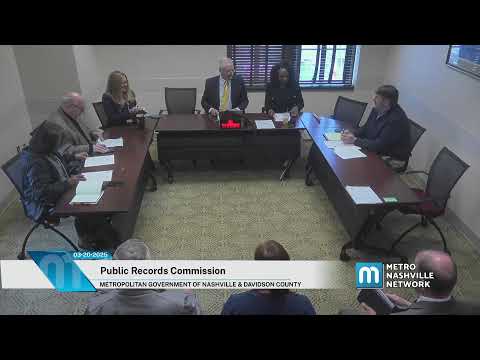
Public Records Commission approves tighter social-media and body-camera retention rules
Loading...
Summary
The Public Records Commission on an unanimous voice vote approved amendments to Metro’s general records schedule that shorten how long social-media content and related metadata are retained, clarify classification and retention of email and other correspondence, and adopt a detailed retention schedule for police body-worn and in-car camera footage.
The Public Records Commission on an unanimous voice vote approved amendments to Metro’s general records schedule that shorten how long social-media content and related metadata are retained, clarify classification and retention of email and other correspondence, and adopt a detailed retention schedule for police body-worn and in-car camera footage.
The changes were approved after presentations from Metro records staff and the police department describing the new categories and an automated retention process that will delete nonexempt material once the new schedules take effect.
Why it matters: The amendments affect public access to social-media comments and internal correspondence, the length of time police video evidence is available locally, and how long the district attorney’s office may retain copies of arrest-related footage. Metro officials said the changes will reduce storage needs while preserving evidence for litigation and prosecution where necessary.
Metro records staff told the commission that the general records schedule update will keep social-media posts for 30 days but will no longer retain commenters’ public exchanges and will reduce stored metadata for many platforms. The staff member said, “the Department of Law doesn't see a lot of value in keeping this kind of metadata for comments people make on social media. It's not government. It's not what the government's saying. It's just what random people in the public are saying.”
On correspondence, the records presenter said the amendments move email into the broader correspondence category and base retention on content rather than medium: policy, procedures or program-administration correspondence will be retained for two years; routine or repetitive correspondence that has no historic value will be disposed of promptly. The presenter summarized: “If it is, then you need to keep that for 2 years. But if it's routine and repetitive, then you don't need to keep it.”
The police presentation described a multi-tiered retention schedule for body-worn camera and in-car video. A police captain said officers tag video events and associate them with incident numbers; arrest-related footage is copied automatically to the district attorney’s (DA's) office within 24 hours. The captain described automated holds and manual holds for requests and litigation: “we have developed an automated process with our vendor, to satisfy the DA's office need to receive all arrest related video… that video is pushed over to the DA's office within 24 hours of the event being uploaded.”
Retention-period examples discussed at the meeting included 18 months for many categories such as investigative stops, routine citizen contacts, calls for service and traffic stops; a longer period for crash/property-loss footage (the captain said property-loss cases are set at three years and noted a practical retention of roughly three-and-a-half years in some categories). The presenter said the Metro schedule generally exceeds many other departments’ practices nationwide and reflected input from public-safety organizations including PERF, IACP and New Jersey Chiefs.
Metro Legal explained how litigation holds interact with the schedule. Cindy Gross of Metro Legal said the office issues litigation holds “routinely” and will keep records, including police video, beyond the standard retention period until appeal deadlines run or Metro Legal releases the hold: “we do it prior to litigation if we're aware of the potential for litigation or upon receipt of a lawsuit. And we don't close our case in our system or then notify the police department to release a hold until, like, the time of appeal would have run.”
Commissioners asked how the DA stores footage after Metro pushes copies; the police captain said Metro maintains its own cloud instance while the DA uses a separate instance and that each manages separate retention rules and storage costs. The captain identified Motorola/WatchGuard as the vendor providing the cloud “video-as-a-service.”
Commission discussion also covered program history (initial pilots in 2017–18 and a departmentwide rollout said by police to be fully functional in 2021), the system’s automated purging and logging capabilities, and internal processes to reclassify uploads that are initially marked “unknown.” The police team said they run monthly reports to match unknown uploads to incident data so items are not inadvertently lost.
Votes at a glance: The commission approved the minutes from the previous meeting by voice vote earlier in the session. Later, after discussion and questions, the commission voted to adopt the retention-schedule amendments and the records-retention plan for the body-worn camera program; the motion passed on a voice vote with no recorded opposition.
Next steps: Officials said the retention schedules will be implemented in the records management system and that Metro Legal and police staff have been coordinating to identify items currently under litigation holds before automated purging begins. The police captain said once schedules are set in the system the platform will process purges automatically and create logs of purged events.