Get Full Government Meeting Transcripts, Videos, & Alerts Forever!
Get email alerts on the County Budget Taxes topic
No spam. Unsubscribe anytime.
Allegany County commissioners direct staff to advertise 6¢ property-tax increase and 0.10 income-tax bump amid $5.7M state-driven shortfall
Summary
Facing roughly $5.7 million in state cuts, Allegany County commissioners agreed to direct staff to post a 6¢ property-tax increase and a 0.10-point rise in the local income tax to 3.13, while discussing deep staff and service reductions if the state gap persists.
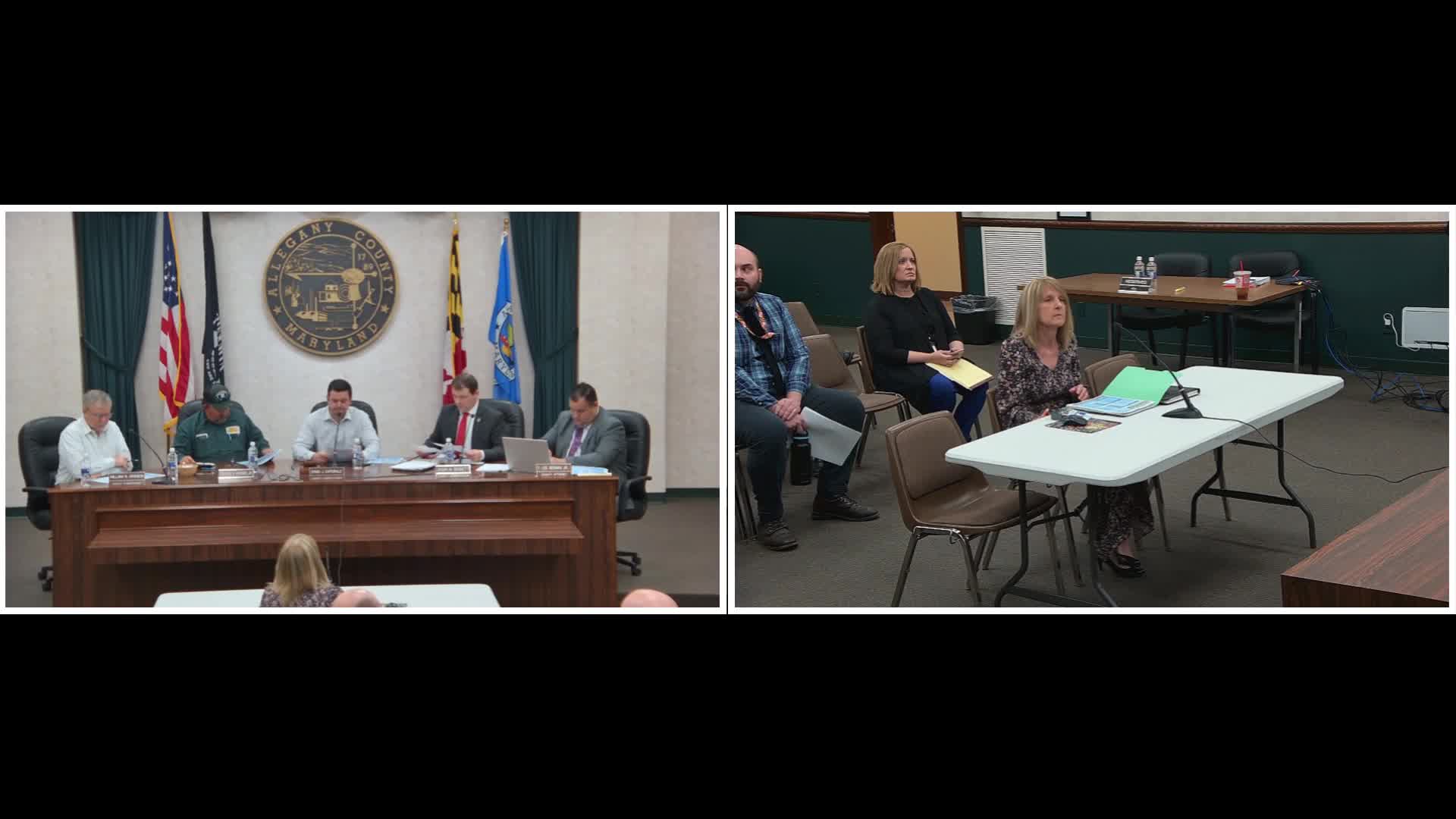
Allegany County commissioners on an internal work session directed staff to prepare notices for a 6-cent increase to the county property tax rate and a 0.10-point increase to the local income tax (from 3.03 to 3.13) as part of a hybrid strategy to plug an estimated $5.7 million shortfall stemming from state budget actions.
The action, taken after more than two hours of discussion, asks staff to advertise the property-tax change and to update revenue projections; commissioners said they will revisit the numbers after the state’s final actions are known. The board agreed to return with a formal adoption schedule and to consider backing off the increases if the state restores funds.
County staff framed the options as blunt choices between immediate revenue increases and deep cuts to services and staff. “Every penny generates basically $540,000 of revenue,” Adam Patterson, county staff, told commissioners when explaining how much additional revenue each penny of property tax would produce. He said a one-cent property-tax increase raises about $540,000 countywide and that a penny on a $100,000 home equals roughly $10 per year.
Commissioners and staff described three revenue levers and multiple expenditure scenarios. Key figures and constraints discussed: - Property tax: staff said each penny yields about $540,000; a 6¢ increase was identified as the preferred near-term figure to advertise. - Income tax: currently at 3.03 and capped by state law at 3.2; an increase to 3.13 (a 0.10 bump) was proposed to generate additional revenue. - State cuts and carryforward effects: staff said many reductions from the governor continue beyond one year, including a disparity grant cut that will worsen by roughly $800,000 next year; highway-user revenue reductions were also cited as a future risk.
On the expenditure side, staff presented worst-case scenarios that would require eliminating dozens of county positions — staff cited cuts in the range of roughly 60–80 employees if the county attempted to close the full gap through layoffs alone. Department-level examples discussed included halving some engineering staff (which county staff estimated would remove nearly $1 million in salary costs but slow internal project delivery), eliminating transit operations (estimated savings about $2 million), and closing emergency-response or 9-1-1 stations (an item that staff said could save about $1.44 million but would increase response times).
Commissioners repeatedly emphasized the risk to basic public services. “I can't see having people not be able to get an ambulance to them, or get this, the road cleared,” one commissioner said during debate on cuts to roads and emergency response. Members said they prefer a hybrid approach — some revenue increases coupled with targeted cuts — to avoid losing essential services.
Staff noted limited one-time options: the county's available fund balance is small after last year’s draw; a lottery fund balance of about $8 million was identified as a possible source for limited one-time relief but not a sustainable fix. Commissioners instructed staff to model a hybrid scenario that combines modest revenue increases (the 6¢/0.10 proposal) with additional expenditure reductions and to prepare the required tax-advertising materials.
Timing and next steps: staff said the county must advertise any proposed tax increase before the next full budget adoption and that state final budget actions could be known as soon as April 10, though uncertainty remains. Commissioners asked staff to prepare notices so the county could revert the advertised increases if the state restores funds.
Discussion points (selected): - Legal/timing constraints: staff reminded the board that property-tax advertising deadlines are fixed and that the county could not raise taxes after publishing the notice without designated procedures. - Employee and service impacts: staff and department heads described practical effects of deep staffing cuts (longer project timelines, contracted-out maintenance at higher cost, snow routes combined causing slower plow response, and potential ambulance/EMS delays). - Political and equity concerns: multiple commissioners expressed reluctance to raise taxes on struggling households but said the state-driven cuts have narrowed options.
Commissioners’ direction: by consensus, staff will: - Advertise a 6¢ property-tax increase and a 0.10-point income-tax increase to 3.13 and update revenue projections accordingly; - Continue work on targeted expenditure cuts and bring further recommendations to the next meeting; - Prepare materials for public outreach and hearings explaining the rationale should the board formally place increases on a future agenda.
The board scheduled follow-up work and expected to take formal action after the next round of state budget clarity and formal public notice requirements are met.
Notes: The meeting transcript shows the board discussed multiple alternative packages and emphasized that the state’s actions left the county few options. Commissioners and staff repeatedly framed the proposals as reluctant, difficult choices intended to preserve core services while avoiding the most severe layoffs and service losses.