Get Full Government Meeting Transcripts, Videos, & Alerts Forever!
Get email alerts on the Board Procedure Exparte topic
No spam. Unsubscribe anytime.
Legal counsel says Board must treat complaint hearings as quasi-judicial and avoid ex parte communications
Summary
At the meeting the Metropolitan Department of Law's counsel told the Board of Ethical Conduct that once a complaint is filed the board functions in a quasi-judicial capacity for that matter and must not engage in ex parte communications; board email communications are public record.
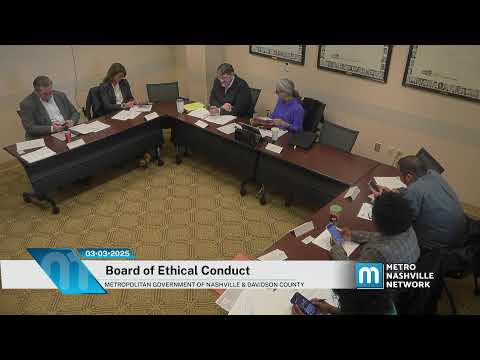
Members of the Board of Ethical Conduct reviewed the Metropolitan Department of Law's 2025 legal training manual and discussed ex parte communications and the board's role in complaint matters.
Legal counsel told the board the manual was written broadly for all boards and commissions but clarified that, "when there is a complaint, you are acting in a really quasi judicial capacity," and that the code "specifically says that once a complaint has been received and until a written decision has been issued by the board, no member of the board shall participate in any communication regarding the allegations or merits of the complaint outside of the board's public meetings or hearings." Counsel added that if a communication occurs it must be disclosed so that "every board member knows that another board member has been contacted."
Board members raised questions about email and the public records act; counsel advised that the substance of communications pertaining to board business is a public record even if sent from a personal email account. A board member advised members to avoid reading unsolicited emails about matters that later come before the board and to disclose any ex parte contact at the meeting when the matter is considered.
The board discussed the interplay between advisory duties and the board's case-specific responsibilities. Counsel said the board's final product on complaints is a recommendation to counsel, but that the process contemplates a quasi-judicial approach to ensure decisions are based on facts and testimony on the record.
No formal action was taken on the manual during this meeting; the item was placed on the agenda for discussion and clarification.