
Committee weighs enrollment fraud bill after colleges report rise in "ghost" students
Get AI-powered insights, summaries, and transcripts
Sign Up Free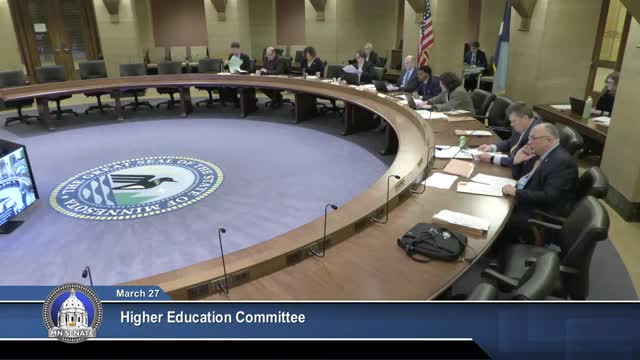
Summary
Senate File 2,703 would create an enrollment fraud working group to combat so-called ghost-student schemes that use bots or stolen identities to enroll at scale and capture federal aid.The committee heard testimony from Century College instructors, Minnesota State security staff and others about the scale, operational burden and detection limits.
Senate File 2,703, sponsored by Senator Gustafson, would create an enrollment fraud working group tasked with developing statewide strategies to detect and deter "ghost student" schemes that exploit financial aid systems.
Joe Haker, a history instructor at Century College, told the committee that in summer 2023 he observed roughly 15% of his students were duplicate or false enrollments and that one colleague found 30 of 60 students in an online course were ghosts. "Sometimes the fraud is blatant and obvious, but a lot of people who actually manage to get into our classes now have become more sophisticated," Haker said, describing the additional workload for faculty and the waste of seats meant for real students.
Jennifer Trinega, president of the InterFaculty Organization (the IFO, the union for Minnesota State faculty), backed a statewide response and warned that faculty and staff have been on the front line combating fraud but cannot address the problem alone. Craig Munson, chief information security officer for Minnesota State Colleges and Universities, said the system serves about 270,000 students and 14,000 faculty and staff and that attackers often target online application systems at scale to steal Pell Grants and other federal subsidies. He said fraudsters can attempt to enroll hundreds or thousands of fake students and increasingly use automated tools and AI to do so.
Munson and other witnesses described technical and equity trade-offs for identity-proofing. He and other Minnesota State representatives said common commercial identity-validation products perform poorly for younger students (under 25) and may create barriers for young or disadvantaged applicants, including PSEO students. Committee members asked about investigation and law-enforcement cooperation; Minnesota State staff said they receive threat intelligence from multi-state and federal bodies and will sometimes refer cases to the FBI, but that pursuing perpetrators can be costly compared with the amounts stolen.
Century College testified that it has assigned dedicated staff (Century reported roughly four full-time employees devoted to counter-fraud measures) and that the patchwork of campus responses leaves the system vulnerable. The bill would require that the working group include students, faculty and MAPE (staff) representation and produce a report with recommended statewide protections. The committee laid Senate File 2,703 over for further consideration.
Outlook: sponsors and system security staff said they will continue work on technical best practices, identity-proofing approaches that avoid creating new equity barriers and threat-intelligence sharing across institutions.