Get Full Government Meeting Transcripts, Videos, & Alerts Forever!
Get email alerts on the Natural Resources Research Institute Nrri topic
No spam. Unsubscribe anytime.
Senate committee hears funding proposals to help NRRI lead Minnesota—s push for green steel
Summary
Senator Mary Kiffmeyer Hochschild told the Senate Higher Education Committee she had two bills aimed at strengthening the Natural Resources Research Institute (NRRI) and the region—s iron and steel industry.
Senator Mary Kiffmeyer Hochschild told the Senate Higher Education Committee she had two bills aimed at strengthening the Natural Resources Research Institute(NRRI) and the region—s iron and steel industry.
"Today I have for you Senate File 2,734," Hochschild said, describing the measure as "a very simple bill" that would appropriate $9,000,000 in fiscal 2026 and another $9,000,000 in 2027 to help NRRI move toward green steel production. She also presented Senate File 2,881, which would change how income from permanent university fund lands (PUF) is distributed so NRRI could receive a 25% directed appropriation and allow the endowed mineral research accountto grow again.
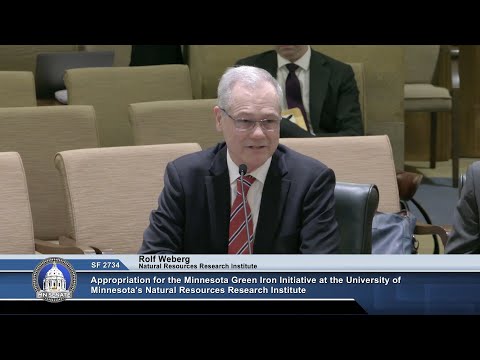
The measures are framed as investments to help Minnesota attract federal partnerships and to prepare supply-chain industries for low-carbon steel. "NRRI is exactly the kind of organization that is gonna help us meet those goals and take the industry to the next level," Sen. Hochschild said. Rolf Weber, executive director of the Natural Resources Research Institute at the University of Minnesota, told the committee NRRI has built partnerships with seven national laboratories and with local industry and that federal officials at the Department of Energy have flagged the region as important to a national industrial transition.
Weber and other witnesses described specific constraints at NRRIincluding aging facilities and the need to hire specialized staff. Weber said the institute is installing $3 million to $4 million pieces of equipment in a 1905-era building and needs funding for safety, code upgrades and to support staff who can engage on a national-lab scale. He said an NRRI-boosted green-steel ecosystem could help keep Minnesota firms competitive and draw federal investment. "We're asking for this infusion as a second investment since 1983 to take NRI to the next step," Weber said.
Weber also described technical reasons for the shift to "green iron" and "green steel": replacing carbon with hydrogen in ironmaking to avoid carbon dioxide emissions and to meet growing market expectations for life-cycle emissions reporting. He estimated one taconite planthas energy demands on the order of 500 megawatts, roughly the amount of electricity used by a large city.
Senators asked technical questions about energy sourcing and partnerships; Senator Otke observed that the electricity source is a central variable and referenced nuclear power as a separate policy discussion. Committee members did not vote on either bill; both Senate File 2,734 (appropriation) and Senate File 2,881 (PUF distribution change) were laid over by the committee for further consideration.
The proposals would not change existing federal or state environmental standards; testimony focused on research capacity, facilities upgrades and funding mechanisms.
Outlook: committee members expressed broad interest; staff and sponsors indicated further work with university and appropriations analysts would continue.