Get Full Government Meeting Transcripts, Videos, & Alerts Forever!
Get email alerts on the Childcare Policy Tax Credit topic
No spam. Unsubscribe anytime.
Senate committee hears broad three-part childcare tax credit package
Summary
Senate Bill 321 would create a refundable child tax credit, a workforce tax credit for childcare workers and an employer-dependent-care tax credit; proponents argued it addresses affordability and workforce shortages while opponents urged caution about tax-credit design and budget transparency.
HELENA, Mont.
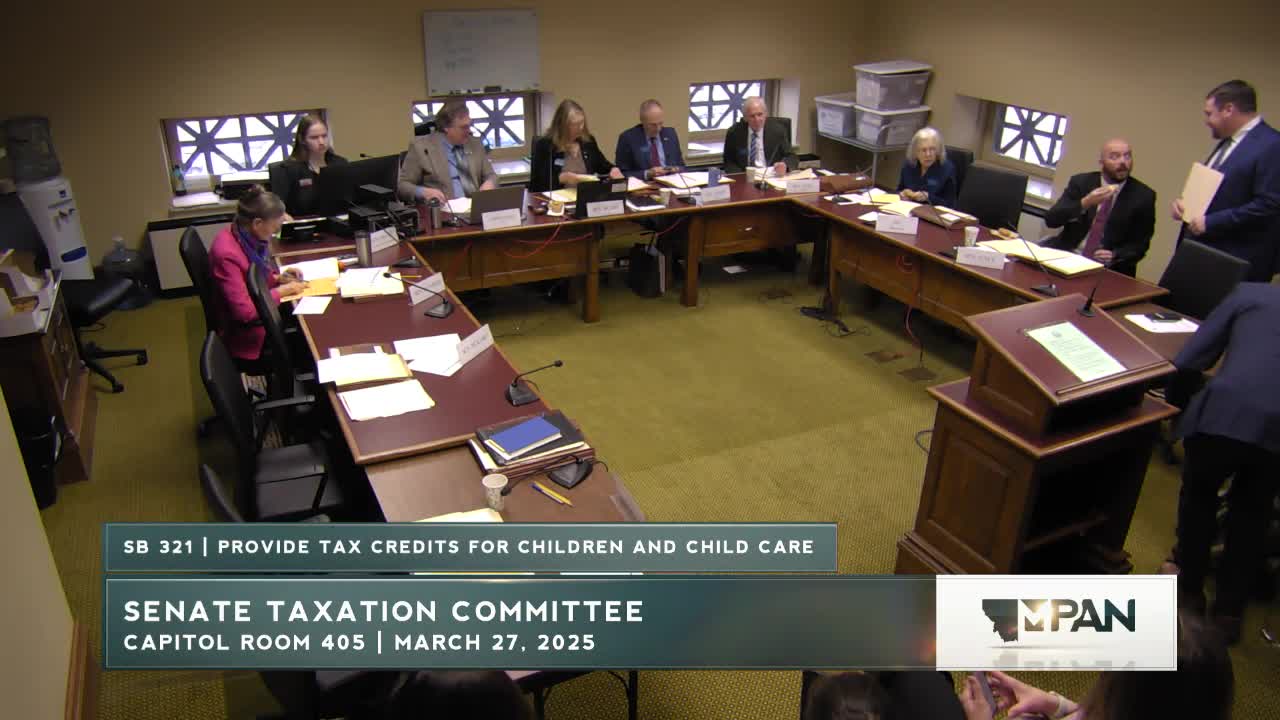
A bipartisan package of tax credits aimed at easing child care costs and stabilizing the state's childcare workforce drew wide support in the Senate Taxation Committee on March 27, with employers, early-childhood advocates, pediatricians and chambers of commerce urging passage. Opponents, including certified public accountants and taxpayer groups, urged the Legislature to consider direct grants and to weigh how restoring refundable credits fits in the state's larger tax-simplification work.
Senate Bill 321, sponsored in the hearing by Senator Josh Kasmier (Senate District 13), proposes three major elements: a refundable child tax credit to provide direct family support; a tax credit to raise compensation or otherwise support the childcare workforce; and an employer tax credit to encourage businesses to provide or subsidize child care for employees. Caitlin Jensen of 0 to 5 Montana described the package as "a three-pronged tax credit proposal with strong bipartisan support designed to address the critical barriers of childcare access, affordability, and family economic security." She summarized the child credit as $1,200 per qualifying child with a phase-out to avoid an abrupt cliff.
Proponents stressed the economic and workforce effects of limited child care. Sheridan Hoyer of the Montana Chamber of Commerce cited national estimates of employer losses due to child-care disruptions and urged that employer incentives are part of a public-private solution. Employer witnesses described direct experience: Dustin Bretz of Bretz RV and Marine described opening employer-run child care to recruit and retain employees in low-unemployment markets, noting the facility improved hiring and retention and that his company invested significant capital to provide slots for employees' children. Hallie Bretz, who attended the employer-run program as a child, testified as a witness in support and described educational advantages.
Health and child-development voices supported the investment. Dr. Lauren Wilson, representing the Montana chapter of the American Academy of Pediatrics, said early-childhood investments improve long-term health and social outcomes. Cindy Cisneros of the Committee for Economic Development provided national research showing childcare's economic effects; she said the Montana-specific finding was an approximate $397 million economic impact related to childcare activity.
Opponents urged caution about choosing tax credits over direct grants. John Iverson, for the Montana Society of CPAs, said his group is not opposed to aiding families or providers but warned that returning to a proliferation of income tax credits undermines the 2021 tax-simplification reforms and can circumvent explicit budgeting that direct appropriations require. Bob Story of the Montana Taxpayers Association recommended earlier statutory review cycles for large new credits.
Committee members questioned eligibility interactions between the proposed child tax credit and the state's Best Beginnings scholarship program, workforce targeting, and whether employer credits should be targeted by business size. Witnesses said scholarship and tax-credit programs could overlap depending on income eligibility, and proponents said employer credits are intentionally flexible to allow on-site care, cooperative employer arrangements, tuition subsidies or employee-dependent-care benefits.
No committee vote was recorded during the hearing. Sponsor Senator Kasmier closed by asking for support, saying the bill would invest in children, working families and employers; proponents and informational witnesses said the package is one available approach among several to improve childcare access and stabilize the workforce.