Lifetime Citizen Portal Access — AI Briefings, Alerts & Unlimited Follows
Senator urges ban on intoxicating delta‑9 hemp; proponents cite youth access, industry seeks carve‑outs
Loading...
Summary
A hearing on Senate Bill 375 drew supporters who said intoxicating hemp products are unregulated and attractive to children, while hemp processors and lab experts warned the bill's current wording could unintentionally eliminate lawful CBD and agribusiness activity and urged narrowly tailored amendments.
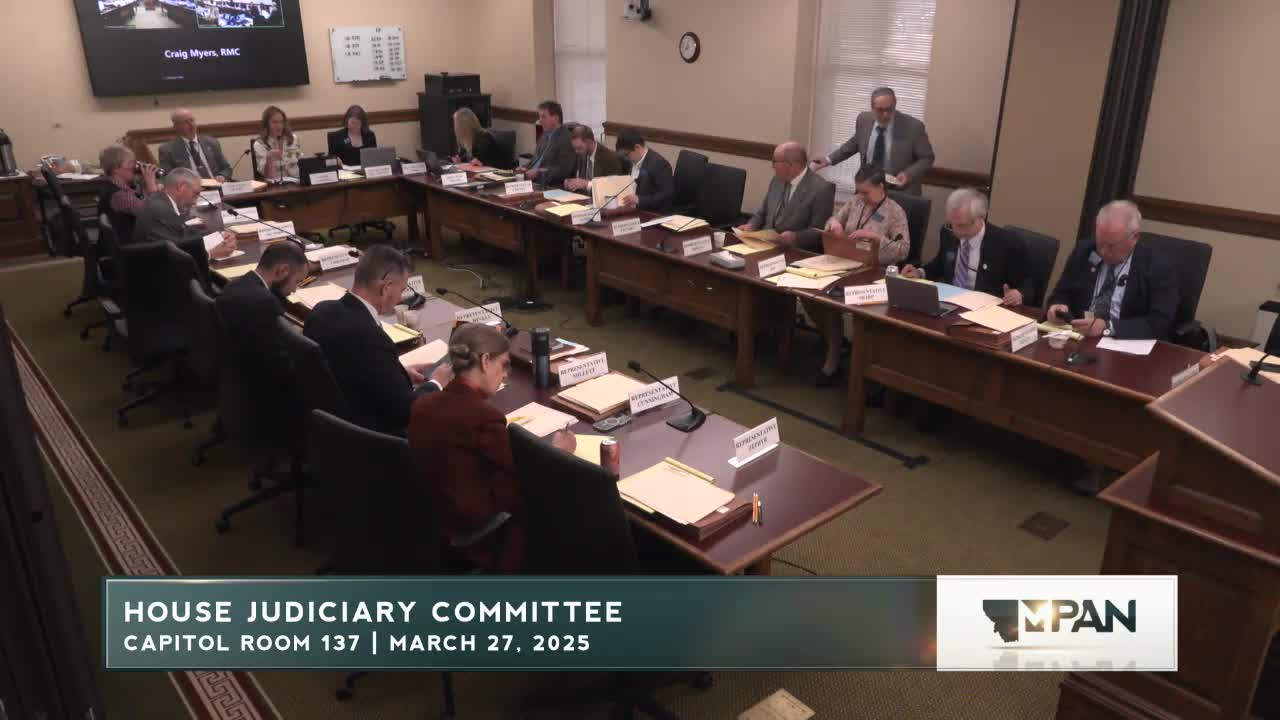
Senator Mark Noland introduced Senate Bill 375 to the House Judiciary Committee, asking lawmakers to ban retail sales of intoxicating hemp products that contain delta‑9 tetrahydrocannabinol (THC) in Montana.
The bill’s sponsor said federal hemp legalization created a loophole that allowed highly potent, hemp‑derived intoxicants to proliferate, often in candy‑like forms that can appeal to youth. "The intent of the bill I bring to you today . . . is to prohibit the sale of the intoxicating hemp products in the state of Montana," Senator Mark Noland said.
Supporters including Safe Montana, Youth Connections, Molson Coors Beverage Company and the Montana Cannabis Guild told the committee these products are unregulated, untaxed and readily available at convenience stores, vape shops and online. Coleen Smith, executive director of Youth Connections, said products are being marketed in ways that target children and there are no consistent age limits at retail. "Our kids are getting access to these intoxicating products," Smith said. Steve Zobowood, founder of Safe Montana, said the state should require all intoxicating THC to be sold through licensed dispensaries or pharmacies, and called the bill a "simple, clean" approach to remove these products from unregulated retail.
Opponents and industry witnesses said they support protecting youth but warned that the bill’s current text lacked clear carve‑outs and could ban ordinary hemp foods and ingredients. Pat Farrell, CEO of Big Sky Scientific, said the bill as drafted could eliminate lawful CBD products because no hemp product is completely free of trace THC. "There is no CBD product that contains 0 amount of THC. It does not exist," Farrell said, and urged language that limits the ban to finished consumer products rather than agribusiness inputs.
Catherine Rosendale, a laboratory director, told the committee Montana law and regulations already use per‑serving and per‑package thresholds (she and several witnesses cited the existing Department of Revenue guidance of 0.5 milligrams of delta‑9 THC per serving and 2 milligrams per package). Rosendale said testing can detect THC at parts‑per‑billion levels and that drafting limits by percent alone can produce unintended exclusions of legitimate non‑intoxicating products. "If we have a limit of no none, that does eliminate all CBD products from the market from Montana consumers," she said.
Kristen Barber, administrator of the Cannabis Control Division at the Department of Revenue, said her agency regulates marijuana but not intoxicating hemp and noted that House Bill 49, moving through the Legislature, addresses synthetic cannabinoids. She told the committee the proliferation of intoxicating hemp products poses risks to youth and public health and that banning sales until a regulatory framework is available could be a reasonable interim approach.
Committee members pressed witnesses on specific drafting problems: whether the bill would prohibit farmers from growing hemp, how post‑harvest biomass and wholesale ingredient sales would be affected, and how to reconcile the federal farm bill hemp definition (0.3% delta‑9 THC by dry weight) with the intent to ban intoxicating retail products. Industry witnesses said the primary concern is that the bill mixes agribusiness definitions with consumer product regulation and asked for clarifying amendments that would restrict the ban to retail consumer products and preserve legitimate hemp farming and processing.
The hearing closed with the sponsor indicating willingness to work with stakeholders on amendments to protect non‑intoxicating hemp businesses while restricting sale of intoxicating retail products.
Votes or final actions were not taken during the hearing; the bill moved forward for further work with stakeholders.