Get Full Government Meeting Transcripts, Videos, & Alerts Forever!
Get email alerts on the Tax Policy Business Equipment topic
No spam. Unsubscribe anytime.
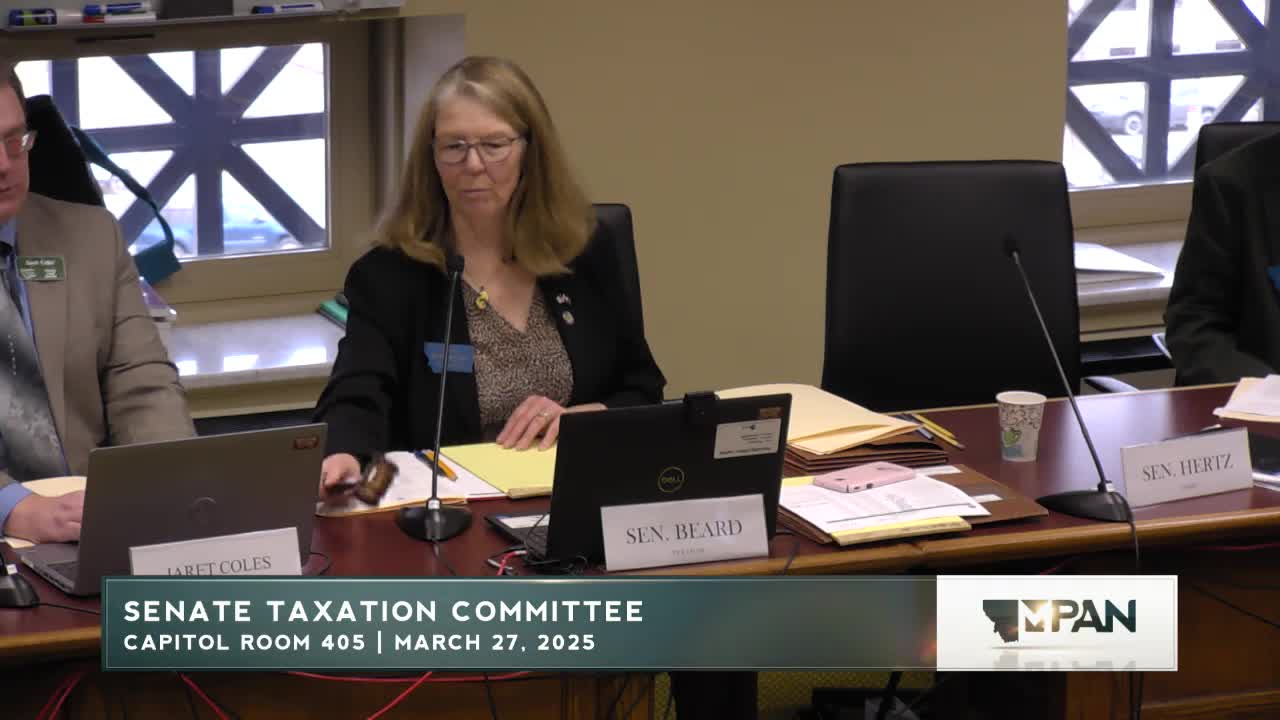
Senate panel hears push to raise business equipment tax exemption to $3 million
Summary
Supporters told the Senate Taxation Committee that raising Montana's business equipment tax exemption from $1 million to $3 million will ease burdens on small businesses and farms; opponents warned the change would shift costs to homeowners and school districts and increase general fund obligations.
HELENA, Mont.
Supporters of an increase in Montana's business equipment tax exemption urged the Senate Taxation Committee on March 27 to approve Senate Bill 322, saying the change would relieve small businesses, farms and other equipment-intensive operators from an onerous, hard-to-administer property tax. Opponents told the committee the proposal would shift tax burden to homeowners and school districts and increase reliance on the state general fund.
Proponents said rising equipment costs make the current $1 million exemption obsolete. "Increasing this from 1,000,000 to 3,000,000 will take another, I think it's about 300," said Bridal Beatty, director of the Montana Department of Revenue, adding the change would remove most small businesses and farms from the rolls and simplify reporting. John Semple of the Montana Grain Growers Association and other industry witnesses described modern farm machinery prices that can put a single combine at roughly $1 million and other implements in the hundreds of thousands of dollars.
Supporters included the Montana Department of Revenue, Montana Grain Growers Association, Montana Taxpayers Association, Montana Economic Developers Association, Montana Stockgrowers Association, Montana Chamber of Commerce, Montana Building Industry Association, Montana Coal Council, Montana Agricultural Business Association and Montana Mining Association. Witnesses told the committee the bill would likely spur investment and job growth by leaving more capital in the hands of employers. "The more money we can put in the employer's pocket, the more money they will invest in their equipment," Beatty said.
Opponents said the fiscal trade-offs are significant. Rose Bender of the Montana Budget & Policy Center traced decades of prior reductions to the business equipment tax and said the policy has already sharply reduced the number of businesses paying the tax. She told the committee the bill does not provide a direct reimbursement mechanism for school districts and would shift property tax burden to residential homeowners and other property classes. "School districts will adjust upward as a result, shifting property taxes to other classes," Bender said.
Dylan Cole and Bryce Kotz of the Department of Revenue answered committee questions about the fiscal note and implementation. Cole explained that the fiscal note projects a statewide drop in taxable value that translates to roughly a 0.35 percentage point change in taxable value on average and observed that the entitlement-share backfill to local governments would be a static dollar amount rather than a growing reimbursement. He said schools are handled differently under current law and that the guaranteed tax base (GTB) mechanism that subsidizes school mills is effectively at its practical limit in many places.
Committee members pressed witnesses on reporting requirements under a higher exemption threshold. Bryce Kotz said the Department of Revenue can discontinue reporting for taxpayers clearly under the threshold and will reestablish accounts if taxpayers later exceed it. Senator Josh Casimir, sponsor of SB 322, argued the change is a targeted way to help small businesses and farms and urged committee support.
The hearing included numerous local and statewide business organizations, county chambers of commerce and industry trade groups. No formal committee vote was recorded during the hearing.
Questions and public testimony highlighted the competing policy priorities: cutting costs for businesses that invest in expensive equipment versus protecting school funding and avoiding unintended tax shifts to homeowners. The committee will consider the bill and its fiscal implications in subsequent steps of the session.